The Fireproof Insulation Material Selection Framework
Master the fireproof insulation material selection framework. Compare mineral wool, cellular glass, and calcium silicate for code-compliant, fire-safe builds.

The 4-Step Fireproof Insulation Material Selection Framework
Selecting a fireproof insulation material requires balancing thermal resistance (R-value), structural load limitations, and strict fire code compliance. A material that performs exceptionally in an exterior cavity wall may fail catastrophically when applied to high-temperature HVAC ductwork or below-grade foundation perimeters. This framework guides architects, engineers, and contractors through the critical decision points required to specify the correct fire-resistant insulation for any building zone.
Phase 1: Code Compliance and Fire Rating Baselines
Before evaluating specific products, you must establish the baseline fire ratings required by your local jurisdiction and the building's occupancy type. The NFPA 220 Standard on Types of Building Construction dictates the fire-resistance ratings for structural elements, which directly influences the insulation required to protect those elements.
When reviewing product data sheets, distinguish between these two critical testing standards:
- ASTM E84 (Surface Burning Characteristics): Measures flame spread and smoke development. A Class A rating (Flame Spread Index 0-25, Smoke Developed Index 0-450) is the minimum requirement for most interior plenums and commercial cavities.
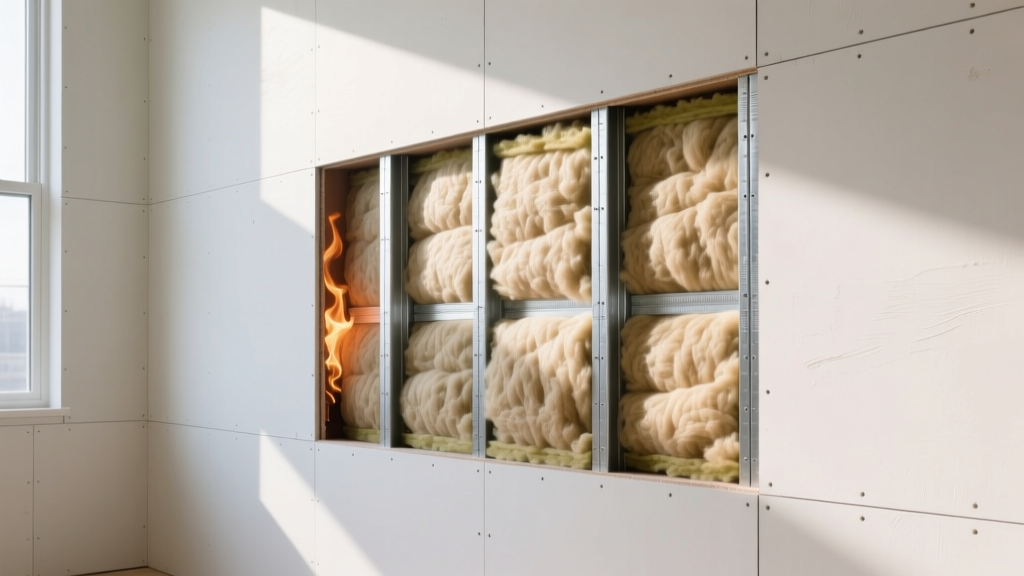
- ASTM E119 (Fire Tests of Building Construction and Materials): Evaluates the entire wall, floor, or roof assembly's ability to contain a fire and maintain structural integrity. According to ASTM E119 protocols, the insulation must not compromise the assembly's hourly rating (e.g., 1-hour, 2-hour, or 4-hour). Mineral wool, for instance, is frequently used in 2-hour and 4-hour rated shaft wall assemblies because it does not melt or lose its form at standard fire curve temperatures.
Phase 2: Material Matrix and Performance Data
The following matrix compares the primary non-combustible insulation categories available in the 2026 commercial market. Pricing reflects current wholesale averages for standard commercial thicknesses.
| Material Type | Max Temp Limit | R-Value / Inch | Avg Cost (per sq ft) | Compressive Strength |
|---|---|---|---|---|
| Stone Mineral Wool | 2,150°F (1,177°C) | R-4.0 to R-4.3 | $1.40 - $2.20 | Low (Flexible batt/board) |
| Cellular Glass | 900°F (482°C) | R-3.9 to R-4.1 | $4.50 - $7.00 | High (Up to 100 psi) |
| Calcium Silicate | 1,200°F (649°C) | R-3.5 to R-4.0 | $3.00 - $5.50 | Medium-High (Rigid pipe/board) |
| Ceramic Fiber Blanket | 2,300°F (1,260°C) | R-3.0 to R-3.5 | $2.50 - $4.00 | None (Flexible drape) |
Phase 3: Application-Specific Decision Tree
Use this diagnostic flow to narrow down the correct material class based on the physical environment and structural demands of the application zone.
- Scenario A: Exterior Cavity Walls and Shaft Enclosures
- Condition: Requires high fire endurance (2-hour+), acoustic dampening, and vapor permeability to allow the wall assembly to dry.
- Selection: Stone Mineral Wool Board. Its high melting point and hydrophobic properties prevent moisture trapping while maintaining the fire barrier.
- Scenario B: Below-Grade Foundation Perimeters and Plaza Decks
- Condition: Constant ground moisture exposure, high compressive loads from soil or vehicular traffic, strict requirement for non-combustibility.
- Selection: Cellular Glass. It is 100% closed-cell, completely impervious to water vapor, and will not wick moisture, unlike mineral wool which can lose R-value if submerged or constantly saturated.
- Scenario C: High-Temperature Process Piping and Industrial Ductwork
- Condition: Surface temperatures consistently exceed 400°F; requires rigid structural support and resistance to mechanical abuse.
- Selection: Calcium Silicate. Specifically formulated for high-heat industrial applications, it maintains dimensional stability and provides excellent compressive strength for metal jacketing.
- Scenario D: Complex Geometries, Kiln Linings, and Expansion Joints
- Condition: Extreme heat (above 1,500°F), irregular surfaces requiring drapability.
- Selection: Ceramic Fiber Blanket. Offers the highest temperature threshold but must be encapsulated to prevent airborne fiber release in occupied spaces.
Phase 4: 2026 Product Spotlights and Specification Nuances
When writing specifications, relying on generic material names can lead to substitution errors. Specify exact product lines that carry the necessary UL (Underwriters Laboratories) or ULC design listings.
ROCKWOOL SAFE'n'SOUND and ROCKWOOL Comfortboard
For interior partition walls requiring both fire and acoustic ratings, ROCKWOOL SAFE'n'SOUND remains the industry baseline. It is a 3-inch thick stone wool batt that delivers an STC (Sound Transmission Class) improvement of up to 8 dB while maintaining non-combustible status. For exterior continuous insulation (ci) applications, ROCKWOOL Comfortboard 80 or 110 (denoting density in kg/m³) provides the necessary rigidity to support cladding systems without compressing behind heavy masonry or metal panels. Expect to pay approximately $1.85 per square foot for Comfortboard 80 at 2-inch thickness.
FOAMGLAS T4+ Cellular Glass
Produced by Owens Corning, FOAMGLAS T4+ is the definitive choice for below-grade and inverted roof membrane assembly (IRMA) applications. Its compressive strength of 65 psi (450 kPa) allows it to support heavy plaza deck loads. A critical specification nuance: FOAMGLAS requires specialized bituminous or cold-applied cellular glass adhesives for seaming; standard construction adhesives will degrade the glass matrix. Budget approximately $5.50 per square foot for 2-inch T4+ boards, excluding the specialized mastic and joint sealants.
Johns Manville Micro-Lok HP Calcium Silicate
For industrial piping up to 1,200°F, JM Micro-Lok HP features a hydrophobic formulation that resists water absorption during outdoor storage and installation. It is pre-formed into half-rounds, eliminating the field-fabrication waste associated with cutting flat boards for pipe insulation. Specify this product with a factory-applied FSK (Foil-Scrim-Kraft) or ASJ (All Service Jacket) to serve as the primary vapor retarder.
Installation Variables and Hidden Costs
Contractor Alert: The material cost of fireproof insulation is often eclipsed by labor and accessory costs. Mineral wool requires heavy-duty PPE (respirators, heavy gloves) due to mechanical irritation from the fibers, slowing installation speeds by 15-20% compared to fiberglass. Cellular glass is brittle and requires specialized carbide-tipped saws for field cuts, generating significant silica dust that mandates strict OSHA respiratory compliance.
Furthermore, fireproof insulation is only as effective as the firestopping systems used at its penetrations. When routing electrical or plumbing through a mineral wool fire barrier, you must use intumescent firestop sealants or collars that expand when heated to seal the gap. Failing to detail these penetrations voids the assembly's ASTM E119 rating, regardless of the insulation's inherent fire resistance.
Frequently Asked Questions
Can I use spray foam insulation if I coat it with an intumescent paint?
No. While intumescent coatings can provide a thermal barrier that delays the ignition of spray polyurethane foam (SPF), SPF is fundamentally a combustible petrochemical product. In assemblies requiring strictly non-combustible insulation (such as Type I and Type II high-rise construction per NFPA 220), SPF is prohibited, even with coatings. You must use an inherently non-combustible material like mineral wool or cellular glass.
Does mineral wool require a vapor barrier?
Mineral wool is vapor-permeable. Whether you need a vapor retarder depends on your climate zone and the wall assembly's hygrothermal profile. In cold climates (Zones 5 and above), a Class I or II vapor retarder is typically required on the interior warm side to prevent condensation within the cavity. In mixed or hot-humid climates, the assembly is often designed to dry to the exterior, meaning no interior vapor barrier should be used, as it would trap moisture against the sheathing.
How does the fire rating of fiberglass compare to mineral wool?
Standard fiberglass batts melt at approximately 1,100°F, which is well below the temperatures generated in a standard structural fire (which can exceed 2,000°F within minutes). While fiberglass will not ignite, it loses its physical form and drops out of the cavity, exposing the structural studs to direct flame. Mineral wool maintains its structural integrity and insulating properties up to 2,150°F, making it the only viable choice for true fire-resistive cavity protection in rated assemblies.
Written by
Priya KapoorPriya Kapoor is a real estate market analyst and construction economics researcher with expertise in housing affordability, development feasibility, and infrastructure investment. She holds a Master of Regional Planning from Cornell University and previously worked as a senior analyst at CBRE's Investment Properties group, where she modeled returns for $4B in mixed-use development pipelines. Priya now runs an independent research practice advising developers, municipalities, and REITs on construction cost forecasting and market timing. She publishes the quarterly "BuildMat Market Pulse" report tracking material price indices across 12 commodity categories. Based in Austin, TX, Priya serves on the board of Habitat for Humanity Austin and is a marathon runner.
More from Priya Kapoor
View all
Construction Cost
Cost to Build a 1600 Sq Ft Home in 2026: Full Breakdown
Accurate 2026 cost to build a 1600 sq ft home—material, labor, and regional pricing breakdowns included. Plan your budget with real-time estimates.
Aug 11, 2026

Wood & Lumber
Name the Types of Wood for Pressure Treatment and Preservation
Learn how to name the types of wood best suited for pressure treatment. Compare species treatability, chemical retention levels, and 2026 preservation costs.
Aug 4, 2026

Stone & Masonry
Stone Veneer Suppliers Lindenhurst: 2026 Cost Analysis
Analyze 2026 stone veneer costs in Lindenhurst, NY. Compare local supplier pricing, delivery fees, and Suffolk County installation labor rates.
Aug 4, 2026