Heat Resistant Material for Fire Pit: 2026 Cost Breakdown
Analyze 2026 costs for heat resistant material for fire pit builds. Compare fire brick, castable refractory, and steel pricing, lifespan, and ROI.

The True Cost of Fire Pit Heat Resistance in 2026
Building a permanent outdoor fire feature requires navigating extreme thermal cycling. Standard building materials like ordinary concrete, red clay brick, and mild steel will rapidly degrade, crack, or warp when exposed to the 1,200°F to 1,800°F temperatures generated by wood-burning or gas fire pits. Selecting the right heat resistant material for fire pit construction is not just a matter of longevity; it is a critical safety requirement to prevent structural failure and flying shrapnel caused by exploding masonry.
This 2026 cost analysis breaks down the material expenses, installation variables, and lifecycle ROI for the top refractory and high-temperature alloys used in modern fire pit construction. Whether you are a masonry contractor pricing a luxury backyard build or a homeowner planning a DIY kit assembly, understanding these material costs will prevent expensive mid-project pivots.
2026 Quick Cost Snapshot
- Average DIY Refractory Liner Cost: $250 – $450 (materials only)
- Custom Castable Refractory Shell: $4.50 – $7.00 per cubic foot
- Premium Corten Steel Insert (1/4-inch): $350 – $600 depending on diameter
- Professional Masonry Installation Labor: $85 – $125 per hour (2026 regional average)
Material-by-Material Cost Breakdown
The core of any fire pit is the combustion chamber liner. The outer veneer (stone, stucco, or tile) is purely aesthetic and must be protected from direct thermal transfer. Here is how the primary heat resistant materials compare in the current market.
1. Dense Refractory Fire Bricks (The Gold Standard)
Refractory bricks are formulated with high alumina and silica content, designed to withstand temperatures up to 2,500°F without spalling. Unlike standard clay bricks, they have low thermal conductivity, meaning they keep the heat inside the pit rather than transferring it to the outer decorative shell.
- Material Cost (2026): $2.85 to $4.50 per standard 9x4.5x2.5 inch brick.
- Refractory Mortar Cost: $45 to $65 per 50-lb bucket (air-setting calcium aluminate mortar). Never use standard Type N or S masonry cement, which will turn to powder after three heating cycles.
- Coverage: A standard 36-inch diameter circular liner requires approximately 80 to 100 bricks.
- Total Liner Cost: $350 – $550.
2. Castable Refractory Cement (For Custom & Monolithic Shapes)
For modern, geometric fire pits or seamless curved bowls, castable refractory cement is poured into forms. It contains stainless steel needles or polypropylene fibers that melt during the first curing fire, creating micro-channels for steam escape to prevent explosive spalling.
- Material Cost: $55 to $85 per 55-lb bag (yields roughly 0.6 cubic feet).
- Formwork & Armature: Add $120 – $200 for high-temp stainless steel mesh and melamine formwork.
- Best Use Case: Architectural gas fire tables and modern minimalist concrete-look fire pits.
3. Ceramic Fiber Board & Blankets (The Insulation Layer)
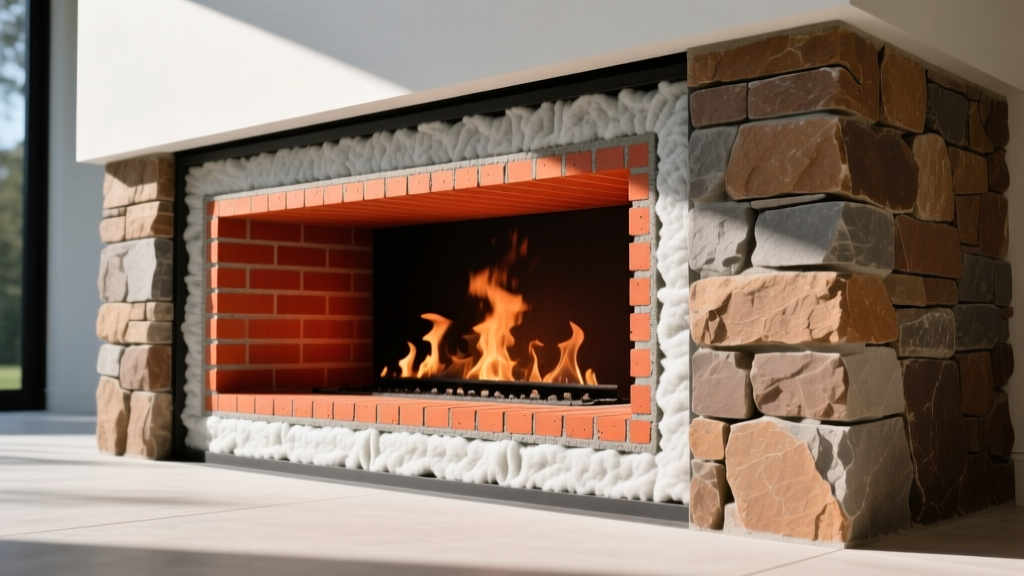
When building a fire pit with a combustible or heat-sensitive outer surround (like wood-adjacent decking or certain thin stone veneers), a ceramic fiber insulation layer is mandatory. Rated for 2,300°F, these boards reflect heat back into the combustion zone.
- Cost: $14.00 to $19.50 per square foot for 1-inch thick rigid board.
- Application: Placed directly behind the fire brick liner or wrapped around steel drop-in pans.
4. Steel Shells: Corten vs. 304 Stainless
Steel fire pit inserts are popular for their clean lines and rapid installation. However, the alloy choice dictates the lifespan and the price.
- A588 Corten (Weathering Steel): $3.50 to $5.50 per square foot (1/4-inch thickness). Corten forms a protective rust patina that halts further corrosion. It will last 15-20 years with heavy use.
- 304 Stainless Steel: $9.00 to $14.00 per square foot (1/4-inch thickness). Highly resistant to oxidation and warping. Essential for coastal environments where salt air accelerates Corten degradation.
- Mild Steel (Avoid): While cheap ($1.50/sq ft), 1/4-inch mild steel will rust through and warp in 2 to 3 seasons. The National Fire Protection Association (NFPA) warns against using degraded metal enclosures that can collapse and spill burning embers.
Comparative Cost & Performance Matrix
| Material | Max Temp Rating | 2026 Material Cost | Expected Lifespan | Installation Difficulty |
|---|---|---|---|---|
| Dense Fire Brick | 2,500°F | $2.85 - $4.50 / brick | 25+ Years | Moderate (Masonry skills required) |
| Castable Refractory | 2,400°F | $90 - $140 / cu. ft. | 15 - 20 Years | High (Requires formwork & curing) |
| Ceramic Fiber Board | 2,300°F | $14 - $19.50 / sq. ft. | Indefinite (if protected) | Low (Cut and place) |
| 1/4" Corten Steel | 1,500°F (Warping point) | $3.50 - $5.50 / sq. ft. | 15 - 20 Years | Low (Drop-in ready) |
| 1/4" 304 Stainless | 1,600°F (Warping point) | $9.00 - $14.00 / sq. ft. | 30+ Years | Low (Drop-in ready) |
Hidden Costs and Catastrophic Failure Modes
When budgeting for a fire pit, contractors and DIYers frequently overlook the sub-base and thermal expansion requirements. Failing to account for these hidden costs leads to catastrophic material failures.
⚠️ The Concrete Pad Explosion Hazard
Never pour a standard concrete slab directly beneath the combustion zone of a fire pit. Standard concrete contains trapped moisture. When subjected to intense, direct heat, this moisture turns to steam, expands, and causes the concrete to violently explode (spall), launching heavy, super-heated shrapnel.
The Fix: Budget $150 – $250 for a 4-inch base of compacted crushed limestone or decomposed granite, topped with a layer of paver base sand. Alternatively, use a specialized high-temp refractory concrete pad, though this triples the base material cost.
Thermal Expansion Gaps
Refractory bricks and steel inserts expand when heated. If a fire brick liner is mortared tightly to the outer stone veneer without an expansion joint, the expanding liner will push the outer wall outward, cracking the mortar joints of your expensive exterior stonework. You must budget for a 1/2-inch to 1-inch air gap filled with high-temperature ceramic fiber rope ($1.20 per linear foot) or loose vermiculite fill.
Labor and Installation Variables
The choice of heat resistant material heavily influences labor costs. According to current masonry trade data, specialized refractory work commands a premium over standard bricklaying.
- Fire Brick Lining: A skilled mason will charge $850 to $1,400 in labor to lay a 36-inch fire brick liner, primarily due to the meticulous cutting required for circular patterns and the specialized mixing of air-setting refractory mortar.
- Steel Drop-In Pans: If you opt for a pre-fabricated Corten or Stainless steel pan, labor drops significantly. A landscaping crew can install the gravel base, set the pan, and connect the gas line (if applicable) for $300 to $500 in labor.
- Gas Line Integration: For gas-fired pits, running a dedicated 3/4-inch black iron or CSST gas line and installing a high-capacity thermocouple safety valve adds $600 to $1,200 to the project, requiring a licensed plumber.
"When designing custom masonry fire features, the initial savings of omitting a refractory liner and using standard clay brick will always be eclipsed by the cost of rebuilding the structure after the first winter freeze-thaw cycle combined with thermal shock." — Refractory Engineering Best Practices Guide
Lifecycle Cost Analysis: ROI of Refractory Materials
While a standard steel ring from a hardware store costs $60, it will rust through and require replacement every 3 years. Over a 15-year period, you will spend $300 and endure the labor of constantly swapping out degraded metal, while dealing with rust stains on your patio pavers.
Conversely, investing $450 in a dense fire brick liner and refractory mortar yields a permanent, maintenance-free combustion chamber. The Environmental Protection Agency (EPA) also notes that properly insulated, high-temperature combustion chambers burn wood more efficiently, reducing particulate smoke emissions compared to shallow, uninsulated metal rings that fail to achieve secondary combustion temperatures.
Frequently Asked Questions (FAQ)
Can I use standard red clay bricks for the inside of my fire pit?
No. Standard clay bricks are fired at lower temperatures and contain microscopic air pockets and moisture. When exposed to the direct 1,500°F heat of a wood fire, they will rapidly spall, crack, and potentially explode due to thermal shock. Always use ASTM-rated dense refractory fire bricks for the inner liner.
Do I need a liner if my fire pit is made of natural stone?
Yes. Natural stones like granite, limestone, and river rock contain trapped moisture and natural fissures. Direct flame contact will cause them to fracture and pop. A fire brick or steel liner protects your expensive exterior stonework and acts as a structural safety barrier. Ensure you leave a 1-inch vermiculite-filled gap between the liner and the stone.
What is the most cost-effective heat resistant material for a DIY gas fire table?
For a gas fire table, a pre-fabricated 304 stainless steel drop-in pan paired with a 1-inch ceramic fiber board underlayment is the most cost-effective and durable route. It eliminates the need for complex masonry formwork, ensures proper gas burner clearances, and costs roughly $250 to $400 in total materials, saving thousands in professional masonry labor.
How do local fire codes affect my material choices?
Many municipalities enforce strict clearances for permanent fire features. The NFPA 1: Fire Code provides baseline guidelines, but local amendments often dictate that permanent wood-burning pits must have non-combustible, spark-arresting enclosures and specific setbacks from property lines. Using certified refractory materials and steel mesh spark screens ensures you pass local fire marshal inspections without costly retrofits.
Written by
James ThorntonJames Thornton is a construction industry veteran with 25 years of hands-on experience in wood framing, lumber grading, and residential building codes. He started as a framing carpenter in rural Oregon, earned his ICC Residential Building Inspector certification, and eventually became a senior plan reviewer for the City of Portland Bureau of Development Services. James holds a B.S. in Wood Science & Technology from Oregon State University and is a certified lumber grader through the West Coast Lumber Inspection Bureau (WCLIB). He has inspected over 3,000 residential construction sites and authored the city's internal guide on advanced framing techniques (2x6 at 24" O.C.). James lives in Bend, OR, where he builds custom timber-frame cabins and competes in lumberjack sports.
More from James Thornton
View all
Insulation
Best Home Insulation Materials: Complete 2026 Guide
Compare top home insulation materials for 2026. Find R-values, installed costs per square foot, and best uses for fiberglass, spray foam, and mineral wool.
Aug 4, 2026

Sustainable Building
Certify Your Green Building Material for LEED and WELL
Step-by-step guide to certifying a green building material for LEED v5 and WELL v2. Master EPDs, HPDs, and VOC limits for 2026 project specifications.
Aug 4, 2026

Stone & Masonry
Veneer Stacked Stone Panels: Interior Design & Style Showcase
Discover how veneer stacked stone panels transform interiors. Explore modern design profiles, material pairings, and technical installation specs.
Aug 4, 2026