Best Outdoor Waterproof Material for Cushions: 2026 Fabric Guide
Compare the best outdoor waterproof material for cushions in 2026. We analyze solution-dyed acrylic, PVC, and olefin fabrics, plus hidden liner tech.

The 'Waterproof' vs. 'Water-Resistant' Cushion Myth
When sourcing the ideal outdoor waterproof material for cushions, buyers frequently encounter a critical terminology trap. In the textile industry, standard woven outdoor fabrics are water-resistant, not waterproof. They rely on a Durable Water Repellent (DWR) surface finish that causes water to bead and roll off. However, under sustained hydrostatic pressure (like someone sitting on a wet cushion), water will eventually penetrate the weave.
True waterproof materials feature a continuous polyurethane (PU) or polyvinyl chloride (PVC) membrane on the underside, boasting a hydrostatic head rating of 1,000mm or higher. But introducing a 100% waterproof outer shell creates a secondary failure mode: trapped condensation. If humidity enters through a zipper or seam needle-hole and cannot escape, the cushion interior becomes an incubator for black mold. Therefore, selecting the right material requires balancing hydrostatic resistance with breathability, seam-sealing capabilities, and interior foam compatibility.
Head-to-Head Outdoor Cushion Material Matrix
| Material Type | Brand Examples | Water Resistance | Breathability | Avg 2026 Cost/Yard |
|---|---|---|---|---|
| Solution-Dyed Acrylic (Marine) | Sunbrella Marine, Outdura Marine | High (PU Backed) | Low-Medium | $42 - $58 |
| PVC-Coated Polyester | Stamoid, Herculite | Absolute (Membrane) | Zero | $24 - $35 |
| Olefin (Polypropylene) | Revolution Outdura, Phifer | Medium (DWR Only) | High | $18 - $26 |
| Texteline (PVC Mesh) | Phifertex, Twitchell | None (Permeable) | Maximum | $15 - $22 |
Deep Dive: Top Fabric Technologies Analyzed
1. Solution-Dyed Acrylic (Marine Grade)
Standard solution-dyed acrylics (like basic patio umbrella fabrics) are highly UV-resistant but lack waterproof backing. For cushions, you must specify Marine Grade acrylic. According to Sunbrella's official outdoor performance data, marine-grade variants feature a highly water-resistant polyurethane undercoating that pushes the hydrostatic head rating to approximately 400mm. This is sufficient to repel heavy rain and pooling water from sitting, while still allowing microscopic water vapor to escape, preventing the 'greenhouse effect' inside the cushion.
- Failure Mode: Needle holes from sewing compromise the PU backing. Seams must be taped with heat-activated PU seam tape or sealed with a silicone-based seam sealer.
- UV Lifespan: 1,500+ hours of direct sunlight before 50% tensile strength loss.
2. PVC-Coated Polyester (Marine Vinyl/Canvas)
Materials like Stamoid are engineered for total liquid impermeability. The polyester scrim is encapsulated in PVC, yielding a hydrostatic head rating well over 2,000mm. This is the mandatory choice for boat cockpit seating or tropical environments with horizontal, wind-driven rain. Because it possesses zero breathability, cushion designers must integrate 1/2-inch brass venting grommets on the underside panels to allow barometric pressure equalization and moisture escape.
- Failure Mode: Plasticizer migration. Over 3 to 5 years, UV exposure causes the PVC to lose plasticizers, resulting in micro-cracking at the fold lines and eventual delamination.
- Best Practice: Never use PVC-coated fabrics on the top seating deck where direct, prolonged human skin contact and friction occur; reserve it for side panels and bottom skirts.
3. Olefin (Polypropylene)
Olefin is a budget-friendly, inherently stain-resistant fiber that is dyed before extrusion. As noted in Phifer's engineered outdoor fabric specifications, olefin's moisture regain is near zero (less than 0.1%), meaning the fiber itself will not absorb water. However, the weave will allow water through unless treated with a heavy aftermarket DWR spray. It is best suited for covered lanais or porch swings where direct rainfall is mitigated by a roofline.
- Failure Mode: Low melting point. Olefin will melt and fuse if exposed to the radiant heat of a nearby fire pit or hot charcoal ember, unlike acrylic which will merely scorch.
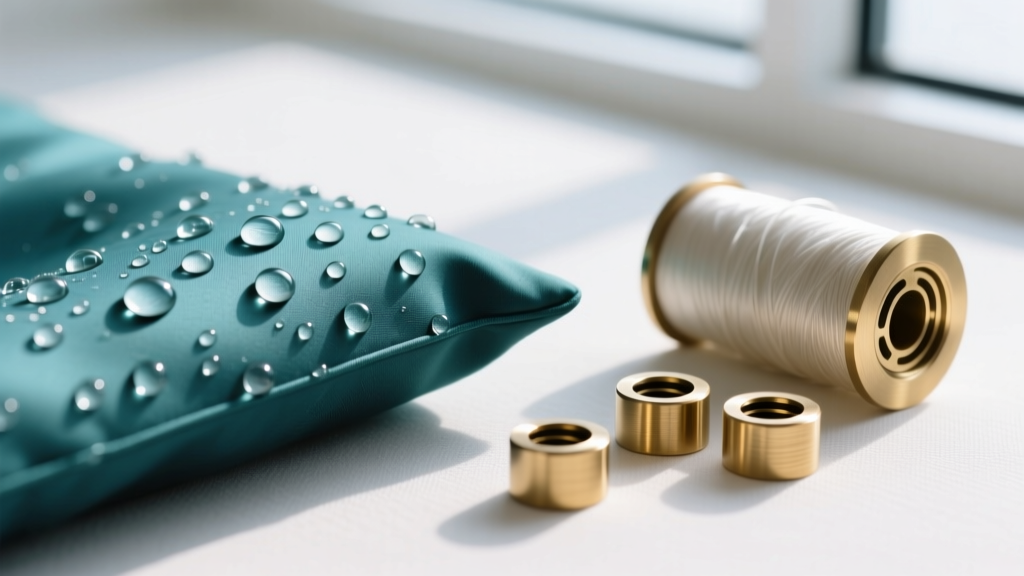
The Hidden Layer: Thread, Liners, and Foam
Selecting the correct outdoor waterproof material for cushions is only 50% of the battle. The internal architecture dictates the actual lifespan of the product.
"A $50-per-yard marine acrylic cover will fail in 14 months if sewn with standard cotton-wrapped polyester thread. The thread acts as a capillary wick, drawing rainwater directly through the needle perforations into the foam core."
PTFE Thread is Non-Negotiable
For any waterproof or highly water-resistant cushion, you must use 100% PTFE (Polytetrafluoroethylene) thread, such as Gore Tenara or Profilen. PTFE is completely impervious to UV radiation, acid rain, and salt spray. While it costs roughly $45 per 5,000-yard spool compared to $8 for standard polyester, it ensures the seams will outlast the fabric itself.
TPU Liners and Closed-Cell Foam
If your design requires 100% waterproof integrity (e.g., marine seating or commercial hospitality), you must encase the foam in a TPU (Thermoplastic Polyurethane) inner liner. TPU is a micro-porous membrane that blocks liquid water but allows air transmission. Pair this with closed-cell polyethylene foam (like Minicel or Volara). Unlike open-cell polyurethane (which acts like a sponge), closed-cell foam has a non-interconnected cellular structure, making it physically impossible for water to penetrate the core, even if the outer fabric and liner are breached.
Decision Framework: Match Material to Microclimate
Use this matrix to specify the exact material stack for your project based on environmental stressors:
- Coastal / Salt-Spray Environments: Marine-grade solution-dyed acrylic outer shell + PTFE thread + open-cell reticulated foam (EZ-Dri). The reticulated foam allows salt water to flush completely through and drain rapidly without trapping brine.
- High-Humidity / Tropical Rainforest: PVC-coated polyester top and sides + TPU inner liner + closed-cell foam. Incorporate brass underside vents to manage barometric condensation.
- High-UV / Arid Desert: Standard solution-dyed acrylic (no PU backing needed) + standard polyester thread. Focus entirely on UV degradation resistance rather than hydrostatic pressure. Avoid PVC entirely, as extreme heat accelerates plasticizer migration.
- Covered Patio / Budget-Conscious: Olefin fabric + DWR aftermarket treatment + standard polyurethane foam wrapped in a Dacron batting to prevent friction wear from the inside.
Maintenance and DWR Reapplication Realities
Factory-applied DWR finishes on water-resistant fabrics degrade due to UV exposure, physical abrasion, and alkaline cleaning agents. To maintain the hydrophobic properties of acrylic or olefin cushion covers, the DWR must be replenished every 12 to 18 months. After a thorough cleaning with a mild, non-detergent soap (never use heavy degreasers or bleach unless specifically treating mildew on acrylic), apply a fluorocarbon-free water repellent like 303 Fabric Guard. Apply two light coats while the fabric is still slightly damp to ensure deep fiber penetration, allowing 24 hours of curing time before exposing the cushions to moisture.
Written by
Sarah WhitfieldSarah Whitfield is a chartered quantity surveyor (MRICS) and construction cost analyst with 15 years of experience in material pricing, procurement strategy, and project budgeting. She earned her degree in Construction Management from the University of Reading (UK) and has worked on projects ranging from $2M custom homes to $180M mixed-use developments across North America and Europe. Sarah currently leads cost estimating for BuildMat Insight, maintaining a proprietary database of 4,000+ material price points updated quarterly. She is a frequent contributor to RSMeans cost data panels and has presented at the International Cost Engineering Council (ICEC) congress. Based in Denver, CO, Sarah is an avid trail runner and volunteer mentor for Women in Construction.
More from Sarah Whitfield
View all
Wood & Lumber
What Are the Different Types of Wood? A Builder's Guide
Compare structural softwoods, finish hardwoods, and engineered lumber. Analyze Janka ratings, MOE values, and 2026 pricing for construction.
Aug 4, 2026

Walls & Panels
Steel Framing vs Wood Framing: Corrosion and Moisture Defense
Compare steel framing vs wood framing for moisture resistance. Learn about galvanized coatings, condensation risks, and corrosion protection strategies.
Jul 21, 2026

Stone & Masonry
How to Cut Stone Veneer: Wet Saw vs Grinder Comparison
Compare the best tools for cutting stone veneer. We review wet saws, angle grinders, and chop saws to help you achieve clean, chip-free cuts.
Jul 21, 2026