Building Code Requirements for Waterproof Casting Material
Navigate IBC and ASTM code requirements for waterproof casting material. Learn hydrostatic mandates, perm ratings, and compliance specs for below-grade builds.
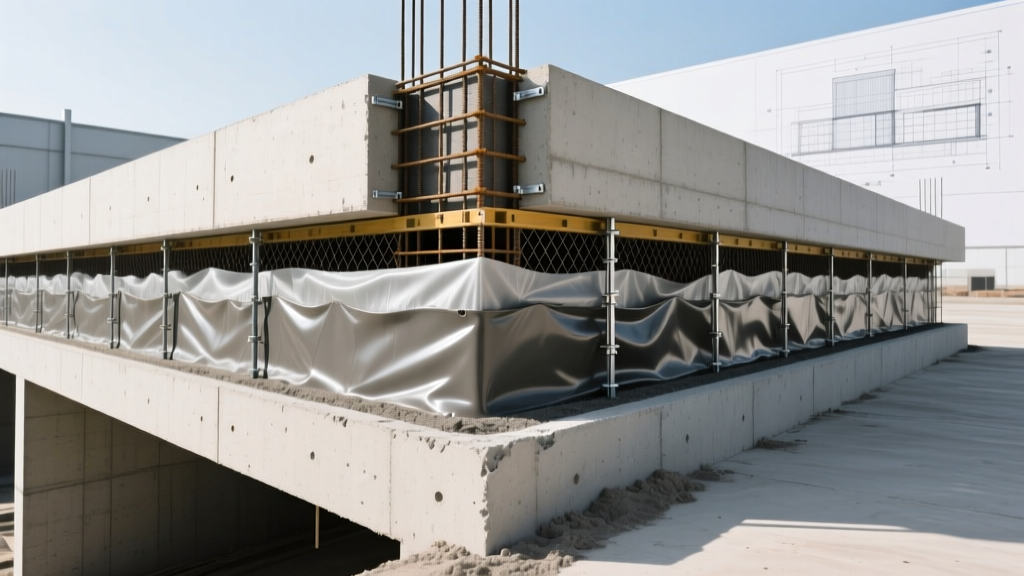
Navigating IBC Chapter 18: Below-Grade Waterproofing Mandates
The International Building Code (IBC) draws a strict legal distinction between dampproofing and waterproofing. According to the International Code Council (ICC), dampproofing is only permissible in soils with poor drainage where no hydrostatic pressure is present. When a geotechnical investigation identifies a high water table, perched water, or expansive soils capable of generating hydrostatic pressure, IBC Section 1805.2.2 mandates full waterproofing.
Waterproof casting material—encompassing integral crystalline admixtures, polymer-modified hydraulic cements, and specialized epoxy or polyurethane casting compounds used for waterstops and joint sealing—must meet specific performance thresholds to satisfy this mandate. Unlike surface-applied membranes, cast-in-place waterproofing systems must demonstrate structural continuity and resistance to lateral water migration under continuous hydrostatic head pressure.
Plan reviewers will reject below-grade foundation designs that rely solely on dampproofing (e.g., standard bituminous coatings) if the soil report indicates any potential for hydrostatic pressure. Waterproof casting materials must be rated to withstand a minimum hydrostatic head equivalent to the depth of the lowest floor slab plus a 20% safety factor, typically translating to a minimum 10- to 15-foot head pressure rating in commercial substructures.
ACI 318 Structural Mandates for Cast-in-Place Waterproofing
When waterproof casting material is used as an integral part of the structural concrete (such as crystalline waterproofing admixtures or pozzolanic blends), it must comply with the durability requirements of ACI 318, published by the American Concrete Institute (ACI). The code categorizes water exposure into specific classes, directly dictating the mix design parameters for the casting material.
Exposure Classes W1 and W2: The Critical Thresholds
For below-grade walls and mat foundations in contact with water, the concrete matrix falls under Exposure Class W1 (continuous contact with fresh water) or W2 (continuous contact with brackish or seawater). The introduction of waterproof casting admixtures cannot compromise the structural integrity mandated for these classes.
| Exposure Class | Max w/cm Ratio | Min Compressive Strength (psi) | Waterproof Casting Requirement |
|---|---|---|---|
| W0 (Limited) | 0.50 | 4,000 | Standard dampproofing; integral optional |
| W1 (Fresh Water) | 0.45 | 4,500 | Mandatory low-permeance casting mix |
| W2 (Salt/Brackish) | 0.45 | 5,000 | Specialized marine-grade casting compounds |
To achieve the 0.45 maximum water-cementitious (w/cm) ratio required for W1 and W2 classes without sacrificing workability, specifiers must utilize high-range water reducers (HRWR) compatible with the specific waterproof casting material. Crystalline admixtures, for instance, often require a slight adjustment in HRWR dosage to maintain a 5-inch to 7-inch slump during placement.
ASTM Standards for Specialized Casting Compounds
For non-structural waterproof casting materials—such as polyurethane grouts injected into cold joints, epoxy casting compounds used for waterstop encapsulation, and hydraulic cement patches used to seal tie-holes—the governing testing standards shift to ASTM International.
- ASTM C1512 (Cold-Bonded Waterstops): Dictates the tensile strength and elongation requirements for waterstops cast into the concrete joints. The casting material encapsulating the waterstop must not exotherm at temperatures that degrade the PVC or hydrophilic rubber (typically keeping peak heat of hydration below 160°F).
- ASTM C494/C494M (Chemical Admixtures): Integral waterproof casting admixtures must meet Type S (Specific Performance) criteria, proving that the addition of the chemical does not reduce the compressive strength of the control mix by more than 10% at 28 days.
- ASTM D412 (Tensile Properties of Elastomers): Applies to flexible polyurethane and polysulfide casting compounds used for expansion joints. Code compliance requires a minimum tensile strength of 1,500 psi and 300% elongation to accommodate structural deflection without tearing.
When specifying integral waterproof casting materials, demand third-party lab results showing a permeance rate of less than 0.04 perms when tested under 200 feet of hydrostatic head pressure (per modified ASTM E96). Many manufacturers only test at 0 psi or low head pressures, which will result in immediate rejection by strict municipal plan reviewers in high-water-table zones like Miami-Dade or coastal New York.
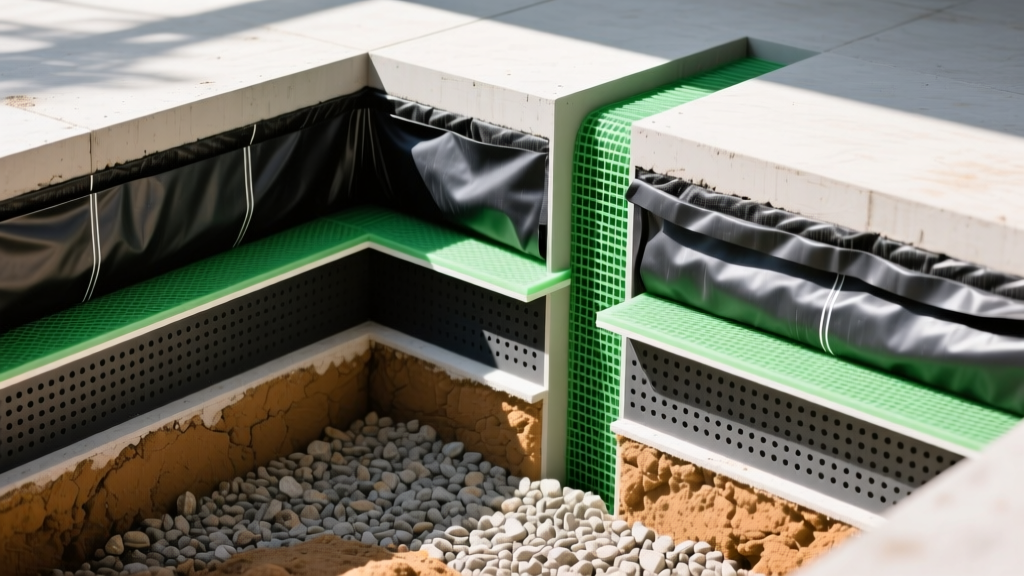
Specifying for Plan Review: Avoiding Common Rejections
Municipal building departments and third-party plan review agencies (like ICC-ES) scrutinize waterproof casting submittals heavily. To prevent costly RFI (Request for Information) delays during the permitting phase, your submittal package must explicitly address the following compliance vectors:
- ICC-ES Evaluation Reports: If using a proprietary crystalline or polymer-modified casting material that deviates from prescriptive ACI mix designs, you must provide a current, unexpired ICC-ES ESR (Evaluation Service Report) that explicitly lists the product as an approved alternative to IBC Section 1805 waterproofing membranes.
- Hydrostatic Head Test Certificates: Include independent laboratory test results (e.g., from SGS or Intertek) demonstrating the material's resistance to water penetration under a minimum 175 psi hydrostatic head (equivalent to roughly 400 feet of water column), far exceeding typical below-grade depths but required for commercial high-rises.
- Compatibility Matrices: Provide documentation proving the casting material is chemically compatible with the specific form-release agents and curing compounds specified on the project. Incompatible curing compounds can prevent crystalline materials from reacting with the free lime in the concrete, nullifying the waterproofing effect and violating the approved design.
Code Compliance FAQ
Can integral crystalline casting materials replace exterior membranes?
Yes, but only if the local jurisdiction accepts them as a standalone waterproofing system under IBC 1805.2.2. Many conservative jurisdictions (such as those in the Pacific Northwest) still mandate a redundant exterior membrane (like a 60-mil HDPE or bentonite sheet) in addition to the integral casting material, treating the crystalline mix as a secondary line of defense rather than a primary code-compliant barrier.
Do epoxy casting compounds for joint sealing require fire ratings?
If the cast joint penetrates a fire-rated foundation wall or floor assembly (typically a 2-hour or 3-hour rating per IBC Table 601), the epoxy or polyurethane casting compound must be tested as part of a through-penetration firestop system per ASTM E814 or UL 1479. Standard structural epoxies will fail the fire hose stream test and will be cited as a code violation during the life-safety inspection.
What is the code-mandated minimum overlap for cast waterstops?
While the IBC does not specify exact dimensions for waterstop splices, ACI 350.3 (Seismic Design of Liquid-Containing Concrete Structures) and standard industry best practices mandate a minimum 6-inch overlap for heat-welded PVC waterstops, and a 4-inch overlap for hydrophilic strip waterstops cast into the concrete. Splices must be factory-welded or chemically bonded; mechanical clamping is universally rejected by inspectors for permanent below-grade waterproofing.
Written by
David NakamuraDavid Nakamura is a licensed architect (AIA) and construction technology writer focused on sustainable building methods, mass timber engineering, and high-performance building envelopes. He holds a Master of Architecture from the University of Washington and is a certified Passive House Consultant (CPHC). David spent eight years at the Seattle firm Mithun, where he led the design of three LEED Platinum projects, before founding his own practice specializing in net-zero residential design. He serves on the editorial advisory board of GreenBuilder Magazine and has authored peer-reviewed papers on cross-laminated timber (CLT) connections for the Journal of Structural Engineering. In his spare time, David teaches woodworking at Pratt Fine Arts Center and kayaks the Puget Sound.
More from David Nakamura
View all
Construction Cost
Labor Cost to Build a Deck Per Sq Ft: 2026 Installation Guide
Discover the exact labor cost to build a deck per sq ft in 2026. This installation guide breaks down contractor rates, complexity factors, and hidden fees.
Aug 4, 2026

Construction Cost
How Much Does It Cost to Build a 3 Bedroom House? Financing Guide
Learn exactly how much it costs to build a 3 bedroom house and explore 2026 financing options, construction loan types, and budget frameworks for your build.
Aug 4, 2026

Construction Cost
Cost to Build a Tennis Court: 2026 Guide
How much does it cost to build a tennis court in 2026? Breakdowns for asphalt, concrete, and synthetic surfaces plus fencing and lighting.
Jul 30, 2026