Selecting the Best Waterproof Upholstery Material for 2026
Compare top waterproof upholstery material options for marine, patio, and healthcare. Learn key metrics like Wyzenbeek double rubs and hydrostatic head.

The Polymer Matrix: Decoding Waterproof Upholstery
Selecting a waterproof upholstery material requires looking past consumer marketing labels. True performance in marine, outdoor patio, and high-moisture commercial environments depends entirely on polymer chemistry, weave density, and backing technologies. A fabric labeled "water-repellent" will fail catastrophically in a saltwater environment, while a fully waterproof vinyl might crack under extreme UV exposure if not properly formulated with UV stabilizers. In 2026, the market is dominated by four distinct material categories, each engineered for specific moisture and abrasion profiles.
Material Comparison Matrix
| Material Type | Top Brand / Model | 2026 Cost (Per Linear Yard) | Wyzenbeek Double Rubs | Hydrostatic Head | Primary Vulnerability |
|---|---|---|---|---|---|
| Solution-Dyed Acrylic | Sunbrella Marine Grade | $48 - $65 | 50,000+ | Water-Resistant (DWR) | Mildew growth on surface dirt |
| PVC-Coated Polyester | Morbern Allsport | $28 - $42 | 100,000+ | 100% Waterproof | Plasticizer migration in extreme cold |
| HDPE Mesh | Phifertex Standard | $22 - $35 | 50,000+ | Permeable (Drains) | Snagging under point loads |
| PU-Coated Nylon | Naugahyde Spirit | $55 - $85 | 100,000+ | 100% Waterproof | Hydrolysis in high humidity |
Critical Performance Metrics to Demand
When sourcing waterproof upholstery material for commercial or demanding residential applications, you must evaluate the technical data sheets (TDS) for three specific metrics. Relying on touch or visual inspection is insufficient.
1. Wyzenbeek Abrasion Resistance (ASTM D4157)
The Wyzenbeek test measures a fabric's ability to withstand surface wear. According to the Association for Contract Textiles (ACT) guidelines, general contract upholstery requires a minimum of 15,000 double rubs. However, for marine seating, outdoor hospitality, and healthcare environments, you must specify materials rated for 100,000+ double rubs. PVC and PU-coated materials easily exceed this threshold, while woven acrylics and meshes typically hover around the 50,000 mark, which is acceptable for low-traffic residential patios but inadequate for commercial marine charters.
2. Hydrostatic Head (AATCC 127)
This metric measures the water pressure a fabric can withstand before moisture penetrates the weave. A standard patio cushion might only need a 1,000mm hydrostatic head to resist light rain. For marine upholstery or exposed outdoor seating, demand a hydrostatic head rating of 10,000mm or higher, or a fully impermeable PVC/PU coating. Note that solution-dyed acrylics (like standard Sunbrella) rely on a Durable Water Repellent (DWR) finish that degrades over time and requires reapplication, making them water-resistant rather than truly waterproof.
3. UV Fade Resistance (AATCC 16)
Waterproofing is useless if the polymer chains break down under ultraviolet radiation. Look for materials tested to a minimum of 1,000 hours of continuous UV exposure with a colorfastness rating of Class 4 or 5. Solution-dyed acrylics excel here because the pigment is embedded in the liquid polymer before extrusion, whereas piece-dyed fabrics will fade rapidly regardless of their waterproof coating.
Polyurethane (PU) coated fabrics offer incredible hand-feel and bleach-cleanability, making them popular in healthcare. However, in high-humidity, non-climate-controlled environments (like boat cabins or covered tropical patios), PU is susceptible to hydrolysis. Moisture in the air chemically breaks down the urethane bonds, causing the coating to peel and flake. If specifying for unclimate-controlled marine or tropical use, choose PVC over PU.
Application-Specific Selection Framework
Use this decision framework to match the material to the specific environmental stressors of your project.
Marine and Saltwater Environments
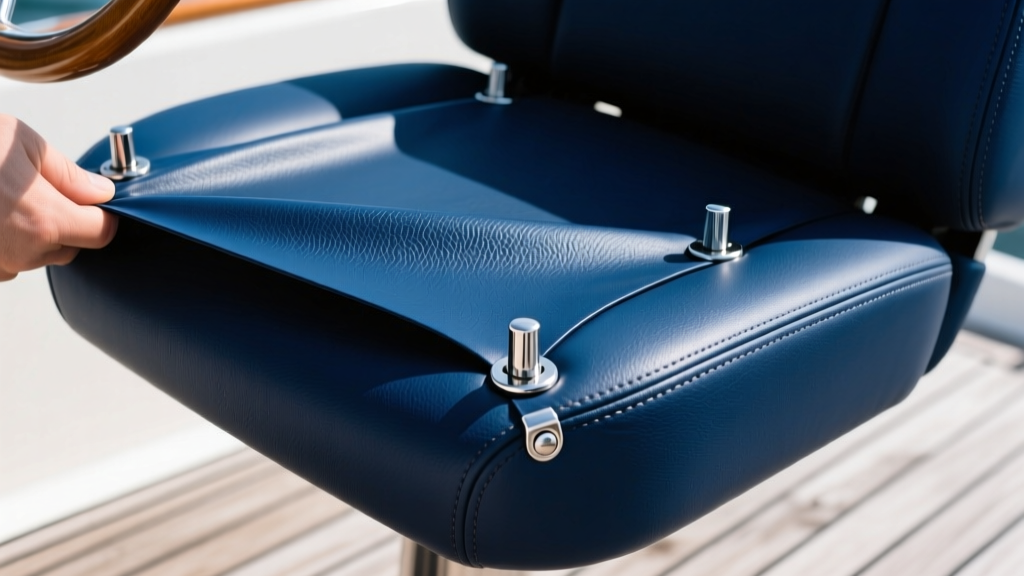
Primary Choice: PVC-Coated Polyester (e.g., Morbern Allsport or Spradling Permablok). Marine upholstery faces a triad of threats: salt spray, intense UV reflection off the water, and constant mechanical abrasion from passengers. PVC is inherently impervious to saltwater and can be cleaned with harsh marine detergents. Ensure the backing is treated with an antimicrobial agent like Microban to prevent pink mold (Serratia marcescens) from colonizing the stitching holes.
Outdoor Sling Furniture and Patio Mesh
Primary Choice: HDPE (High-Density Polyethylene) Mesh (e.g., Phifertex). For sling-style patio chairs where water must drain immediately rather than pool, woven HDPE mesh is the industry standard. It is dimensionally stable, meaning it will not stretch or sag when wet, and it dries in minutes. When sourcing, specify a 16x14 weave density for optimal tear strength.
Healthcare and High-Moisture Hospitality
Primary Choice: Advanced PU or Silicone-coated textiles. Healthcare upholstery requires materials that can withstand 1:10 bleach solutions for infection control without degrading the waterproof barrier. While traditional PVC cracks under repeated bleach exposure, modern silicone-coated fabrics (like Crypton or specialized Naugahyde lines) maintain their waterproof integrity and pass the 1,000-cycle bleach cleanability test required by modern hospital procurement standards.
The Substrate: Reticulated Foam and Drainage
The most common cause of outdoor and marine upholstery failure is not the fabric itself, but the foam beneath it. Standard closed-cell polyurethane foam acts as a sponge. Even if your waterproof upholstery material has a 20,000mm hydrostatic head, water will inevitably enter through zipper tracks, stitching needle holes, and seam intersections. Once inside, standard foam traps the moisture, leading to internal rot and foul odors.
Always pair waterproof fabrics with reticulated (open-cell) foam, often branded as DryFast or QuickDry foam. The manufacturing process blasts the cell windows open, leaving only the skeletal structure. This allows water to pass straight through the cushion and drain out the bottom mesh panel in under 60 seconds. For marine helm seats, use a hybrid approach: a 1-inch top layer of closed-cell foam for comfort, bonded to a 3-inch base of reticulated foam for rapid drainage.
Fabrication Tolerances and Seam Sealing
When working with waterproof upholstery material, the fabrication methodology dictates the final water resistance. Sewing a PVC or PU fabric creates thousands of microscopic puncture wounds along the seam line.
- Thread Selection: Never use cotton or standard nylon thread, which will wick water into the cushion via capillary action. Specify 100% PTFE (polytetrafluoroethylene) thread, such as Gore Tenara or Sailrite Profilen. PTFE is completely impervious to UV and water, and it will outlast the fabric itself.
- Seam Sealing: For true submersion-level waterproofing (such as personal watercraft seats or open-deck marine seating), seams must be heat-welded using a high-frequency RF welder or hot air wedge. If sewing is required, apply a flexible urethane seam sealer (like Seam Grip) to the interior stitch line before assembly.
- Fastening: Avoid stainless steel staples for marine applications, as they can tear through the vinyl under dynamic loads. Instead, use stainless steel ring nails or a hook-and-loop (Velcro) closure system integrated into a welded flange.
Sourcing and Verification in 2026
Counterfeit and off-brand "marine vinyls" have flooded e-commerce platforms, often substituting cheap plasticizers that off-gas and crack within a single season of UV exposure. Always verify the material's origin and request a physical sample to perform a "cold crack" test: place the sample in a standard freezer at 0°F (-18°C) for 24 hours, then attempt to fold it sharply. High-quality marine PVC will remain pliable, while inferior blends will fracture or show white stress marks at the fold line. For comprehensive project planning, consulting specialized marine fabricators and resources like the Sailrite fabric selection guidelines can provide critical insights into material behavior under real-world marine conditions.
By prioritizing polymer chemistry, demanding rigorous ASTM testing data, and pairing your fabric with the correct open-cell substrate, you can engineer an upholstery system that remains completely dry and structurally sound for a decade or more in the harshest environments.
Written by
James ThorntonJames Thornton is a construction industry veteran with 25 years of hands-on experience in wood framing, lumber grading, and residential building codes. He started as a framing carpenter in rural Oregon, earned his ICC Residential Building Inspector certification, and eventually became a senior plan reviewer for the City of Portland Bureau of Development Services. James holds a B.S. in Wood Science & Technology from Oregon State University and is a certified lumber grader through the West Coast Lumber Inspection Bureau (WCLIB). He has inspected over 3,000 residential construction sites and authored the city's internal guide on advanced framing techniques (2x6 at 24" O.C.). James lives in Bend, OR, where he builds custom timber-frame cabins and competes in lumberjack sports.
More from James Thornton
View all
Insulation
Best Home Insulation Materials: Complete 2026 Guide
Compare top home insulation materials for 2026. Find R-values, installed costs per square foot, and best uses for fiberglass, spray foam, and mineral wool.
Aug 4, 2026

Sustainable Building
Certify Your Green Building Material for LEED and WELL
Step-by-step guide to certifying a green building material for LEED v5 and WELL v2. Master EPDs, HPDs, and VOC limits for 2026 project specifications.
Aug 4, 2026

Stone & Masonry
Veneer Stacked Stone Panels: Interior Design & Style Showcase
Discover how veneer stacked stone panels transform interiors. Explore modern design profiles, material pairings, and technical installation specs.
Aug 4, 2026