What Materials Are Waterproof? Complete Building Guide 2026
Discover what materials are waterproof for construction. Compare membranes, coatings, and inherent barriers with costs, lifespans, and failure modes.

The Science: Waterproof vs. Water-Resistant
When evaluating building envelopes, the distinction between water-resistant and waterproof is defined by hydrostatic pressure. A water-resistant material sheds liquid water under normal atmospheric conditions (like wind-driven rain) but will eventually allow moisture transmission when subjected to standing water or hydrostatic head pressure. True waterproofing materials maintain absolute impermeability even under continuous hydrostatic load.
Hydrostatic pressure increases by 0.433 PSI for every foot of water depth. A below-grade foundation wall sitting in 8 feet of saturated soil experiences nearly 3.5 PSI of continuous hydrostatic pressure. According to the Building Science Corporation, managing this pressure requires either an inherently impermeable barrier or a designed drainage plane that relieves the hydrostatic head before it reaches the structural substrate.
Inherently Waterproof Construction Materials
Some building materials possess molecular structures that naturally repel or block water penetration without requiring secondary coatings.
Metals and Alloys
- Copper and Zinc: Used primarily in flashing, roofing, and architectural details. Copper forms a protective patina that halts corrosion, offering a 100+ year lifespan. Installed costs range from $18 to $25 per square foot.
- Galvanized Steel: Coated with a layer of zinc to prevent oxidation. While the steel itself is waterproof, the seams require soldering or specialized sealants to maintain envelope integrity.
Polymers and Plastics
- High-Density Polyethylene (HDPE): Extruded into geomembranes and dimpled drainage boards. HDPE has a water vapor transmission rate (WVTR) of nearly zero, making it the standard for below-grade blind-side waterproofing and landfill liners. Material costs average $1.50 to $3.00 per square foot.
- PVC (Polyvinyl Chloride): Widely used in plumbing and commercial roofing membranes. PVC is inherently impervious to water, though plasticizer migration over decades can eventually cause brittleness.
Applied Waterproofing Systems: Membranes and Coatings
For porous substrates like concrete, wood, and masonry, applied systems are mandatory. These materials transform a water-absorbent structure into a waterproof assembly.
Sheet Membranes
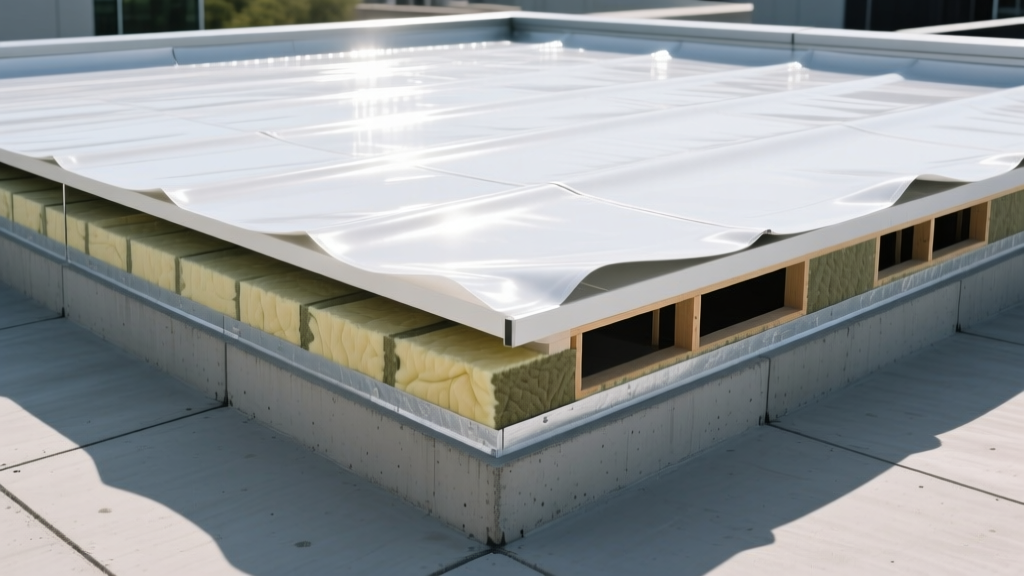
Sheet membranes provide a consistent, factory-controlled thickness. TPO (Thermoplastic Polyolefin) dominates the commercial low-slope roofing market due to its heat-weldable seams and high solar reflectance. EPDM (Ethylene Propylene Diene Monomer) remains superior in extreme cold climates, retaining flexibility down to -40°F, though its seams rely on adhesives or tape rather than thermal welding, making seam integrity the primary vulnerability.
Liquid-Applied Coatings
Liquid systems cure to form a seamless, fully adhered monolithic membrane. Polyurea is the highest-performance liquid option available in 2026. Applied via a heated plural-component spray rig, 100% solids polyurea cures in 15 to 30 seconds and can be applied up to 125 mils thick in a single pass. It exhibits 400% elongation, bridging structural cracks without tearing. Polyurethane offers similar elongation but requires moisture or oxygen to cure, making it slower and more sensitive to application conditions.
Material Performance and Cost Matrix
| Material Category | Hydrostatic Resistance | Expected Lifespan | Installed Cost (USD/sq ft) | Ideal Application |
|---|---|---|---|---|
| HDPE Dimpled Board | Extreme (with drainage) | 50+ Years | $4.50 - $6.50 | Below-grade foundation walls, plaza decks |
| TPO Sheet Membrane | High (up to 3 PSI) | 20 - 30 Years | $7.00 - $10.00 | Commercial flat roofs, podiums |
| Spray Polyurea | Extreme (10+ PSI) | 25 - 40 Years | $9.00 - $14.00 | Water containment, podiums, heavy-traffic decks |
| Bentonite Clay Panels | High (self-sealing) | 50+ Years | $3.50 - $5.50 | Blind-side below-grade, non-accessible areas |
| Copper Flashing | Absolute | 100+ Years | $18.00 - $25.00 | Roof penetrations, parapet caps, masonry weeps |
Concrete: Waterproofing the Porous Giant
Concrete is fundamentally a sponge. Untreated concrete exhibits capillary action that can draw water upward against gravity at a rate of several inches per hour. To answer the question of what materials are waterproof in concrete construction, the industry relies on two distinct methodologies:
Integral Crystalline Waterproofing (ICW)
ICW admixtures (such as those manufactured by Xypex or Kryton) are added to the concrete batch at the plant. These chemicals react with the calcium hydroxide and free water in the curing concrete to form insoluble needle-like crystals. These crystals block the capillary tracts and micro-cracks. The distinct advantage of ICW is that it is self-healing; if a structural crack forms years later and water enters, the dormant chemicals reactivate to crystallize and seal the new fissure.
Surface-Applied Bentonite
Sodium bentonite clay expands up to 15 times its dry volume when exposed to water. Encased in cardboard or geotextile panels, bentonite is applied to the exterior of below-grade walls. When groundwater contacts the panels, the clay swells, forming a dense, impermeable gel that seals against the concrete substrate. This system requires continuous confinement pressure to function correctly.
A common failure in masonry and stucco construction is blocking weep holes. Weep holes are not a sign of a waterproofing failure; they are a critical component of a drained cavity system. According to the National Research Council of Canada, blocking weep holes traps moisture inside the wall cavity, leading to efflorescence, freeze-thaw spalling, and structural rot. Never seal weep holes in an attempt to make a drained system 'waterproof'.
Real-World Failure Modes: Why 'Waterproof' Materials Leak
When investigating building envelope failures, the membrane itself is rarely the culprit. The EPA's guidelines on moisture control highlight that water intrusion almost always exploits vulnerabilities in the assembly rather than the material. The primary failure modes include:
- Seam Degradation: In EPDM roofing, liquid adhesives used at seams degrade under UV exposure and thermal cycling, leading to lap joint failures long before the membrane field fails.
- Penetration Flashing: Pipes, HVAC curbs, and electrical conduits penetrate the waterproofing layer. If these transitions rely solely on caulking rather than mechanically fastened, integrated flashing boots, they will leak within 3 to 5 years.
- Substrate Outgassing: Applying liquid coatings or adhered membranes to 'green' (uncured) concrete traps escaping moisture vapor. When the sun heats the surface, the vapor expands, creating blisters that eventually rupture the waterproofing layer.
- Puncture and Abrasion: During backfilling, sharp rocks can easily puncture standard 60-mil sheet membranes. This is why HDPE dimpled drainage boards are required as a protection course over below-grade waterproofing.
Decision Framework: Selecting the Right System
Choosing the correct waterproofing material requires matching the physical properties of the system to the specific environmental and structural demands of the project.
Step 1: Assess Hydrostatic Load
If the area is above grade and only subject to wind-driven rain, a water-resistive barrier (WRB) or standard liquid acrylic coating is sufficient. If the area is below the water table or subject to ponding water, you must specify a hydrostatic-rated system like HDPE, bentonite, or polyurea.
Step 2: Evaluate UV and Thermal Exposure
For exposed roofs, TPO and PVC reflect UV radiation and resist thermal degradation. EPDM absorbs UV and heat, requiring a protective ballast or reflective coating in hot climates. Polyurea requires an aliphatic topcoat if exposed to direct sunlight, as standard aromatic polyurea will chalk and degrade under UV rays.
Step 3: Account for Substrate Movement
If the structural substrate is prone to cracking (e.g., suspended concrete slabs, timber framing), the waterproofing material must possess high elongation properties. Rigid coatings like cementitious slurries will crack alongside the substrate. In these scenarios, specify elastomeric liquid membranes with a minimum 300% elongation or loosely laid sheet membranes that can accommodate structural shifting without tearing.
Written by
James ThorntonJames Thornton is a construction industry veteran with 25 years of hands-on experience in wood framing, lumber grading, and residential building codes. He started as a framing carpenter in rural Oregon, earned his ICC Residential Building Inspector certification, and eventually became a senior plan reviewer for the City of Portland Bureau of Development Services. James holds a B.S. in Wood Science & Technology from Oregon State University and is a certified lumber grader through the West Coast Lumber Inspection Bureau (WCLIB). He has inspected over 3,000 residential construction sites and authored the city's internal guide on advanced framing techniques (2x6 at 24" O.C.). James lives in Bend, OR, where he builds custom timber-frame cabins and competes in lumberjack sports.
More from James Thornton
View all
Insulation
Best Home Insulation Materials: Complete 2026 Guide
Compare top home insulation materials for 2026. Find R-values, installed costs per square foot, and best uses for fiberglass, spray foam, and mineral wool.
Aug 4, 2026

Sustainable Building
Certify Your Green Building Material for LEED and WELL
Step-by-step guide to certifying a green building material for LEED v5 and WELL v2. Master EPDs, HPDs, and VOC limits for 2026 project specifications.
Aug 4, 2026

Stone & Masonry
Veneer Stacked Stone Panels: Interior Design & Style Showcase
Discover how veneer stacked stone panels transform interiors. Explore modern design profiles, material pairings, and technical installation specs.
Aug 4, 2026