Is MR Material Waterproof? Selection Guide for Wet Areas
Discover if MR material is truly waterproof. This selection guide compares moisture-resistant substrates with true waterproof membranes for wet areas.

The Core Misconception: Moisture Resistant vs. Waterproof
A pervasive error in residential and commercial construction is conflating "moisture-resistant" (MR) with "waterproof." When builders and DIYers ask if a specific MR material is waterproof, the technical answer is almost always no. Moisture-resistant substrates are engineered to withstand high ambient humidity, occasional condensation, and minor surface splashing without degrading. They are not designed to withstand hydrostatic pressure, continuous liquid water exposure, or capillary action.
True waterproofing requires a continuous, impermeable barrier that prevents liquid water migration entirely. Using an MR substrate in a high-exposure wet zone without a secondary waterproof membrane is a primary cause of structural rot, mold proliferation, and tile assembly failure. This guide delineates the exact performance thresholds of MR materials and provides a framework for selecting the correct waterproofing overlays.
Decoding MR Substrates: Performance and Limitations
To make accurate material selections, you must understand the specific water-handling properties of common MR building materials. The Gypsum Association and industry testing standards define these limits clearly.
MR Gypsum Board (Green/Purple Board)
MR gypsum boards feature a water-resistant core and face paper. Products like USG Sheetrock Mold Tough are treated with silicone or wax emulsions. Under ASTM C473 testing, MR gypsum is limited to a maximum water absorption of 5% by weight after two hours of submersion. While this prevents immediate swelling, prolonged exposure to liquid water will eventually compromise the gypsum core's structural integrity and lead to fastener pull-through.
MR Plywood and OSB
MR-grade plywood utilizes moisture-resistant urea-formaldehyde or melamine-urea-formaldehyde (MUF) resins. According to APA - The Engineered Wood Association, MR plywood can handle temporary weather exposure during construction and high-humidity interior environments (like kitchen cabinetry). However, it lacks the waterproof phenolic glues and higher-grade veneers found in true Marine-Grade plywood (BS 1088 standard). MR plywood will delaminate if subjected to standing water.
Cementitious Backer Units (CBU)
Cement boards (e.g., Durock, HardieBacker) are frequently misidentified as waterproof. While they are entirely impervious to water *damage*—meaning they will not rot, swell, or harbor mold—they are highly porous. Water passes directly through a standard 1/2-inch cement board in minutes. They are water-resistant substrates, not waterproof barriers.
Material Selection Matrix: MR vs. Waterproof Systems
| Material Category | Moisture Tolerance | Hydrostatic Rating | Required Overlay for Wet Zones |
|---|---|---|---|
| MR Gypsum Board | High Humidity / Vapor | None | ANSI A118.10 Liquid or Sheet Membrane |
| MR Plywood (Interior) | Ambient Dampness | None | Epoxy Sealer or Peel-and-Stick Flashing |
| Cement Backer Board | Direct Liquid Exposure | None (Porous) | ANSI A118.10 Membrane over seams and face |
| Foam Tile Backer (e.g., Kerdi-Board) | Direct Liquid Exposure | High (Closed-Cell) | Seam banding only (Face is inherently WP) |
| Liquid Applied Membrane (e.g., Hydro Ban) | Full Submersion | High | N/A (This is the waterproofing layer) |
When to Upgrade from MR to Full Waterproofing
Selecting the right assembly depends entirely on the specific moisture load of the environment. Use this decision framework to determine when an MR material is sufficient and when a dedicated waterproofing system is mandatory.
- Zone 1: High Humidity Only (MR Sufficient). Bathroom walls outside the shower/tub splash zone, kitchen backsplashes, and laundry room walls. MR gypsum board with standard latex paint is adequate here.
- Zone 2: Occasional Splashing (MR + Sealer). Kitchen countertops, mudroom flooring, and half-bath wainscoting. MR plywood or MDF substrates sealed with a high-quality polyurethane or epoxy edge-sealer will perform reliably.
- Zone 3: Continuous Wet / Direct Water (Full Waterproofing Mandatory). Shower pans, shower walls, steam rooms, and balcony decks. MR substrates must be completely covered by a continuous, code-approved waterproof membrane. The Tile Council of North America (TCNA) Handbook explicitly requires waterproofing in these zones to prevent structural degradation.
Hybrid Assembly Guide: Pairing MR Substrates with Membranes
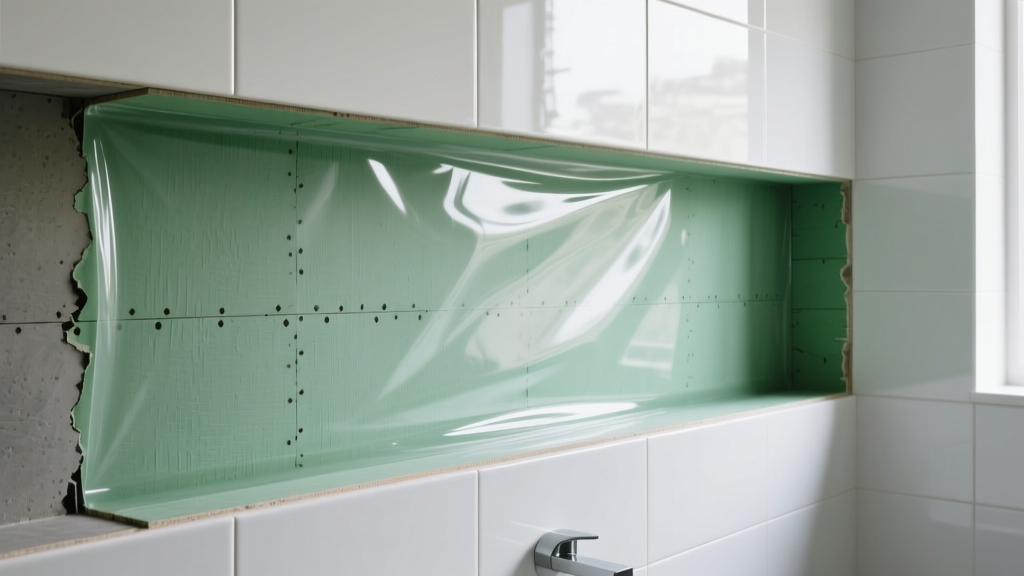
The most cost-effective and structurally sound approach for wet areas is utilizing a stable, water-resistant substrate (like cement board or foam board) paired with a surface-applied waterproof membrane. Below is the standard step-by-step protocol for a modern shower wall assembly.
- Substrate Installation: Install 1/2-inch cement backer board or extruded polystyrene foam board over wall studs. Leave a 1/8-inch gap between panels.
- Seam Treatment: Fill gaps with alkali-resistant mesh tape and thin-set mortar. Do not use standard drywall joint compound, which will dissolve upon water exposure.
- Membrane Application: Apply a liquid-applied waterproofing membrane (e.g., Laticrete Hydro Ban or Custom Building Products RedGard) using a 3/8-inch nap roller. Ensure the wet mil thickness meets the manufacturer's specification (typically 30-40 wet mils).
- Curing and Testing: Allow the membrane to cure fully (usually 24 hours). Perform a 24-hour flood test on the shower pan and visually inspect walls for pinholes before proceeding to tile installation.
2026 Cost Breakdown: Substrates vs. Waterproofing Add-ons
Budgeting accurately requires separating the cost of the MR substrate from the waterproofing layer. The table below reflects average national material costs for 2026.
| Component | Material Example | Unit Cost (2026) | Cost per Sq. Ft. |
|---|---|---|---|
| MR Gypsum (1/2") | USG Mold Tough 4x8 | $22.00 / sheet | $0.68 |
| Cement Board (1/2") | USG Durock 3x5 | $16.50 / sheet | $1.10 |
| Liquid Membrane | RedGard (1 Gallon) | $78.00 / gal | $2.60 (2 coats) |
| Sheet Membrane | Schluter-Kerdi (Roll) | $195.00 / 108 sq ft | $1.80 |
Note: Labor costs for applying liquid membranes average $1.50 to $2.50 per square foot, while sheet membranes require higher precision and thin-set mortar, pushing labor to $3.00 to $4.50 per square foot.
Expert Troubleshooting: Why MR Assemblies Fail
Even when high-quality MR materials are selected, assemblies frequently fail due to installation errors that bypass the material's engineered defenses.
- The Vapor Trap: Installing a polyethylene vapor barrier behind the studs *and* a liquid waterproof membrane on the face of the cement board creates a "mold sandwich." Moisture that migrates through the grout lines gets trapped between the two impermeable layers, leading to severe rot. Always use a single, surface-applied waterproofing layer and omit the rear poly sheeting.
- Fastener Penetration: Driving screws through a cured liquid membrane on the backer board punctures the waterproof envelope. If you must attach fixtures (like grab bars or shower doors), inject 100% silicone sealant into the pilot hole before driving the fastener.
- Substrate Deflection: MR materials like plywood and OSB are susceptible to dimensional movement when exposed to seasonal humidity shifts. If used as a subfloor beneath tile without an uncoupling/waterproof membrane (like Schluter-Ditra), the lateral movement will crack the grout and compromise the assembly.
Frequently Asked Questions
Can I use MR MDF for bathroom vanity cabinets?
Yes, MR MDF is an excellent choice for vanity cabinet boxes, provided all exposed edges and cutouts (especially around sink plumbing) are thoroughly sealed with a high-quality edge-banding or epoxy sealer. Unsealed edges will wick moisture from the air and swell rapidly.
Is marine-grade plywood considered an MR material?
Marine-grade plywood exceeds standard MR classifications. While MR plywood uses moisture-resistant glues, marine-grade plywood (BS 1088) uses fully waterproof phenolic glues and defect-free veneers to prevent internal voids where water can pool. It is suitable for boat building and exterior applications, whereas MR plywood is strictly for interior, non-submerged use.
Do I need to waterproof the ceiling of my shower?
While building codes do not universally mandate waterproofing on shower ceilings (unless it is a continuous steam room), best practices dictate extending your liquid or sheet membrane up to the ceiling. Condensation on shower ceilings frequently leads to peeling paint and drywall degradation over time.
Written by
Sarah WhitfieldSarah Whitfield is a chartered quantity surveyor (MRICS) and construction cost analyst with 15 years of experience in material pricing, procurement strategy, and project budgeting. She earned her degree in Construction Management from the University of Reading (UK) and has worked on projects ranging from $2M custom homes to $180M mixed-use developments across North America and Europe. Sarah currently leads cost estimating for BuildMat Insight, maintaining a proprietary database of 4,000+ material price points updated quarterly. She is a frequent contributor to RSMeans cost data panels and has presented at the International Cost Engineering Council (ICEC) congress. Based in Denver, CO, Sarah is an avid trail runner and volunteer mentor for Women in Construction.
More from Sarah Whitfield
View all
Wood & Lumber
What Are the Different Types of Wood? A Builder's Guide
Compare structural softwoods, finish hardwoods, and engineered lumber. Analyze Janka ratings, MOE values, and 2026 pricing for construction.
Aug 4, 2026

Walls & Panels
Steel Framing vs Wood Framing: Corrosion and Moisture Defense
Compare steel framing vs wood framing for moisture resistance. Learn about galvanized coatings, condensation risks, and corrosion protection strategies.
Jul 21, 2026

Stone & Masonry
How to Cut Stone Veneer: Wet Saw vs Grinder Comparison
Compare the best tools for cutting stone veneer. We review wet saws, angle grinders, and chop saws to help you achieve clean, chip-free cuts.
Jul 21, 2026