Polyurethane Waterproofing Material Cost Breakdown & 2026 Pricing
Detailed 2026 cost breakdown for polyurethane waterproofing material, covering aromatic vs. aliphatic pricing, labor, surface prep, and long-term ROI.

Material Costs by Polyurethane Chemistry
Polyurethane (PU) waterproofing systems are not a monolith; their pricing and performance vary drastically based on their chemical backbone. When estimating a project, specifying the exact chemistry is the first step in accurate budgeting. In 2026, raw material supply chain stabilization has normalized prices, though advanced aliphatic formulations command a premium due to their complex manufacturing process and superior UV resistance.
| PU Chemistry | Product Example | Cost per Gallon | Coverage (mil thickness) | Material Cost / Sq Ft |
|---|---|---|---|---|
| Aromatic (Standard) | Tremco Vulkem 116 | $55 - $75 | 40 sq ft @ 40 mils | $1.37 - $1.87 |
| Aliphatic (UV Stable) | Sika Sikaflex-505 UV | $95 - $140 | 50 sq ft @ 30 mils | $1.90 - $2.80 |
| Moisture-Cured | BASF MasterSeal HLM 5000 | $65 - $85 | 45 sq ft @ 35 mils | $1.44 - $1.88 |
| Water-Based PU Dispersion | Kryton Krystol Membrane | $40 - $55 | 60 sq ft @ 20 mils | $0.66 - $0.91 |
Aromatic polyurethanes are the most cost-effective and offer exceptional tensile strength, making them ideal for below-grade applications or as a base coat in exposed systems. However, they degrade and chalk under ultraviolet light. Aliphatic polyurethanes contain specialized UV stabilizers, maintaining their color and structural integrity for 15+ years in direct sunlight, justifying their 40-60% price premium for exposed plaza decks and commercial rooftops.
Surface Preparation and Labor Breakdown
The most common cause of polyurethane membrane failure is inadequate surface preparation. PU membranes are highly sensitive to substrate contaminants, moisture, and improper profile depths. Budgeting strictly for material while underestimating prep work will inevitably lead to delamination and costly warranty voids.
Substrate Remediation Costs
- Shot Blasting / Diamond Grinding: Required to achieve a Concrete Surface Profile (CSP) of 3 to 5 per ICRI guidelines. Costs range from $0.45 to $0.95 per square foot depending on concrete hardness and aggregate exposure.
- Crack Routing and Sealing: Hairline cracks must be routed to a minimum 1/4-inch width and filled with a flexible PU sealant (e.g., Sikaflex-1a) before membrane application. Budget $3.50 to $6.00 per linear foot for routing and sealing.
- Primer Application: Epoxies or specialized PU primers (like Sika Primer-207) are mandatory for porous concrete to prevent outgassing and pinholes. Primer adds $0.25 to $0.45 per square foot in material and labor.
Application Labor Rates
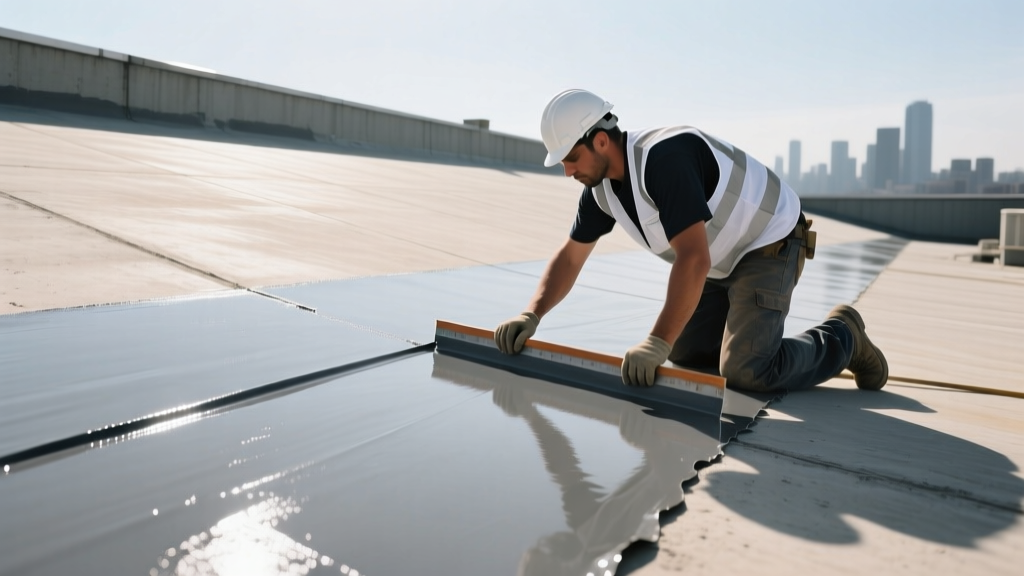
Labor costs for applying liquid-applied polyurethane systems typically range from $2.75 to $5.50 per square foot. The variance depends on site accessibility, the complexity of penetrations (HVAC curbs, drain flanges), and the required number of coats. Detailing work around pipes and parapets can increase localized labor costs by up to 25%, as these areas require meticulous brushwork and reinforcing mesh integration.
Polyurethane vs. Competing Membrane Systems
To contextualize the investment, it is necessary to compare polyurethane against alternative liquid-applied and sheet membranes. While PU is rarely the cheapest upfront option, its elongation properties (often exceeding 600% per ASTM C836) make it unmatched for structures experiencing thermal movement or dynamic cracking.
| Metric | Polyurethane (Aliphatic) | PMMA (Polymethyl Methacrylate) | Acrylic Elastomeric | Hot-Applied Rubberized Asphalt |
|---|---|---|---|---|
| Total Installed Cost (Sq Ft) | $7.50 - $12.00 | $14.00 - $22.00 | $3.50 - $6.00 | $9.00 - $14.00 |
| Cure Time to Traffic | 12 - 24 Hours | 1 - 2 Hours | 24 - 48 Hours | Cooling dependent (Hours) |
| Elongation / Flexibility | Excellent (600%+) | Good (200-300%) | Moderate (300-400%) | Excellent (1000%+) |
| UV Stability (Uncoated) | Excellent | Excellent | Good | Poor (Requires overlay) |
| Expected Lifespan | 15 - 20 Years | 20 - 25 Years | 5 - 8 Years | 15 - 20 Years |
Hidden Costs and Edge Cases
Budget overruns in polyurethane waterproofing rarely stem from the primary membrane itself. Project estimators must account for the following secondary cost drivers:
- Temperature and Climate Constraints: Standard PU systems require ambient and surface temperatures between 40°F and 95°F. If a project schedule forces application in colder temperatures, contractors must use specialized winter-grade accelerators or heated enclosures, adding 10-15% to the total project cost.
- Isocyanate Safety and Compliance: Polyurethanes contain isocyanates, which are potent respiratory sensitizers. Compliance with OSHA isocyanate safety standards requires specialized PPE, supplied-air respirators for enclosed spaces, and strict ventilation protocols. Budget an additional $0.20 to $0.40 per square foot for safety compliance and specialized labor in confined areas like parking garages or water treatment tanks.
- Waste and Overage: Liquid-applied systems on highly textured or broom-finished concrete can experience a 15-20% material loss due to surface absorption and profile filling. Always calculate material volume with a minimum 15% waste factor.
Long-Term ROI and Lifecycle Costing
Evaluating polyurethane waterproofing material strictly on initial invoice price is a flawed procurement strategy. The true metric is the lifecycle cost per year of service.
Consider a 10,000 square foot commercial plaza deck. An acrylic system might cost $45,000 installed but requires complete tear-off and reapplication every 7 years due to UV degradation and ponding water sensitivity. Over a 21-year building lifecycle, the acrylic system costs $135,000 (excluding inflation and business disruption costs).
Conversely, a high-solids aliphatic polyurethane system installed for $95,000 will typically require only a simple power washing and a thin mil re-coat at year 12 (costing roughly $25,000). The 21-year lifecycle cost for the PU system is $120,000, yielding a net savings while providing superior protection against structural water infiltration. Furthermore, modern PU formulations are highly resistant to ponding water, a common failure point for cheaper elastomeric alternatives.
2026 Procurement and Compliance Notes
When sourcing polyurethane waterproofing materials in 2026, procurement managers must navigate tightening environmental regulations. The EPA's architectural coatings VOC regulations and localized air quality management district (AQMD) rules strictly limit the volatile organic compound content in liquid-applied membranes.
Ensure that the specified products meet the current VOC limits (typically under 250 g/L for single-ply roof coatings, though specific waterproofing categories vary by state, with California's SCAQMD Rule 1113 being the strictest benchmark). Purchasing outdated, high-VOC inventory from discount liquidators can result in severe municipal fines and the inability to secure a manufacturer's warranty. Always request a current Technical Data Sheet (TDS) and verify the manufacturing date; polyurethane components have a strict shelf life of 12 to 18 months, and expired Part B (curing agent) will result in a tacky, non-curing membrane that must be mechanically removed at great expense.
For structural integrity and warranty validation, ensure the installation contractor holds a current, manufacturer-certified applicator license. Most tier-one manufacturers (Sika, Tremco, BASF) will not honor a 10-year material and labor warranty unless the substrate prep and application mil-thickness are documented via daily wet-film thickness (WFT) gauge logs and verified by an independent third-party inspector.
Written by
James ThorntonJames Thornton is a construction industry veteran with 25 years of hands-on experience in wood framing, lumber grading, and residential building codes. He started as a framing carpenter in rural Oregon, earned his ICC Residential Building Inspector certification, and eventually became a senior plan reviewer for the City of Portland Bureau of Development Services. James holds a B.S. in Wood Science & Technology from Oregon State University and is a certified lumber grader through the West Coast Lumber Inspection Bureau (WCLIB). He has inspected over 3,000 residential construction sites and authored the city's internal guide on advanced framing techniques (2x6 at 24" O.C.). James lives in Bend, OR, where he builds custom timber-frame cabins and competes in lumberjack sports.
More from James Thornton
View all
Insulation
Best Home Insulation Materials: Complete 2026 Guide
Compare top home insulation materials for 2026. Find R-values, installed costs per square foot, and best uses for fiberglass, spray foam, and mineral wool.
Aug 4, 2026

Sustainable Building
Certify Your Green Building Material for LEED and WELL
Step-by-step guide to certifying a green building material for LEED v5 and WELL v2. Master EPDs, HPDs, and VOC limits for 2026 project specifications.
Aug 4, 2026

Stone & Masonry
Veneer Stacked Stone Panels: Interior Design & Style Showcase
Discover how veneer stacked stone panels transform interiors. Explore modern design profiles, material pairings, and technical installation specs.
Aug 4, 2026