Waterproofing Materials for Roof Systems: A Complete Guide
Compare the top waterproofing materials for roof applications, including TPO, EPDM, PVC, and liquid membranes, with 2026 costs and lifespan data.

The Evolution of Roof Waterproofing
Selecting the correct membrane dictates the 20- to 30-year lifecycle of a low-slope or flat commercial roof. The modern roofing market has shifted away from traditional built-up roofing (BUR) and hot asphalt toward single-ply synthetics and fluid-applied systems. These advanced waterproofing materials for roof applications offer superior UV resistance, higher tensile strength, and better thermal reflectivity. However, a material that performs flawlessly in a dry, temperate climate may suffer catastrophic seam failure in a region with high thermal cycling or ponding water. This guide breaks down the technical specifications, installation requirements, and real-world failure modes of the primary commercial roofing membranes available today.
Decision Matrix: Matching Membrane to Substrate and Climate
There is no universal 'best' membrane. The optimal choice depends on the roof's slope, the number of HVAC penetrations, local weather patterns, and the structural load capacity of the deck. Below is a technical breakdown of the four dominant systems.
1. Thermoplastic Polyolefin (TPO)
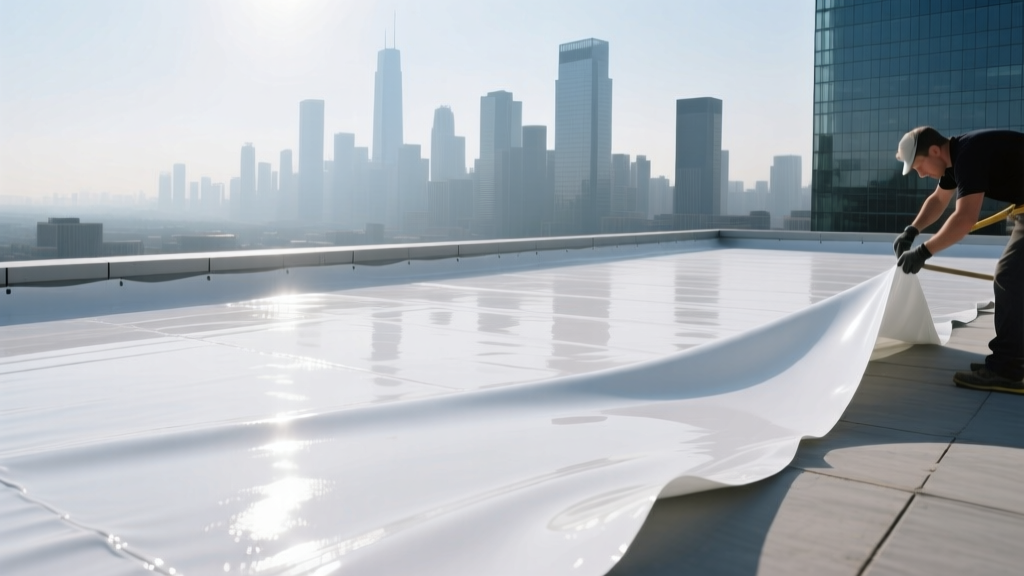
TPO is a single-ply, heat-welded thermoplastic membrane that dominates the North American commercial market. Standard commercial applications utilize 60-mil reinforced TPO. The seams are fused using hot-air welding at temperatures between 1,000°F and 1,150°F, creating a monolithic bond that is stronger than the membrane itself.
- Ideal Application: Large, open roof areas with minimal penetrations; new construction with rigid polyiso insulation.
- Climate Suitability: Excellent in high-UV environments due to highly reflective white surfaces, which reduce cooling loads and comply with US Department of Energy cool roof standards.
- Failure Mode: Under-welded seams in cold weather or over-welded seams in high heat. Early-generation TPO (pre-2011) suffered from premature cracking, but modern formulations with advanced UV stabilizers and thicker top plies (minimum 15 mils over the scrim) have resolved this.
2. Ethylene Propylene Diene Monomer (EPDM)
EPDM is a synthetic rubber membrane available in 45-mil, 60-mil, and 90-mil thicknesses. Unlike TPO, EPDM seams are joined using liquid adhesives or double-sided butyl tape. It is highly elastic, capable of stretching over 300% without tearing, making it exceptionally forgiving on structures that experience significant thermal expansion and contraction.
- Ideal Application: Complex roofs with numerous penetrations, ballasted systems over existing substrates, and regions with extreme temperature swings.
- Climate Suitability: Black EPDM is ideal for cold climates as it absorbs solar heat, melting snow and preventing ice damming. White EPDM is available but requires a titanium dioxide coating that can wear over time.
- Failure Mode: Membrane shrinkage. After 15 to 20 years, un-reinforced EPDM can shrink, pulling away from flashings and parapet walls. Fully adhered installations mitigate this better than mechanically fastened or ballasted systems.
3. Polyvinyl Chloride (PVC) & KEE
PVC membranes are chemically welded using solvent-based liquids that melt the overlapping layers together. Standard PVC relies on liquid plasticizers to maintain flexibility. Over time, these plasticizers can migrate out of the material, leading to brittleness. To solve this, manufacturers developed KEE (Ketone Ethylene Ester) PVC, which uses a solid polymer plasticizer that does not migrate, extending the membrane's flexible lifespan well beyond 30 years.
- Ideal Application: Roofs exposed to animal fats, vegetable oils, or chemical exhaust (e.g., restaurants and manufacturing plants), as PVC is highly resistant to hydrocarbon degradation.
- Failure Mode: Plasticizer migration in non-KEE formulations, and incompatibility with asphalt or polystyrene insulation (which requires a separation layer like gypsum board).
4. Liquid-Applied Polyurethane and Silicone
Fluid-applied systems are sprayed or rolled directly onto the substrate, curing to form a seamless, fully adhered elastomeric membrane. Silicone is the premier choice for flat roofs with poor drainage, as it is entirely impervious to ponding water. Polyurethane offers higher tensile strength and abrasion resistance but will degrade if water ponds for more than 48 hours.
- Ideal Application: Roof restorations over existing metal, concrete, or modified bitumen; domes, arches, and roofs with dense HVAC piping where sheet membranes are impossible to detail.
- Application Specs: Requires 60 to 120 dry mils of thickness, often applied in two coats with a reinforcing polyester mesh embedded at all seams and penetrations.
- Failure Mode: Applying over a damp substrate. Trapped moisture will vaporize under solar heat, causing blisters and delamination.
2026 Cost and Lifecycle Comparison Matrix
The following table reflects 2026 commercial roofing market averages for material and professional installation costs. Prices vary based on regional labor rates, roof access difficulty, and insulation requirements.
| Membrane Type | Standard Thickness | Installed Cost (per sq. ft.) | Expected Lifespan | Ponding Water Resistance |
|---|---|---|---|---|
| TPO (Reinforced) | 60 mil | $4.50 - $7.00 | 20 - 25 years | Moderate (requires slope) |
| EPDM (Un-reinforced) | 60 mil | $5.00 - $8.00 | 25 - 30 years | Low (seams degrade in water) |
| PVC / KEE PVC | 50 - 80 mil | $6.50 - $10.00 | 25 - 35+ years | High (heat-welded seams) |
| Liquid Silicone | 60 - 100 dry mils | $7.00 - $12.00 | 20 - 30 years | Excellent (seamless) |
Critical Failure Modes and Edge Cases
Adding a new single-ply membrane over an existing wet roof system is a leading cause of premature failure. If the underlying insulation has absorbed moisture, the sun will heat the new membrane, turning the trapped water into steam. This creates vapor pressure that blisters and delaminates the new roof. Always conduct infrared moisture surveys or nuclear moisture scans before approving an overlay installation.
For buildings in coastal or high-wind zones, standard mechanical fastening patterns are insufficient. Specify systems tested to UL 580 or FM 1-90 wind uplift ratings. This often requires denser fastener spacing in the perimeter and corner zones (e.g., 12-inch on-center spacing in corners versus 24-inch in the field) to prevent catastrophic membrane peeling during hurricane-force events.
Substrate Preparation: The Hidden Variable
The longevity of any waterproofing material for roof systems is entirely dependent on the substrate. For liquid-applied systems, the concrete or metal deck must be meticulously prepared. Concrete substrates must be cured for a minimum of 28 days and tested for moisture content. The industry standard mandates a moisture content of less than 5% (tested via anhydrous calcium chloride kits or electronic impedance meters) before applying polyurethane or silicone primers.
For single-ply sheets, the transition from the roof deck to the parapet wall is the most vulnerable point. Installers must use pre-formed, reinforced inside and outside corner flashings. Relying on field-cut membrane for these transitions introduces tension and folding, which will inevitably split as the building shifts. According to technical bulletins from the National Roofing Contractors Association (NRCA), over 80% of roof leaks occur at flashings, penetrations, and transitions, not in the field of the membrane.
Industry Standards and Compliance
When specifying materials, ensure the product data sheets explicitly state compliance with the relevant ASTM International standards. For TPO, the governing standard is ASTM D6878, which dictates minimum tensile strength, tearing resistance, and heat aging properties. For EPDM, look for ASTM D4637 compliance. PVC membranes should meet ASTM D4434. Reject any manufacturer that cannot provide independent, third-party testing certificates verifying these specific ASTM metrics, as off-brand materials frequently fail to maintain dimensional stability under prolonged thermal cycling.
Written by
Elena RodriguezElena Rodriguez is a civil engineer and technical writer specializing in concrete technology, masonry systems, and ASTM/ACI compliance. She earned her B.S. in Civil Engineering from Texas A&M University and spent a decade at a materials testing laboratory, performing over 2,000 concrete compressive strength tests and masonry prism evaluations. Elena is an ACI-certified Field Testing Technician (Grade I) and a member of ASTM Committee C12 on Natural Building Stone. She currently consults on forensic engineering cases involving concrete failures and moisture intrusion. Based in San Antonio, TX, Elena is a proud member of the Society of Women Engineers (SWE) and coaches her daughter's FIRST Robotics team.
More from Elena Rodriguez
View all
Walls & Panels
Cost Analysis: Light Gauge Steel Framing Advantages and Disadvantages
Evaluate light gauge steel framing advantages and disadvantages through a strict cost analysis lens, comparing material, labor, and lifecycle expenses.
Aug 4, 2026

Walls & Panels
Gypsum Board Types: Exact Specifications, Thickness & Dimensions
Compare standard, Type X, and moisture-resistant gypsum board types. Get exact specifications, thicknesses, dimensions, and ASTM standards for your project.
Aug 4, 2026

Fire Resistance
Best Fire-Resistant Outdoor Decking Materials: 2026 Buyer Guide
Discover the best fire-resistant outdoor decking materials for 2026. Compare Class A PVC, aluminum, and hardwood options for WUI compliance and safety.
Aug 4, 2026