Troubleshooting Waterproof Raincoat Material: Fix Leaks and Delamination
Diagnose and fix common failures in waterproof raincoat material. Learn how to resolve ePTFE delamination, PU coating degradation, and seam tape leaks.

Diagnostic Matrix: Identifying Membrane and Coating Failures
High-performance waterproof raincoat material—whether utilized in technical apparel, architectural tensile structures, or heavy-duty construction site enclosures—relies on a precise balance of polymer chemistry and mechanical engineering. When these materials fail, the issue rarely stems from the base fabric itself. Instead, failures occur at the microscopic level within the membrane pores, the chemical bonds of the polyurethane (PU) matrix, or the thermal welds of the seam tape. Before attempting any repairs, accurately diagnosing the failure mode is critical to avoid irreversible damage to the textile's moisture vapor transmission rate (MVTR).
| Observed Symptom | Root Cause | Primary Material Affected | Severity Level |
|---|---|---|---|
| Surface absorbs water, heavy condensation inside | DWR (Durable Water Repellent) degradation / Wetting out | All face fabrics (Nylon/Polyester) | Moderate (Breathability loss) |
| Cloudy patches, bubbling, peeling inner liner | Hydrolysis or UV-induced polymer breakdown | PU and TPU coatings/membranes | Severe (Structural failure) |
| Water ingress at stitch lines despite dry fabric | Thermal seam tape adhesive failure or plasticizer migration | Seam seal tapes (TPU/PVC) | High (Direct leak path) |
| Leaks only occur when fabric is stretched or under wind load | Mechanical pore collapse or micro-tearing in ePTFE matrix | ePTFE (expanded PTFE) membranes | Severe (Permanent membrane damage) |
Symptom 1: 'Wetting Out' and the 2026 DWR Shift
When waterproof raincoat material 'wets out,' the outer face fabric becomes saturated with water. While the underlying membrane may still be technically waterproof, the saturated fabric creates a vapor barrier, dropping the MVTR to near zero and causing internal condensation that mimics a leak. This is caused by the degradation of the DWR finish, which lowers the water contact angle from a hydrophobic 140+ degrees to a hydrophilic sub-90 degrees.
The 2026 PFAS Regulatory Impact
Historically, C8 and C6 fluorocarbon-based DWR treatments provided near-permanent water repellency. However, due to global environmental regulations enacted through 2025 and 2026, the industry has rapidly transitioned to C0 (PFAS-free) DWR chemistries, such as plant-based dendrimers and silicone-based hyperbranched polymers. According to the EPA's PFAS guidelines, these legacy 'forever chemicals' are now heavily restricted. C0 finishes are inherently less durable against oil-based contaminants and abrasion, meaning modern waterproof textiles require more frequent maintenance to maintain their hydrostatic head performance.
The Fix: Reactivation vs. C0 Reapplication
- Deep Cleaning: Wash the material with a technical, non-detergent cleaner (e.g., Nikwax Tech Wash or Grangers Performance Wash) at 40°C. Standard laundry detergents leave hydrophilic surfactant residues that permanently ruin water repellency.
- Thermal Reactivation: Tumble dry on medium heat (approx. 55°C) for 40 minutes, or apply a commercial heat press at 130°C for 15 seconds. Heat realigns the existing fluoropolymer or silicone chains at the microscopic level.
- C0 Reapplication: If reactivation fails, apply a PFAS-free spray-on DWR. Target a uniform application of 150-200 grams per square meter (gsm). Allow to cure for 24 hours before exposing to hydrostatic pressure.
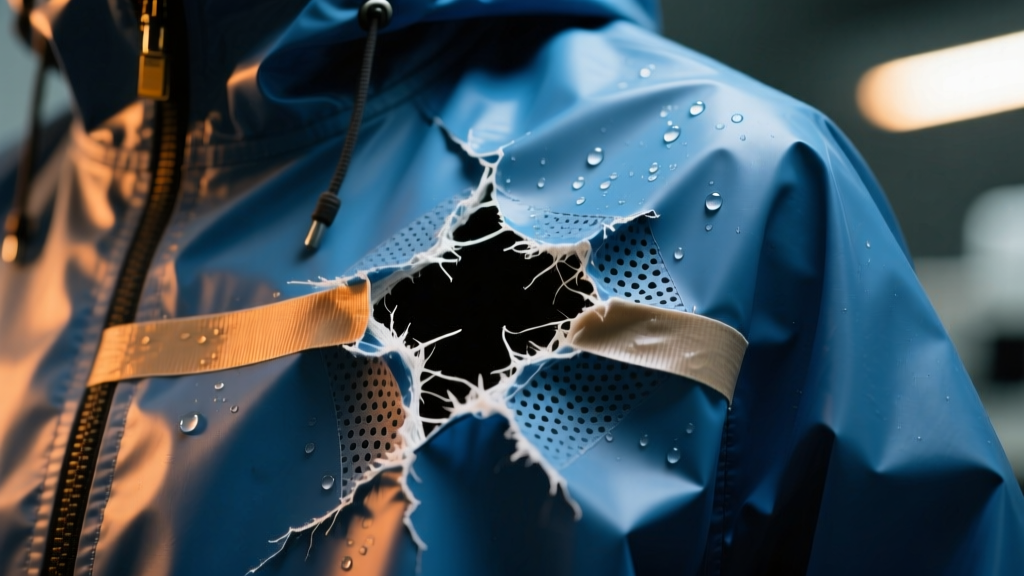
Symptom 2: Delamination and Hydrolysis in PU/TPU Layers
If the inner coating of your waterproof raincoat material is flaking, turning tacky, or bubbling, you are witnessing hydrolysis. Polyurethane (PU) and Thermoplastic Polyurethane (TPU) membranes are susceptible to moisture-induced chemical cleavage, where water molecules break the ester bonds in the polymer chain. This is particularly prevalent in ester-based TPUs stored in high-humidity environments, whereas ether-based TPUs offer superior hydrolytic stability but at a 20-30% higher manufacturing cost.
Assessing the Damage
Delamination cannot be chemically reversed once the polymer chains have cleaved. If the hydrostatic head rating has dropped below 5,000mm H2O (the minimum threshold for heavy rain protection per ASTM D751 standards for coated fabrics), the membrane is structurally compromised. Professional relamination of ePTFE or TPU membranes onto existing face fabrics typically costs between $45 and $85 per square yard in industrial settings, making it viable only for high-value architectural membranes or heavy-duty construction enclosures rather than consumer apparel.
Symptom 3: Seam Tape Peeling and Micro-Leaks
The most common point of catastrophic failure in waterproof raincoat material is the seam. Needle punctures create direct channels through the membrane. To seal these, manufacturers apply TPU or PVC seam seal tape via hot air welding. When this tape peels, it is rarely due to the adhesive failing; it is usually caused by plasticizer migration or improper initial thermal activation.
Step-by-Step Seam Re-taping Procedure
Industrial TPU seam seal tape costs roughly $0.15 to $0.30 per linear meter, making it a highly cost-effective repair if executed with precision.
- Step 1: Tape Removal and Residue Cleaning. Peel back the delaminated tape. Use a specialized PU adhesive solvent or isopropyl alcohol (99% purity) to dissolve the degraded adhesive layer. Do not use acetone on PU-coated fabrics, as it will dissolve the primary waterproof membrane.
- Step 2: Tape Selection. Select a 22mm wide, single-sided TPU seam seal tape with a melting point matched to your substrate. For standard nylon/PU laminates, a low-melt TPU (activating at 120°C) is ideal. For heavier polyester/PVC architectural fabrics, use a high-melt tape (140°C–150°C).
- Step 3: Thermal Activation. Using a hot air welder with a 10mm nozzle, direct 140°C air precisely at the adhesive side of the tape. Maintain a nozzle distance of 15mm. Follow immediately with a silicone pressure roller applying 3-4 kg of downward force.
- Step 4: Cooling and Curing. The adhesive requires a 24-hour cross-linking period to achieve maximum peel strength (typically >8 N/cm). Do not subject the seam to hydrostatic testing or mechanical tension during this window.
Symptom 4: Mechanical Pore Collapse in ePTFE Under Tension
Expanded Polytetrafluoroethylene (ePTFE) membranes, widely recognized under trade names like Gore-Tex, function via a microscopic node-and-fibril structure containing roughly 9 billion pores per square inch. These pores are small enough (0.2 microns) to block liquid water but large enough to pass water vapor. However, when waterproof raincoat material utilizing ePTFE is subjected to extreme mechanical tension—such as in tensioned site hoardings, temporary roofing, or tightly stretched apparel joints—the node-and-fibril matrix can deform.
When the material stretches beyond its 15% yield point, the pores elongate and widen. While this might seem like it would increase breathability, it actually compromises the surface tension barrier that prevents liquid water penetration. Once the pore geometry is permanently altered, the material will leak under minimal hydrostatic pressure (as low as 2,000mm H2O).
Structural Reinforcement Solutions
To resolve tension-induced ePTFE failure, the mechanical load must be transferred away from the membrane. In architectural and construction applications, this requires applying high-tenacity ripstop reinforcement patches (typically 500D Cordura or Kevlar blends) bonded with a flexible, high-shear epoxy adhesive to the high-stress zones (corners, grommets, and anchor points). For apparel or flexible enclosures, integrating structural webbing or elasticized tension-relief panels adjacent to the anchor points prevents the ePTFE layer from bearing the direct vector forces.
Written by
David NakamuraDavid Nakamura is a licensed architect (AIA) and construction technology writer focused on sustainable building methods, mass timber engineering, and high-performance building envelopes. He holds a Master of Architecture from the University of Washington and is a certified Passive House Consultant (CPHC). David spent eight years at the Seattle firm Mithun, where he led the design of three LEED Platinum projects, before founding his own practice specializing in net-zero residential design. He serves on the editorial advisory board of GreenBuilder Magazine and has authored peer-reviewed papers on cross-laminated timber (CLT) connections for the Journal of Structural Engineering. In his spare time, David teaches woodworking at Pratt Fine Arts Center and kayaks the Puget Sound.
More from David Nakamura
View all
Construction Cost
Labor Cost to Build a Deck Per Sq Ft: 2026 Installation Guide
Discover the exact labor cost to build a deck per sq ft in 2026. This installation guide breaks down contractor rates, complexity factors, and hidden fees.
Aug 4, 2026

Construction Cost
How Much Does It Cost to Build a 3 Bedroom House? Financing Guide
Learn exactly how much it costs to build a 3 bedroom house and explore 2026 financing options, construction loan types, and budget frameworks for your build.
Aug 4, 2026

Construction Cost
Cost to Build a Tennis Court: 2026 Guide
How much does it cost to build a tennis court in 2026? Breakdowns for asphalt, concrete, and synthetic surfaces plus fencing and lighting.
Jul 30, 2026