Waterproof Cotton Material Cost Breakdown: 2026 Construction Guide
Analyze the 2026 cost breakdown for waterproof cotton material in construction, covering waxed canvas, PU-coated fabrics, and installation labor rates.

The Economics of Waterproof Cotton in Modern Construction
Waterproof cotton material occupies a highly specialized niche in construction, architectural tensile structures, and historic restoration. Unlike ubiquitous PVC or HDPE synthetics, treated cotton offers high breathability, superior UV degradation resistance, and a natural aesthetic. In 2026, the demand for sustainable, non-petroleum-based temporary enclosures and premium scaffolding wraps has driven a resurgence in high-performance cotton textiles. However, specifying waterproof cotton requires a precise understanding of the cost breakdown, as the initial material expense is only a fraction of the total lifecycle cost. This guide dissects the exact pricing, fabrication labor, and maintenance economics of waterproof cotton materials for professional builders and architects.
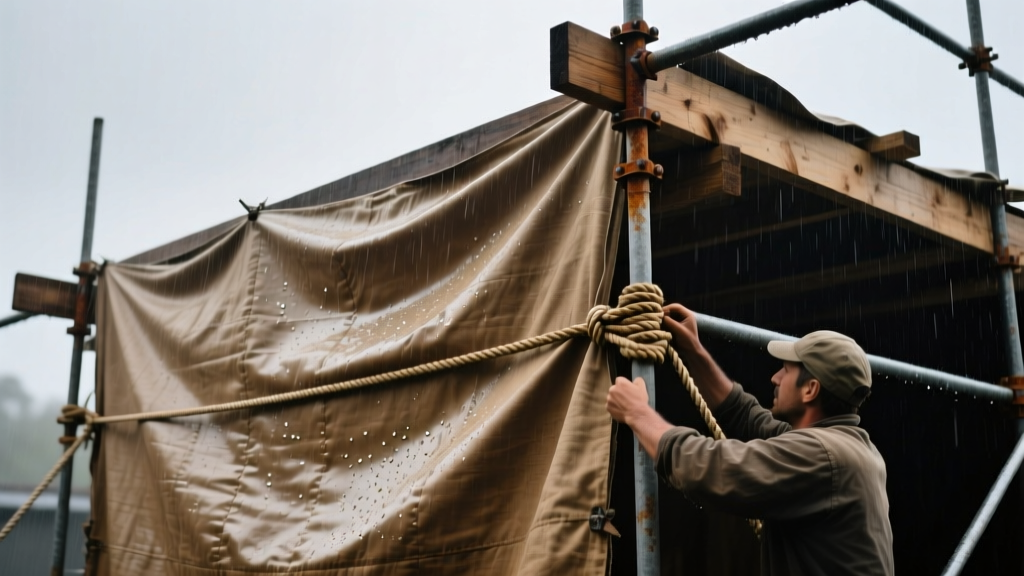
Base Material Costs: Fabric Types and Pricing Matrix
The term 'waterproof cotton' encompasses three distinct manufacturing processes, each yielding different hydrostatic head ratings and price points. According to industry textile suppliers like Sailrite, the base fabric weight (measured in ounces per square yard) and the specific waterproofing treatment dictate the raw material cost.
| Material Type | Weight (oz/yd²) | Waterproofing Method | Hydrostatic Head | 2026 Cost per Sq. Yard |
|---|---|---|---|---|
| Heavyweight Waxed Canvas | 18 - 24 oz | Paraffin/Beeswax saturation | 300 - 500 mm | $16.50 - $22.00 |
| PU-Coated Cotton | 10 - 14 oz | Polyurethane back-coating | 1,000 - 1,500 mm | $12.00 - $16.00 |
| Fluorocarbon-Treated (e.g., Ventile) | 8 - 12 oz | DWR finish + high-density weave | 600 - 800 mm | $38.00 - $55.00 |
For heavy-duty construction enclosures, 18 oz waxed canvas remains the industry standard due to its puncture resistance. PU-coated cotton is generally reserved for lighter architectural shades where drape and flexibility are prioritized over abrasion resistance. Fluorocarbon-treated high-density weaves are reserved for premium, breathable architectural facades where condensation buildup behind the membrane is a critical failure risk.
Fabrication, Labor, and Hardware Costs
Raw fabric costs are misleading without accounting for industrial fabrication. Waterproof cotton cannot be heat-welded like PVC; it must be sewn, which introduces needle holes that compromise the waterproof barrier if not executed correctly.
Thread and Seam Sealing Specifications
Standard polyester thread creates capillary action, wicking water through the needle holes. Professional fabricators use either 100% PTFE (polytetrafluoroethylene) thread or cotton-wrapped polyester core thread (like V-92 or V-138 sizes) that swells when wet to seal the stitch. PTFE thread adds approximately $0.85 to $1.20 per linear foot to fabrication costs. Alternatively, applying a seam-sealing tape or liquid wax to standard seams adds $0.50 per linear foot but requires annual reapplication.
Grommeting and Edge Reinforcement
Cotton lacks the tear strength of synthetic ripstops. Grommets must be spaced no more than 24 inches apart, and edges must be reinforced with a 2-inch double-fold hem or a synthetic webbing border.
- Brass Spur Grommets (Size #2 or #3): $0.75 - $1.10 per unit installed.
- Synthetic Webbing Edge Binding (2-inch nylon): $2.50 - $3.80 per linear foot.
- Corner Reinforcement Patches (Leather or Hypalon): $8.00 - $12.00 per corner.
- Industrial Sewing Labor Rate: $45.00 - $65.00 per hour (approx. $4.50 - $7.00 per linear foot of seaming).
Warning: The Capillary Wicking Trap
Never use standard nylon thread on waterproof cotton enclosures. Nylon degrades under prolonged UV exposure and, more critically, acts as a wick. During a 2025 field study on scaffolding wraps, enclosures sewn with standard nylon thread experienced a 40% higher internal moisture accumulation rate due to micro-wicking through the stitch channels, leading to interior mold growth on adjacent timber framing.
Lifecycle Maintenance: The Hidden Costs of Natural Fibers
Unlike PVC, which is largely maintenance-free until the end of its lifespan, waterproof cotton material requires active lifecycle management. The cost of ownership must factor in periodic re-proofing and biological degradation prevention.
Re-Waxing and Re-Proofing Schedules
Waxed canvas loses its hydrophobic properties as the wax matrix fractures from folding, UV exposure, and abrasion. In active construction environments, re-waxing is required every 12 to 18 months. Using commercial-grade re-waxing compounds (such as those formulated by Nikwax or traditional paraffin blends), the material cost is approximately $0.45 per square foot. Labor for cleaning, drying, and re-applying the wax compound averages $1.50 per square foot. Over a 5-year lifespan, maintenance will add roughly $9.50 per square yard to the total cost.
Mildew and Biological Degradation
Cotton is a cellulose-based fiber, making it inherently susceptible to mildew and rot if stored while damp. Construction crews must budget for specialized enzymatic cleaners and ensure strict dry-storage protocols. Failure to do so will result in catastrophic tensile failure, as mildew consumes the cellulose structure, reducing the fabric's tear strength by up to 60% within a single wet season.
Total Cost of Ownership (TCO): Cotton vs. Synthetic Alternatives
To justify the premium of waterproof cotton material, project managers must evaluate the 5-year TCO against traditional synthetics. While cotton has a higher upfront and maintenance cost, it offers distinct advantages in specific architectural and historic applications.
| Metric (5-Year TCO) | 18 oz Waxed Cotton | 18 oz PVC Coated Poly | Heavy Duty HDPE Tarp |
|---|---|---|---|
| Initial Material Cost (per sq yd) | $19.00 | $11.50 | $6.00 |
| Fabrication & Hardware | $8.50 | $4.00 (Heat welded) | $2.00 (Pre-fab) |
| 5-Year Maintenance | $9.50 | $1.00 (Cleaning) | $0.00 (Disposable) |
| Expected Lifespan | 5 - 8 Years | 3 - 5 Years | 6 - 12 Months |
| UV Degradation Resistance | Excellent | Poor (Becomes brittle) | Moderate |
| Aesthetic / Historic Compliance | High | Low | None |
As outlined in textile testing standards monitored by organizations like ASTM International, the UV degradation of PVC leads to plasticizer migration, causing the material to crack in high-sun exposure zones. Waxed cotton, conversely, degrades gracefully and can be re-waxed indefinitely, making it the superior economic choice for permanent or semi-permanent architectural shades and historic district scaffolding where visual compliance is legally mandated.
Real-World Failure Modes and Edge Cases
When specifying waterproof cotton, engineers must account for environmental edge cases that synthetic materials handle more forgivingly.
- Snow Load and Stretching: Cotton fibers stretch when wet and under load. A waterproof cotton canopy spanning more than 12 feet without intermediate structural support will sag significantly during heavy, wet snow events. Always design tensioning systems with turnbuckles to allow for mid-season re-tensioning.
- Abrasion at Contact Points: Where the canvas rubs against rough timber or steel scaffolding joints, the wax coating will rapidly wear away, exposing the raw cotton to moisture ingress. Specify leather or Hypalon chafing guards at all structural contact points, adding roughly $15 per guard to the fabrication budget.
- Fire Retardancy Requirements: Standard waxed cotton is highly flammable. If local building codes require NFPA 701 compliance for temporary enclosures, you must specify inherently fire-retardant (IFR) treated cotton or apply a topical fire-retardant spray. IFR-treated waterproof cotton carries a 30% to 45% price premium over standard waxed canvas, pushing the base material cost to $28.00 - $32.00 per square yard.
Decision Framework: When to Specify Waterproof Cotton
Choose Waterproof Cotton If: The project is in a historic district requiring non-reflective, natural aesthetics; the enclosure requires high breathability to prevent condensation on sensitive substrates; or the structure is semi-permanent (3+ years) and subject to high UV exposure that would destroy PVC.
Choose Synthetics (PVC/HDPE) If: The project requires strict fire-retardancy on a tight budget; the enclosure will be subjected to heavy, standing water loads; or the application is strictly short-term (under 12 months) where lifecycle maintenance is impossible.
Final Procurement Recommendations
For 2026 construction budgets, allocate a minimum of $32.00 per square yard for fully fabricated, hardware-ready 18 oz waxed cotton enclosures. Always mandate the use of PTFE thread or cotton-wrapped poly-core thread in your fabrication contracts, and explicitly require double-fold hems with synthetic webbing reinforcement. By front-loading the fabrication specifications, project managers eliminate the primary failure modes of natural fiber textiles, ensuring the material survives the harsh realities of the job site while delivering the architectural and environmental benefits unique to waterproof cotton.
Written by
James ThorntonJames Thornton is a construction industry veteran with 25 years of hands-on experience in wood framing, lumber grading, and residential building codes. He started as a framing carpenter in rural Oregon, earned his ICC Residential Building Inspector certification, and eventually became a senior plan reviewer for the City of Portland Bureau of Development Services. James holds a B.S. in Wood Science & Technology from Oregon State University and is a certified lumber grader through the West Coast Lumber Inspection Bureau (WCLIB). He has inspected over 3,000 residential construction sites and authored the city's internal guide on advanced framing techniques (2x6 at 24" O.C.). James lives in Bend, OR, where he builds custom timber-frame cabins and competes in lumberjack sports.
More from James Thornton
View all
Insulation
Best Home Insulation Materials: Complete 2026 Guide
Compare top home insulation materials for 2026. Find R-values, installed costs per square foot, and best uses for fiberglass, spray foam, and mineral wool.
Aug 4, 2026

Sustainable Building
Certify Your Green Building Material for LEED and WELL
Step-by-step guide to certifying a green building material for LEED v5 and WELL v2. Master EPDs, HPDs, and VOC limits for 2026 project specifications.
Aug 4, 2026

Stone & Masonry
Veneer Stacked Stone Panels: Interior Design & Style Showcase
Discover how veneer stacked stone panels transform interiors. Explore modern design profiles, material pairings, and technical installation specs.
Aug 4, 2026