Best Waterproof Clothing Material Reviews for 2026
Compare top waterproof clothing material options for 2026. We review Gore-Tex, eVent, and NeoShell for hydrostatic head, MVTR, and real-world durability.
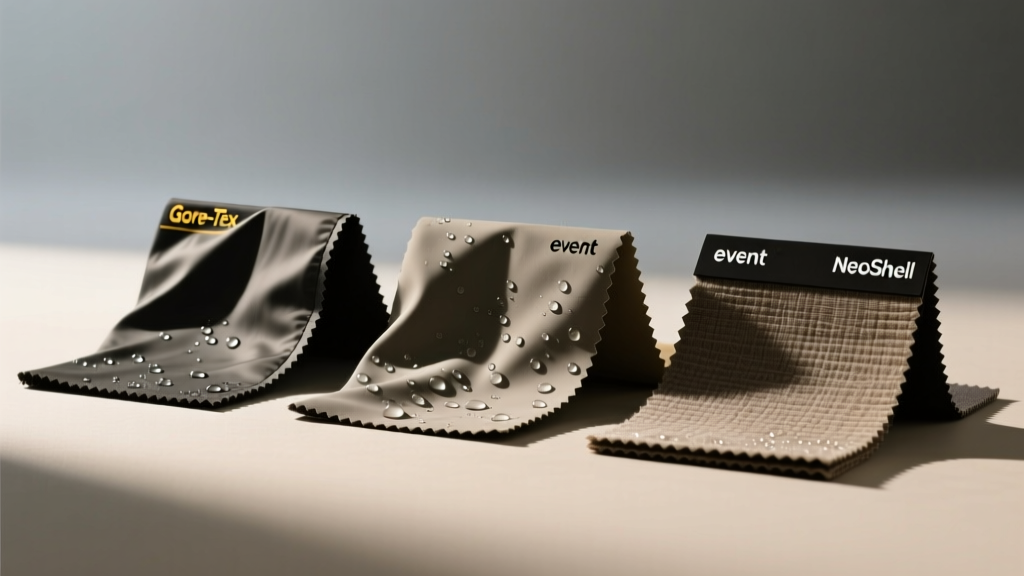
The 2026 Reality: ePE Membranes and PFAS-Free DWR
Evaluating waterproof clothing material in 2026 requires understanding a massive industry shift: the forced transition away from per- and polyfluoroalkyl substances (PFAS). Historically, expanded polytetrafluoroethylene (ePTFE) membranes and C8/C6 fluorocarbon Durable Water Repellent (DWR) coatings were the gold standard for shedding water. Following strict EPA guidelines on PFAS and global textile regulations, major manufacturers have pivoted to expanded polyethylene (ePE) membranes and C0 (PFAS-free) DWR treatments.
Gore-Tex Pro (ePE): The Heavy-Duty Benchmark
Gore-Tex Pro remains the most recognizable waterproof clothing material for extreme alpine environments. The 2026 iterations utilize a 3-layer ePE construction that drastically reduces the carbon footprint while maintaining the ruggedness expected of the 'Pro' line. The membrane is sandwiched between a high-tenacity nylon face fabric (typically 40D to 80D) and a low-denier micro-grid backer.
Technical Specifications
- Hydrostatic Head (HH): 28,000mm+ (Tested via the ISO 811:2018 standard for water penetration resistance)
- Moisture Vapor Transmission Rate (MVTR): ~25,000 g/m²/24h
- Air Permeability: Near 0 CFM (Cubic Feet per Minute) - completely windproof
- Retail Jacket Cost: $500 - $800 (e.g., Arc'teryx Alpha SV)
Real-World Performance: Gore-Tex Pro excels in static or low-output scenarios where absolute weather protection is non-negotiable. The 28,000mm HH rating means it can withstand the pressure of a heavy pack strap pressing wet fabric into your shoulder without failing. However, because it lacks air permeability, high-output activities like skinning uphill will overwhelm its MVTR limits, leading to internal sweat buildup.
Polartec NeoShell: Prioritizing Airflow Over Armor
Polartec NeoShell approaches waterproofing from a breathability-first perspective. Unlike traditional monolithic membranes, NeoShell is a sub-micron fiber matrix that is electrospun to create an interconnected web of microscopic pores. This structure allows for actual air exchange, making it a hybrid between a hard shell and a soft shell.
Technical Specifications
- Hydrostatic Head (HH): 10,000mm - 20,000mm (varies by face fabric stretch)
- MVTR: >30,000 g/m²/24h
- Air Permeability: 0.5 to 1.0 CFM
- Retail Jacket Cost: $350 - $550
According to Polartec NeoShell technical specifications, the 0.5 CFM air permeability is the magic threshold. It is just enough to allow convective heat loss and vapor escape, but low enough to block wind chill.
eVent DVexpedition: Direct Venting for High-Output
eVent pioneered the 'direct venting' technology, which omits the solid polyurethane (PU) top coat found on standard membranes. Instead, eVent treats the microscopic pores of the ePTFE membrane with a proprietary oleophobic (oil-hating) coating. This keeps body oils and sweat from clogging the pores, allowing vapor to escape instantly rather than waiting to build up enough pressure to push through a solid PU layer.
Pros and Cons of eVent
| Advantages | Drawbacks |
|---|---|
| Instantaneous breathability without needing to 'heat up' first. | Requires aggressive and frequent washing; body oils will permanently ruin the oleophobic coating. |
| Exceptional comfort in fluctuating temperatures. | Slightly heavier and less packable than modern 2.5-layer alternatives. |
| High hydrostatic head ratings (up to 20,000mm). | Fewer 2026 PFAS-compliant variations available compared to Gore-Tex. |
Pertex Shield: The Ultralight Contender
For fast-packing, trail running, and summer alpinism where every gram matters, Pertex Shield is the premier waterproof clothing material. Pertex utilizes a highly refined 2.5-layer or 3-layer construction featuring ultra-thin 7D to 15D nylon face fabrics.
While the hydrostatic head sits at a respectable 20,000mm, the MVTR is rated around 20,000 g/m²/24h. The trade-off for the featherweight construction (jackets often weigh under 8 ounces) is durability. A 10D Pertex Shield jacket will not survive bushwhacking or the abrasive friction of a 50lb hauling bag. It is strictly a high-mobility, low-abrasion emergency shell or rain-running layer.
Head-to-Head Material Comparison Matrix
| Material | Hydrostatic Head | MVTR | Air Permeable? | Durability |
|---|---|---|---|---|
| Gore-Tex Pro (ePE) | 28,000mm+ | 25,000 g/m² | No (0 CFM) | Extreme |
| Polartec NeoShell | 10k - 20,000mm | >30,000 g/m² | Yes (0.5+ CFM) | High |
| eVent DVexpedition | 20,000mm | 22,000+ g/m² | No (0 CFM) | High |
| Pertex Shield | 20,000mm | 20,000 g/m² | No (0 CFM) | Low/Medium |
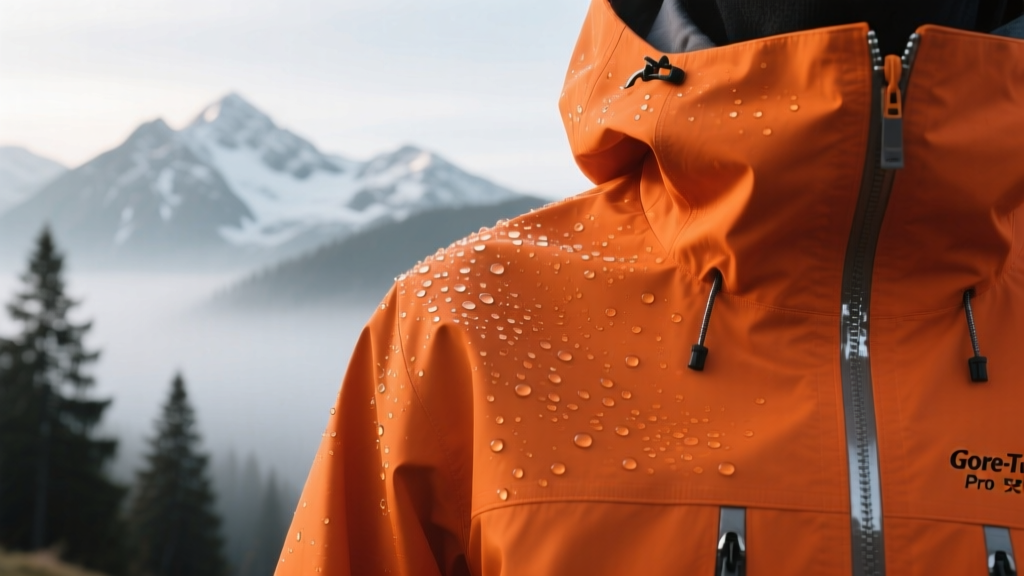
Activity-Based Decision Framework
Selecting the correct waterproof clothing material requires matching the membrane's physical properties to your specific metabolic output and environmental abrasion risks.
Scenario A: Static or Low-Output in Severe Weather
Activity: Ice climbing belays, expedition basecamp duties, winter resort skiing, emergency storm shelters.
Selection: Gore-Tex Pro. When you are not generating excess body heat, air permeability is a liability that allows cold wind to steal your warmth. You need maximum hydrostatic head and absolute wind blockage. Look for 80D face fabrics if ice climbing to prevent crampon and ice axe punctures.
Scenario B: High-Output Aerobic Exertion in Cold/Wet Conditions
Activity: Backcountry ski touring, alpine climbing approaches, winter trail running.
Selection: Polartec NeoShell. The 0.5 CFM airflow acts as a mechanical venting system, actively pushing humid air out of the microclimate inside your jacket before it can condense on the inner membrane wall. You will stay significantly drier from the inside out.
Scenario C: Fast-and-Light Summer Mobility
Activity: Ultralight backpacking, summer scrambling, trail running, bikepacking.
Selection: Pertex Shield (2.5 Layer). Weight and packability are the primary metrics. A 7D or 10D face fabric packs down to the size of a grapefruit. Accept that it will not survive dragging your hips up a granite chimney, but it will easily handle a 3-hour summer downpour while keeping your base weight under 12 lbs.
Maintenance: Preserving 2026 PFAS-Free Membranes
The elimination of C8 and C6 DWRs means the margin for error in gear maintenance is zero. Legacy fluorocarbon DWRs could survive months of neglect, dirt, and campfire smoke while still shedding water. Modern C0 DWRs degrade rapidly when exposed to sebum (body oils), sunscreen, and DEET bug spray.
- Wash Frequency: Clean your shell every 10 days of active use, or immediately if the face fabric begins to wet out in light rain.
- Detergent Selection: Never use standard laundry detergents, fabric softeners, or bleach. Standard detergents contain hydrophilic (water-attracting) surfactants that will permanently ruin the DWR. Use a dedicated technical wash like Nikwax Tech Wash or Grangers Performance Wash.
- Heat Reactivation: Most 2026 C0 DWR formulations require heat to realign the microscopic polymer chains on the fabric surface. Tumble dry on low heat for 20 minutes after washing. If the jacket still fails to bead water after washing and heat-reactivating, apply a wash-in or spray-on PFAS-free reproofing agent.
Written by
Marcus ChenMarcus Chen is a licensed structural engineer (PE) and building materials analyst with over 12 years of experience across residential, commercial, and industrial construction. He holds a Master of Science in Civil Engineering from UC Berkeley and spent six years at Thornton Tomasetti before transitioning to independent consulting and technical writing. Marcus specializes in material selection for seismic-prone regions, concrete reinforcement strategies, and lifecycle cost analysis. His work has been cited by the American Concrete Institute (ACI) and the Structural Engineers Association of California (SEAOC). When he is not on a job site or at his desk, you will find him hiking the Sierra Nevada or restoring a 1920s craftsman bungalow in Oakland, CA.
More from Marcus Chen
View all
Construction Cost
How Much Did the Eiffel Tower Cost to Build?
How much did the Eiffel Tower cost to build in 1889? We adjust for inflation and compare its budget to modern skyscraper construction.
Aug 4, 2026

Fire Resistance
What Is a Fire Resistant Material? Testing & Certification Guide
Discover what is a fire resistant material through ASTM and UL testing. Learn how fire ratings, certifications, and assemblies work in construction.
Aug 4, 2026

Construction Cost
How Much Did the Burj Khalifa Cost to Build?
How much did the Burj Khalifa cost to build? We break down the $1.5B project and extract 5 money-saving strategies for your next build.
Jul 30, 2026