Is EVA Material Waterproof? A Complete Membrane Guide
Discover if EVA material waterproof performance holds up. Explore ethylene vinyl acetate membrane specs, welding temps, costs, and PVC comparisons.

The Science Behind EVA Material Waterproof Performance
Ethylene Vinyl Acetate (EVA) is a highly effective, inherently waterproof copolymer used extensively in geotechnical and structural engineering. Unlike traditional polyethylene, EVA is created by copolymerizing ethylene with vinyl acetate (VA). The ethylene segments provide a crystalline structure that delivers tensile strength and chemical resistance, while the VA segments introduce amorphous regions that grant exceptional flexibility, elongation, and low-temperature impact resistance.
For waterproofing applications, the VA content typically ranges between 18% and 28%. This specific chemical ratio eliminates the need for migrating plasticizers—the primary cause of embrittlement and failure in older PVC liners. Because EVA material waterproof integrity relies on its molecular backbone rather than liquid additives, it maintains its watertight seal for decades without shrinking or cracking under thermal cycling.
EVA vs. PVC vs. TPO vs. HDPE: A Waterproofing Matrix
Selecting the right membrane requires understanding how EVA stacks up against alternative polymers. The following matrix highlights the operational differences across major waterproofing materials used in civil and commercial projects.
| Property | EVA (18-28% VA) | PVC (Plasticized) | TPO | HDPE |
|---|---|---|---|---|
| Plasticizer Migration Risk | None (Inherent flexibility) | High (Embrittles over time) | None | None |
| Low-Temp Flexibility (-20°C) | Excellent | Poor to Fair | Good | Poor (High stiffness) |
| Puncture Resistance | Moderate (Requires geotextile) | Low | Moderate | Very High |
| Weldability | Excellent (Hot wedge / extrusion) | Good (Hot air / solvent) | Excellent | Difficult (Requires high heat) |
| Hydrocarbon Resistance | Poor (Swells in oils/fuels) | Poor | Moderate | Excellent |
Installation Protocol: Heat Welding EVA Geomembranes
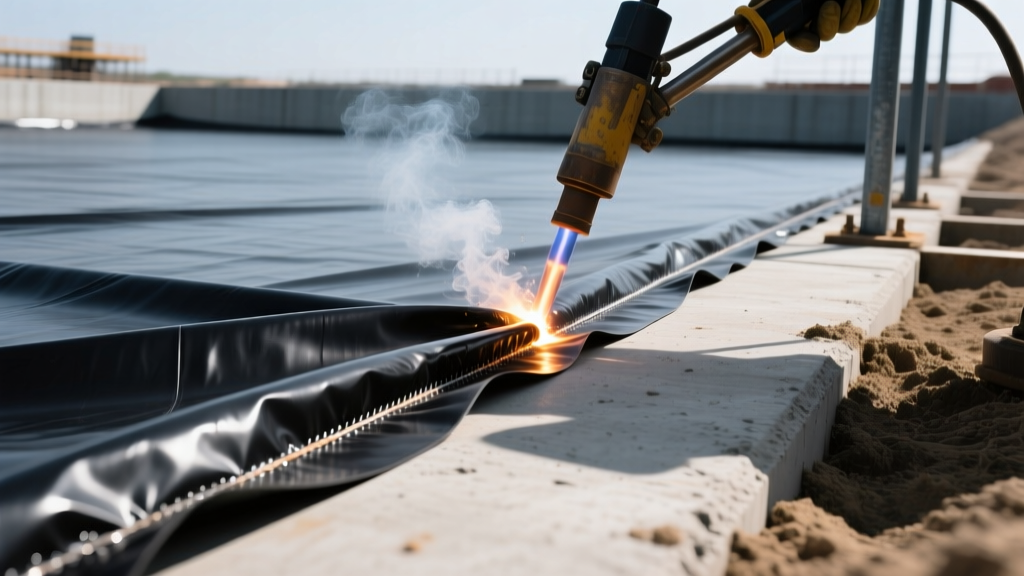
The waterproof continuity of an EVA system is entirely dependent on seam integrity. EVA's relatively low melting point (compared to HDPE) makes it highly responsive to hot wedge welding, allowing for fast, consistent dual-track seams.
- Subgrade Preparation: Compact the subgrade to 95% Standard Proctor density. Remove all angular aggregate larger than 0.75 inches. Deploy a non-woven needle-punched geotextile (minimum 12 oz/sq yd) as a cushion layer to prevent subgrade puncture.
- Panel Deployment: Unroll the 1.5 mm (60 mil) EVA panels, allowing a 24-hour acclimation period for thermal expansion/contraction. Maintain a minimum 4-inch overlap at all seams.
- Hot Wedge Welding: Set the automated wedge welder temperature between 420°F and 480°F (215°C - 250°C). Calibrate the drive speed to 10-15 feet per minute, applying 30-40 PSI of roller pressure. The target is a 1.5-inch weld band with a 0.5-inch air channel in the center.
- Non-Destructive Testing (NDT): Utilize the dual-track air channel for air-lance pressure testing. Cap the ends of the seam, insert a needle, and pressurize the channel to 30 PSI. Hold for 5 minutes; a pressure drop of less than 10% indicates a watertight seal.
- Destructive Testing: Perform peel and shear tests on field-fabricated test welds every 500 linear feet to verify welder calibration and environmental adjustments.
Cost Breakdown and Lifecycle Economics
When budgeting for an EVA waterproofing system in 2026, contractors must account for both material premiums and specialized labor. While EVA raw material costs are higher than standard PVC, the lifecycle cost is significantly lower due to the elimination of plasticizer replacement cycles.
- Material Cost (1.5 mm EVA Geomembrane): $1.80 to $3.20 per square foot, depending on roll volume and carbon-black UV stabilization requirements.
- Geotextile Cushion Layer (12 oz): $0.45 to $0.85 per square foot.
- Specialized Welding Labor: $2.50 to $4.50 per square foot. EVA requires certified technicians familiar with tight temperature tolerances.
- Total Installed Cost: $4.75 to $8.55 per square foot.
For projects requiring long-term watertight integrity, such as municipal potable water reservoirs or agricultural retention ponds, the EPA hazardous waste containment standards frequently reference the durability metrics found in ethylene interpolymer geomembranes, justifying the higher initial capital expenditure over a 40-year lifecycle.
Common Failure Modes and Prevention Strategies
While EVA material waterproof performance is exceptional when installed correctly, specific edge cases lead to premature system failure. Understanding these failure modes is critical for specifiers and site supervisors.
1. Subgrade Puncture and Stress Cracking
EVA has high elongation (up to 800%) but moderate initial puncture resistance. If installed directly over angular gravel or uncompacted debris, hydrostatic pressure will force the membrane into the voids, causing localized thinning and eventual pinhole leaks. Fix: Always mandate a geotextile separation layer and ensure strict subgrade sign-off before deployment.
2. UV Degradation in Exposed Applications
Unstabilized EVA will degrade under prolonged ultraviolet exposure, leading to surface chalking and loss of tensile strength. Fix: For exposed applications (e.g., uncovered reservoirs or green roof root barriers), specify EVA compounded with 2% to 3% carbon black or advanced Hindered Amine Light Stabilizers (HALS). Refer to the Federal Highway Administration's tunnel engineering guidelines for detailed specifications on polymer stabilization in exposed infrastructure environments.
3. Thermal Creep on Steep Slopes
On slopes exceeding 3:1 (horizontal to vertical), the thermoplastic nature of EVA can lead to thermal creep during peak summer temperatures, causing the liner to stretch and pull away from anchor trenches. Fix: Use textured-surface EVA membranes on slopes to increase the interface friction angle with the geotextile, and ensure anchor trenches are backfilled and compacted in 6-inch lifts.
FAQ: Quick Answers on EVA Membranes
Is EVA safe for potable drinking water?
Yes. Because it contains no migrating plasticizers, heavy metals, or BPA, NSF/ANSI 61-certified EVA is widely used for municipal drinking water reservoirs.
Can EVA be repaired if torn?
Yes. Small punctures can be patched using extrusion welding with an EVA welding rod, or by applying a hot-air welded patch with a 2-inch overlap on all sides.
How does EVA handle freezing temperatures?
EVA remains highly flexible down to -50°C (-58°F), making it superior to PVC and HDPE for waterproofing applications in alpine, arctic, or high-altitude environments where freeze-thaw cycling is severe.
Written by
Sarah WhitfieldSarah Whitfield is a chartered quantity surveyor (MRICS) and construction cost analyst with 15 years of experience in material pricing, procurement strategy, and project budgeting. She earned her degree in Construction Management from the University of Reading (UK) and has worked on projects ranging from $2M custom homes to $180M mixed-use developments across North America and Europe. Sarah currently leads cost estimating for BuildMat Insight, maintaining a proprietary database of 4,000+ material price points updated quarterly. She is a frequent contributor to RSMeans cost data panels and has presented at the International Cost Engineering Council (ICEC) congress. Based in Denver, CO, Sarah is an avid trail runner and volunteer mentor for Women in Construction.
More from Sarah Whitfield
View all
Wood & Lumber
What Are the Different Types of Wood? A Builder's Guide
Compare structural softwoods, finish hardwoods, and engineered lumber. Analyze Janka ratings, MOE values, and 2026 pricing for construction.
Aug 4, 2026

Walls & Panels
Steel Framing vs Wood Framing: Corrosion and Moisture Defense
Compare steel framing vs wood framing for moisture resistance. Learn about galvanized coatings, condensation risks, and corrosion protection strategies.
Jul 21, 2026

Stone & Masonry
How to Cut Stone Veneer: Wet Saw vs Grinder Comparison
Compare the best tools for cutting stone veneer. We review wet saws, angle grinders, and chop saws to help you achieve clean, chip-free cuts.
Jul 21, 2026