Sourcing at Adams Surplus Building Materials Athens TX: A Contractor's Guide
Discover how to source discounted lumber, roofing, and fixtures at Adams Surplus Building Materials in Athens, TX. Expert inspection and transport tips.

The Strategic Value of Regional Liquidation Yards
As construction supply chains normalize in 2026, the margin-squeezing effect of big-box retail pricing has pushed East Texas contractors toward regional liquidators. Adams Surplus Building Materials in Athens, TX, occupies a critical geographic node: situated in Henderson County, it bridges the dense pine forests of East Texas and the high-volume residential expansion of the Dallas-Fort Worth metroplex. For general contractors, custom home builders, and serious DIYers, sourcing from this facility requires a shift from passive purchasing to active material auditing.
Surplus yards do not operate on the standardized SKU guarantees of major distributors. Inventory at Adams Surplus typically consists of mill-second lumber, discontinued roofing profiles, overstocked insulation, and liquidated interior fixtures. The financial upside is substantial—often 30% to 55% below traditional retail—but the risk of material degradation or batch inconsistency falls entirely on the buyer. This guide details the exact inspection protocols, logistics requirements, and financial modeling needed to profitably source from this specific Athens, TX facility.
Primary Inventory: Southern Yellow Pine (SYP) dimensional lumber, architectural asphalt shingles, Type X drywall, and liquidated HVAC fixtures.
Buyer Profile: High-volume residential framers, rural barndominium builders, and rural property developers.
Key Advantage: Proximity to regional mills reduces inbound freight costs, allowing deeper discounts on heavy, bulk materials like lumber and roofing.
Core Inventory Categories and Sourcing Tactics
Dimensional Lumber and Engineered Wood
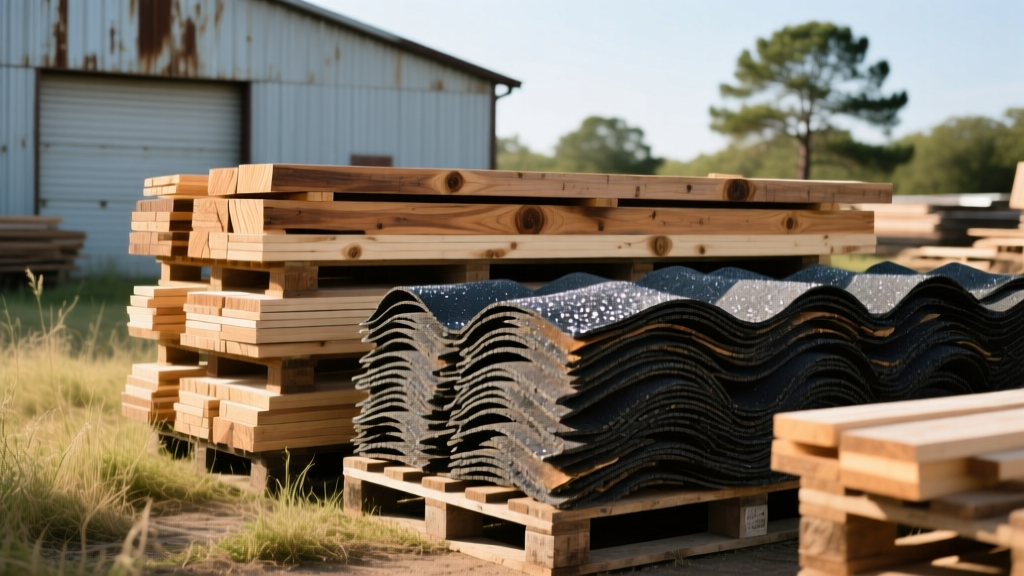
The East Texas timber industry heavily influences local surplus stock. At Adams Surplus, the dominant framing material is #2 Southern Yellow Pine (SYP). When purchasing surplus SYP, you are frequently encountering 'mill-seconds' or 'falling down' grades. These are studs and plates that failed to meet the strict visual grading criteria for #2 Prime due to wane (bark on the edge), slight crook, or blue stain (a harmless fungal discoloration), but still meet the structural load-bearing requirements outlined by the USDA Forest Products Laboratory Wood Handbook.
Actionable Tactic: Always carry a moisture meter. Surplus lumber stored in open-air Athens yards during the humid spring months can easily exceed 19% moisture content (MC). Framing with lumber above 19% MC leads to severe twisting and drywall nail-pops as the wood acclimates to the interior environment. Reject any batch that consistently reads above 15% MC for interior conditioning.
Roofing and Weatherization Surplus
Discontinued architectural shingles are a staple of the Athens surplus market. Manufacturers frequently update their color blends and shadow lines, leaving warehouses with perfectly functional but aesthetically obsolete inventory. The primary risk with surplus asphalt shingles in Texas is thermal degradation of the self-sealing strips.
If pallets of shingles were stored in an unclimate-controlled tin warehouse through a 105°F August, the heat can cause the factory-applied sealant strips to prematurely activate or melt into the release tape. According to technical bulletins from the National Roofing Contractors Association (NRCA), compromised sealant strips will result in immediate wind-uplift failures post-installation. Always pull three random bundles from the center of the pallet and verify the sealant strip is tacky but cleanly releases from the tape without tearing the fiberglass mat.
The Surplus Material Inspection Matrix
Do not rely on visual sweeps. Use this standardized inspection framework when evaluating pallets at the Athens yard to determine if the discount justifies the defect rate.
| Material Category | Critical Defect to Audit | Acceptable Tolerance (Buy) | Walk-Away Threshold (Reject) |
|---|---|---|---|
| SYP 2x4 / 2x6 Framing | End-splitting and checking | Splits less than 1/3 the board length | Splits extending past the nailing zone or accompanied by severe twist |
| 5/8" Type X Drywall | Edge crush and corner breakage | Chipped edges (can be cut off for butt joints) | Crushed paper face or moisture-swollen gypsum core |
| Architectural Shingles | Sealant strip integrity | Strip is intact, releases cleanly from tape | Sealant fused to release tape or granule loss on the strip |
| Fiberglass Batts (R-19/R-38) | Compression and moisture intrusion | Tightly compressed in original poly-wrap | Punctured poly-wrap with visible water staining or mold |
East Texas Transport and Logistics Protocols
Hauling heavy, discounted building materials out of Athens requires strict adherence to Texas Department of Transportation (TxDOT) regulations, particularly when navigating rural highways like US-175 or SH-31 back to job sites. Surplus yards often sell 24-foot or 28-foot framing lumber and LVL beams that exceed standard pickup truck beds.
Load Securement Framework:
- Strapping: Use 3,000 lb break-strength ratchet straps. Never use bungee cords or standard rope for dimensional lumber. Place a strap every 8 to 10 feet along the load.
- Edge Protection: Surplus lumber often has sharp, unfinished edges from mill-seconds. Always use plastic or rubber edge protectors under the straps to prevent cutting the webbing under highway tension.
- Weight Distribution: A pallet of 5/8" drywall weighs approximately 2,300 lbs. Ensure your truck's payload capacity (not just towing capacity) is rated for the material. Half-ton pickups are generally insufficient for palletized drywall or roofing; utilize a 3/4-ton or 1-ton dually.
Financial Modeling: Surplus vs. Traditional Supply Chains
Understanding the exact margin expansion is critical for bidding jobs accurately. Below is a comparative pricing model based on early 2026 East Texas market averages for a standard 2,500 sq. ft. residential build.
| Material Line Item | Big Box Retail Cost (Approx.) | Adams Surplus Cost (Approx.) | Net Savings per Unit |
|---|---|---|---|
| #2 SYP 2x4x8 Stud | $3.65 | $2.45 | $1.20 (32% reduction) |
| Architectural Shingles (per square) | $42.00 | $28.50 | $13.50 (32% reduction) |
| R-19 Kraft-Faced Batts (per roll) | $58.00 | $41.00 | $17.00 (29% reduction) |
Note: Surplus pricing fluctuates weekly based on mill liquidations. Always call ahead to verify stock levels for large-scale framing packages, as surplus yards rarely hold 15,000+ board feet of consistent grades in a single run.
Contractor Protocols for Liquidation Yards
Batch Matching and Aesthetics
When sourcing interior finishes like luxury vinyl plank (LVP) or ceramic tile from Adams Surplus, you must treat every pallet as a distinct dye lot. Manufacturers change dye formulations annually. If you are flooring a 1,200 sq. ft. open-concept area, you must purchase the entire square footage from the exact same pallet batch number. Mixing pallets, even if the SKU on the box is identical, will result in visible shading transitions under natural light.
Negotiating Volume and 'Dead Pallets'
Surplus yards are highly motivated to clear 'dead pallets'—materials that have sat on the lot for over 180 days. While front-line dimensional lumber moves quickly, specialized items like metal roofing flashing, specialized HVAC registers, or odd-sized structural headers often stagnate. If you are purchasing a primary framing package, leverage your total ticket size to negotiate an additional 10% to 15% off these slow-moving accessory pallets. Yard managers prefer liquidating dead stock at cost to free up forklift space for faster-moving inventory.
The Return Policy Reality
Unlike national chains that offer 90-day return windows on unopened materials, surplus liquidators operate on an 'as-is, where-is' basis. Once the material leaves the Athens property line, the risk of warping, breakage, or moisture damage transfers entirely to the contractor. Only load what your crew can use within a 14-day window. Storing surplus materials in unconditioned job-site trailers during East Texas humidity spikes will void any implicit warranty and destroy the material's integrity before installation.
Written by
Marcus ChenMarcus Chen is a licensed structural engineer (PE) and building materials analyst with over 12 years of experience across residential, commercial, and industrial construction. He holds a Master of Science in Civil Engineering from UC Berkeley and spent six years at Thornton Tomasetti before transitioning to independent consulting and technical writing. Marcus specializes in material selection for seismic-prone regions, concrete reinforcement strategies, and lifecycle cost analysis. His work has been cited by the American Concrete Institute (ACI) and the Structural Engineers Association of California (SEAOC). When he is not on a job site or at his desk, you will find him hiking the Sierra Nevada or restoring a 1920s craftsman bungalow in Oakland, CA.
More from Marcus Chen
View all
Construction Cost
How Much Did the Eiffel Tower Cost to Build?
How much did the Eiffel Tower cost to build in 1889? We adjust for inflation and compare its budget to modern skyscraper construction.
Aug 4, 2026

Fire Resistance
What Is a Fire Resistant Material? Testing & Certification Guide
Discover what is a fire resistant material through ASTM and UL testing. Learn how fire ratings, certifications, and assemblies work in construction.
Aug 4, 2026

Construction Cost
How Much Did the Burj Khalifa Cost to Build?
How much did the Burj Khalifa cost to build? We break down the $1.5B project and extract 5 money-saving strategies for your next build.
Jul 30, 2026