Sourcing Masonry: Guide to Cherokee Building Materials in Tulsa, OK
Explore our comprehensive guide to Cherokee Building Materials in Tulsa, OK. Compare masonry, stone veneer, and stucco options for your 2026 projects.

The Role of Regional Distributors in Northeast Oklahoma Construction
When planning a commercial facade or a custom residential build in Northeast Oklahoma, the selection of your exterior envelope materials dictates both the aesthetic longevity and structural resilience of the project. Cherokee Building Materials in Tulsa, OK, has established itself as a premier regional distributor specializing in masonry, natural and manufactured stone, stucco, and architectural accents. Unlike big-box home improvement centers that stock generalized inventory, specialized regional yards curate their product lines to withstand local environmental stressors—specifically the severe freeze-thaw cycles, high summer humidity, and expansive clay soils characteristic of the Tulsa metropolitan area.
This comprehensive guide breaks down the core material categories available through specialized Tulsa suppliers, provides technical selection criteria for local builders, and outlines the logistical realities of ordering heavy masonry products for job sites across Rogers, Wagoner, and Tulsa counties.
Core Product Categories and Technical Specifications
Sourcing from a dedicated masonry and stone supplier requires an understanding of the specific grades, sizes, and material compositions that perform best in Oklahoma's climate. Below is a deep dive into the primary material categories.
Brick and Clay Masonry
Clay brick remains a dominant facade choice in Tulsa due to its thermal mass and classic aesthetic. When sourcing brick, it is critical to specify the correct weathering grade. According to the Brick Industry Association, bricks are classified by their resistance to freeze-thaw cycling. For the Tulsa climate, where winter temperatures frequently fluctuate above and below freezing while the masonry is saturated, you must specify Severe Weathering (SW) grade brick. Moderate Weathering (MW) bricks are prone to spalling and face-shaling within three to five years in this region.
- Modular (4x2.25x7.625 inches): The standard for residential veneer. Yields approximately 6.86 bricks per square foot.
- Norman (4x2.25x11.625 inches): Highly popular in Tulsa custom homes for a more linear, contemporary profile. Yields 5.76 bricks per square foot.
- Jumbo / Closure (4x3.5x7.625 inches): Used heavily in commercial construction to reduce labor costs and mortar joints per square foot.
Natural and Manufactured Stone Veneer
Stone veneer applications have surged in popularity for both interior feature walls and exterior wainscoting. Regional suppliers typically stock two distinct categories:
- Natural Stone: Sourced from regional quarries, including Oklahoma fieldstone, Kansas limestone, and Arkansas sandstone. Natural stone requires a structural brick ledge or heavy-duty angle iron support due to its weight (often exceeding 35 lbs per square foot).
- Manufactured Stone Veneer (MSV): Brands like Cultured Stone or Coronado Stone offer concrete-based casts that mimic natural profiles (e.g., ledgestone, fieldstone, dry-stack). MSV weighs roughly 10-12 lbs per square foot, allowing it to be adhered directly to a properly prepared substrate (scratch coat over wire lath) without requiring foundational ledges.
Stucco and EIFS Systems
For Mediterranean, Spanish Colonial, or modern minimalist architecture, traditional Portland cement stucco and Exterior Insulation and Finish Systems (EIFS) are primary choices. The Whole Building Design Guide notes that traditional 3-coat stucco (scratch, brown, and finish) provides excellent impact resistance and breathability, which is vital for preventing trapped moisture in Tulsa's humid summers. EIFS, while offering superior R-value insulation, requires meticulous flashing and sealant detailing at all penetrations to prevent water intrusion behind the foam board.
Comparative Analysis: Exterior Cladding Materials
Choosing the right exterior cladding involves balancing upfront material costs, labor intensity, and long-term maintenance. The matrix below compares the primary materials stocked by Tulsa-area masonry distributors based on 2026 regional pricing and performance metrics.
| Material Type | Avg. Material Cost (per sq. ft.) | Weight (lbs / sq. ft.) | Installation Speed | Maintenance Requirement |
|---|---|---|---|---|
| Modular Clay Brick (SW) | $4.50 - $7.00 | 28 - 30 lbs | Moderate | Very Low |
| Natural Limestone Veneer | $12.00 - $18.00 | 35 - 45 lbs | Slow | Low (Requires Sealer) |
| Manufactured Stone (MSV) | $6.50 - $10.00 | 10 - 12 lbs | Fast | Low |
| Traditional 3-Coat Stucco | $5.00 - $8.00 | 10 - 11 lbs | Slow (Curing Time) | Moderate (Crack Repair) |
Mortar Selection and Moisture Management
The mortar used to bind masonry units is just as critical as the units themselves. A common failure mode in Tulsa masonry is the use of mortar that is harder and less permeable than the brick or stone it surrounds. When moisture enters the wall cavity and freezes, it must escape through the mortar joints. If the mortar is too rigid (e.g., a high-Portland cement Type M mix used on soft, historic-style brick), the brick faces will spall and pop off.
The 'Softer Mortar' Rule
For standard above-grade residential veneer in Oklahoma, Type N mortar (1 part Portland cement, 1 part hydrated lime, 6 parts sand) is the industry standard. It offers a good balance of compressive strength (approx. 750 psi) and flexibility. For below-grade applications, such as retaining walls or foundation piers exposed to the region's heavy spring rains, Type S mortar (higher compressive strength at 1,800 psi) is required to resist lateral soil loads and hydrostatic pressure.
Flashing and Weep Hole Architecture
According to guidelines supported by the Portland Cement Association, masonry veneer is a drainage wall system, not a barrier system. Water will penetrate the outer wythe of brick. To manage this:
- Through-Wall Flashing: Must be installed at the base of the wall, above all openings (windows/doors), and at shelf angles. Use a composite flashing material (like copper-asphalt-copper) rather than cheap peel-and-stick membranes, which degrade under the high heat loads of Oklahoma summers.
- Weep Vents: Place open-head joint weep vents every 24 inches on center along the base course. Do not use rope wicks, as they tend to clog with mortar droppings (snots) during construction, rendering the drainage system useless.
Logistics, Delivery, and Site Preparation
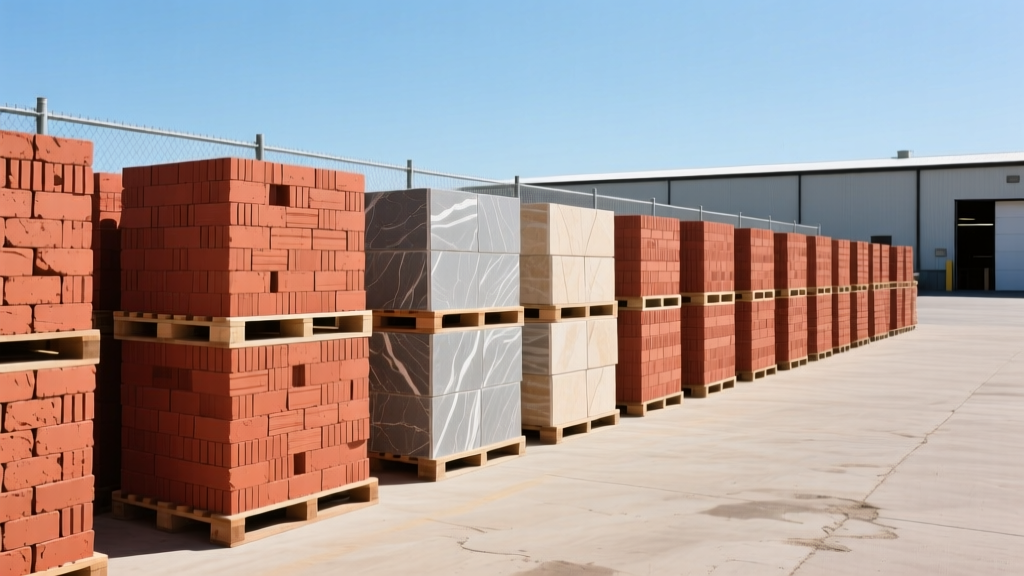
Ordering heavy masonry materials requires precise logistical planning. A standard pallet of modular brick weighs between 2,800 and 3,200 lbs. A single pallet of natural stone can exceed 4,000 lbs. Standard residential job sites in Tulsa often lack the space for 53-foot semi-trailers to maneuver.
Material Yield and Estimation Guide
Accurate estimation prevents costly mid-project delays. Use the following baseline yields when calculating material takeoffs for your Tulsa project. Always add a 5% to 8% waste factor for brick (due to cutting and breakage) and a 10% to 15% waste factor for irregular natural stone.
| Material Profile | Coverage per Pallet / Ton | Mortar Required (per 1,000 units) | Sand Required (per 1,000 units) |
|---|---|---|---|
| Modular Brick | ~340 sq. ft. (approx. 2,300 bricks) | 8.5 bags (Type N/S) | 1.5 cubic yards |
| Norman Brick | ~400 sq. ft. (approx. 2,300 bricks) | 9.0 bags (Type N/S) | 1.6 cubic yards |
| Manufactured Stone Veneer | ~100 sq. ft. per pallet (varies by profile) | N/A (Uses Type S Mortar Mix for scratch/adhesion) | N/A |
| Natural Flagstone / Veneer | ~60 sq. ft. per ton (1.5" thickness) | N/A (Set on mud-bed or adhered) | N/A |
Frequently Asked Questions (FAQ)
Can I pick up materials directly from the yard, or is delivery mandatory?
While specialized masonry yards primarily operate as wholesale distributors for contractors, many allow direct pickup for smaller residential projects. However, you must bring a heavy-duty flatbed truck or trailer capable of handling 3,000+ lb pallets. Standard half-ton pickup trucks (like a Ford F-150 or Chevy Silverado 1500) are not rated for a full pallet of brick and will suffer severe suspension and braking damage. A 3/4-ton or 1-ton truck with a dual-axle trailer is the minimum requirement for safe transport.
How far in advance should I order custom brick blends or specific stone profiles?
For standard inventory (common reds, tans, and standard manufactured stone profiles), materials are usually available for next-day delivery. However, if your architectural plans specify a custom brick blend, a specific Oklahoma limestone cut, or a specialized EIFS finish color, lead times can range from 4 to 8 weeks. Kiln-fired clay brick production runs are scheduled months in advance, so early procurement during the design phase is highly recommended to avoid stalling the framing and exterior envelope schedule.
"The success of any masonry project in Oklahoma relies heavily on the relationship between the builder and the local supplier. Regional yards provide the technical submittals, ASTM testing data, and mortar mix designs that big-box stores simply cannot offer."
Written by
Sarah WhitfieldSarah Whitfield is a chartered quantity surveyor (MRICS) and construction cost analyst with 15 years of experience in material pricing, procurement strategy, and project budgeting. She earned her degree in Construction Management from the University of Reading (UK) and has worked on projects ranging from $2M custom homes to $180M mixed-use developments across North America and Europe. Sarah currently leads cost estimating for BuildMat Insight, maintaining a proprietary database of 4,000+ material price points updated quarterly. She is a frequent contributor to RSMeans cost data panels and has presented at the International Cost Engineering Council (ICEC) congress. Based in Denver, CO, Sarah is an avid trail runner and volunteer mentor for Women in Construction.
More from Sarah Whitfield
View all
Wood & Lumber
What Are the Different Types of Wood? A Builder's Guide
Compare structural softwoods, finish hardwoods, and engineered lumber. Analyze Janka ratings, MOE values, and 2026 pricing for construction.
Aug 4, 2026

Walls & Panels
Steel Framing vs Wood Framing: Corrosion and Moisture Defense
Compare steel framing vs wood framing for moisture resistance. Learn about galvanized coatings, condensation risks, and corrosion protection strategies.
Jul 21, 2026

Stone & Masonry
How to Cut Stone Veneer: Wet Saw vs Grinder Comparison
Compare the best tools for cutting stone veneer. We review wet saws, angle grinders, and chop saws to help you achieve clean, chip-free cuts.
Jul 21, 2026