Evaluating the Quality of Building Materials: Technical Spec Guide
Learn how to evaluate the quality of building materials using ASTM and ISO technical specifications, testing standards, and compliance frameworks.

The Hidden Cost of Substandard Material Specs
Procuring construction materials based solely on nominal dimensions or manufacturer marketing claims is a primary driver of premature structural degradation and project delays. With global supply chain shifts stabilizing in 2026, procurement officers are seeing an influx of alternative-origin materials that meet basic dimensional tolerances but fail under rigorous environmental or seismic stress. Evaluating the true quality of building materials requires moving beyond visual inspections and relying on verifiable technical specifications, mill test reports, and standardized testing protocols.
Core Technical Frameworks for Material Verification
To systematically assess material quality, engineers and procurement teams must anchor their specifications to recognized consensus standards. The ASTM International standards database provides the foundational metrics for structural integrity, chemical composition, and environmental resilience.
Structural Steel and Rebar: ASTM A615 vs. ASTM A706
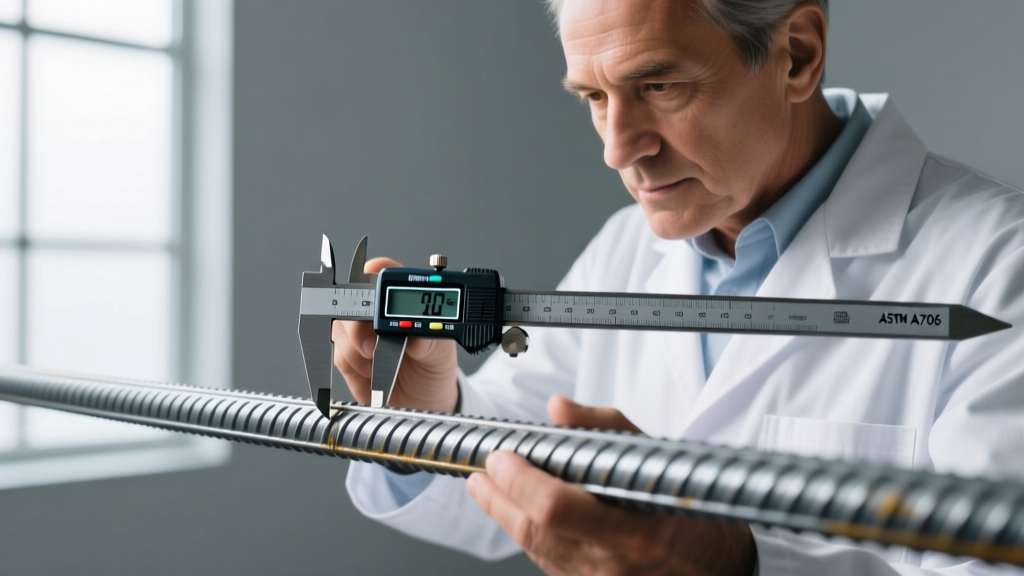
A common failure in material procurement is substituting ASTM A615 rebar where ASTM A706 is specified. While both are used for concrete reinforcement, their technical profiles dictate vastly different performance outcomes under stress.
- ASTM A615 (Standard Carbon Steel): Offers high yield strength (typically 60 ksi or 80 ksi) but lacks strict limits on carbon content. This makes it brittle and highly susceptible to cracking during field welding or severe seismic events.
- ASTM A706 (Low-Alloy Steel): Specifically engineered for seismic resistance and weldability. It restricts the carbon equivalent (CE) to a maximum of 0.55% and mandates a minimum tensile-to-yield strength ratio of 1.25. This ensures the steel will yield and deform plastically, absorbing seismic energy rather than snapping catastrophically.
Actionable Spec: For any moment-resisting frames or structural elements requiring field welding, explicitly specify ASTM A706 Grade 60. Reject A615 substitutions unless a structural engineer recalculates the weldability and ductility requirements.
Portland Cement and Concrete Mixes: Decoding ASTM C150
Cement quality is not a monolith; it is defined by its chemical compound ratios. According to the Portland Cement Association, specifying the correct cement type prevents sulfate attack and controls heat generation during the curing process.
- Type I/II: The standard for general construction. Type II includes a limit on Tricalcium Aluminate (C3A) content (typically under 8%), providing moderate sulfate resistance crucial for foundations in soils with high sulfate concentrations.
- Type III: High early-strength cement. It is ground much finer, accelerating the hydration process. While useful for precast concrete or cold-weather pours, using Type III in mass concrete pours (like large mat foundations) will cause thermal cracking due to excessive heat of hydration.
Material Verification Matrix
Use the following matrix to establish minimum acceptable thresholds during the submittal review process.
| Material Category | Governing Standard | Critical Quality Metric | Minimum Acceptable Threshold / Limit |
|---|---|---|---|
| Weldable Rebar | ASTM A706 | Carbon Equivalent (CE) | 0.55% maximum |
| Structural Steel Plate | ASTM A572 Gr 50 | Minimum Yield Strength | 50,000 psi (345 MPa) |
| Portland Cement (Sulfate Resisting) | ASTM C150 Type V | Tricalcium Aluminate (C3A) | 5.0% maximum |
| Rigid Foam Insulation | ASTM C578 Type IV | Compressive Resistance | 25 psi minimum at 10% deflection |
| Acoustic Insulation Batts | ASTM E90 | Sound Transmission Class (STC) | STC 45+ (assembly dependent) |
Decoding Mill Test Reports (MTRs) and Certificates of Compliance
A Certificate of Compliance (CoC) is merely a manufacturer's promise that the material meets the spec. An MTR is the empirical proof. When evaluating the quality of building materials like structural steel, aluminum, or specialized alloys, the MTR is your primary defense against counterfeit or out-of-spec imports.
How to Audit an MTR in 4 Steps:
- Verify the Heat Number: The heat number stamped on the physical material must perfectly match the heat number on the MTR. If they do not match, the material is untraceable and must be rejected.
- Check Chemical Composition: Cross-reference the MTR's elemental breakdown (Carbon, Manganese, Phosphorus, Sulfur) against the ASTM standard limits. Pay special attention to Phosphorus and Sulfur, which should generally be kept below 0.04% to prevent cold and hot shortness.
- Validate Mechanical Properties: Ensure the reported yield strength, tensile strength, and elongation percentages meet or exceed the project specifications.
- Confirm the Testing Facility: Ensure the tests were performed by an ISO/IEC 17025 accredited laboratory, not just an in-house quality desk.
Non-Destructive Testing (NDT) for On-Site Quality Assurance
Even with perfect paperwork, materials can be damaged in transit or substituted on the job site. The National Institute of Standards and Technology (NIST) emphasizes the importance of field verification. Implementing NDT protocols ensures the material in situ matches the material on paper.
- Schmidt Hammer (Rebound Hardness Test): Used on cured concrete to estimate compressive strength. While not a replacement for cylinder break tests (ASTM C39), a rebound value consistently below 30 on a standard N-type hammer indicates potential under-strength concrete requiring core sampling.
- Ultrasonic Pulse Velocity (UPV): Measures the transit time of acoustic waves through concrete or timber. High velocity indicates dense, uniform material, while sudden drops in velocity reveal internal voids, honeycombing, or delamination.
- Positive Material Identification (PMI): Utilizing portable X-ray Fluorescence (XRF) analyzers to instantly verify the alloy composition of stainless steel piping or structural connections on-site, ensuring a 304 stainless pipe wasn't accidentally swapped with a less corrosion-resistant 201 alloy.
"In modern construction, the assumption of quality is a critical vulnerability. The most robust technical specifications are worthless if the site receiving protocol does not include empirical verification of the delivered heat numbers and physical properties."
— Structural Forensics Division, Building Materials Research Institute
Thermal and Acoustic Insulation: Beyond the R-Value
When assessing the quality of building materials for the building envelope, insulation is frequently reduced to a single metric: the R-value. However, technical specifications demand a broader view of material performance under real-world conditions.
For rigid foam boards (ASTM C578), the compressive strength is just as critical as thermal resistance when used under slabs or in plaza decks. A high R-value is irrelevant if the material crushes under the hydrostatic pressure of a concrete pour, losing its dimensional stability and creating thermal bridges.
Similarly, for acoustic materials, evaluating quality requires looking at the Sound Transmission Class (STC) and Impact Insulation Class (IIC) ratings tested under ASTM E90 and ASTM E492. High-density mineral wool batts (typically 2.5 to 8.0 pcf) provide superior acoustic damping compared to standard fiberglass (0.5 to 1.2 pcf), but they also require specific vapor permeability checks to ensure they do not trap moisture within the wall cavity.
Actionable Procurement Checklist for 2026 Projects
To institutionalize the evaluation of material quality, integrate the following requirements into all vendor contracts and submittal workflows:
- Specify by Standard, Not Brand: Write specs using 'ASTM [Standard Number], [Grade/Type]' followed by 'or approved equivalent that meets all listed physical and chemical properties.' This prevents vendors from substituting lower-tier proprietary products.
- Mandate MTRs at Delivery: Include a clause that material offloading will not commence until the delivery driver provides physical or digital MTRs matching the purchase order heat/lot numbers.
- Require Third-Party Submittals: For critical envelope and structural components, require test reports from independent, accredited labs (e.g., Intertek, UL, SGS) dated within the last 24 months.
- Establish a Rejection Protocol: Define clear financial penalties and return-logistics responsibilities for vendors who deliver materials failing site NDT or visual inspection (e.g., rusted rebar exceeding ASTM A615 surface rust allowances, or cement bags showing signs of pre-hydration).
By anchoring procurement and site-receiving protocols to rigorous technical specifications, project teams eliminate the ambiguity that leads to structural compromises, ensuring the built environment performs exactly as engineered.
Written by
James ThorntonJames Thornton is a construction industry veteran with 25 years of hands-on experience in wood framing, lumber grading, and residential building codes. He started as a framing carpenter in rural Oregon, earned his ICC Residential Building Inspector certification, and eventually became a senior plan reviewer for the City of Portland Bureau of Development Services. James holds a B.S. in Wood Science & Technology from Oregon State University and is a certified lumber grader through the West Coast Lumber Inspection Bureau (WCLIB). He has inspected over 3,000 residential construction sites and authored the city's internal guide on advanced framing techniques (2x6 at 24" O.C.). James lives in Bend, OR, where he builds custom timber-frame cabins and competes in lumberjack sports.
More from James Thornton
View all
Insulation
Best Home Insulation Materials: Complete 2026 Guide
Compare top home insulation materials for 2026. Find R-values, installed costs per square foot, and best uses for fiberglass, spray foam, and mineral wool.
Aug 4, 2026

Sustainable Building
Certify Your Green Building Material for LEED and WELL
Step-by-step guide to certifying a green building material for LEED v5 and WELL v2. Master EPDs, HPDs, and VOC limits for 2026 project specifications.
Aug 4, 2026

Stone & Masonry
Veneer Stacked Stone Panels: Interior Design & Style Showcase
Discover how veneer stacked stone panels transform interiors. Explore modern design profiles, material pairings, and technical installation specs.
Aug 4, 2026