Natural Building Materials Cost Analysis & ROI 2026
Compare the 2026 costs of natural building materials like hempcrete, rammed earth, and straw bale. Analyze upfront pricing, labor, and long-term ROI.
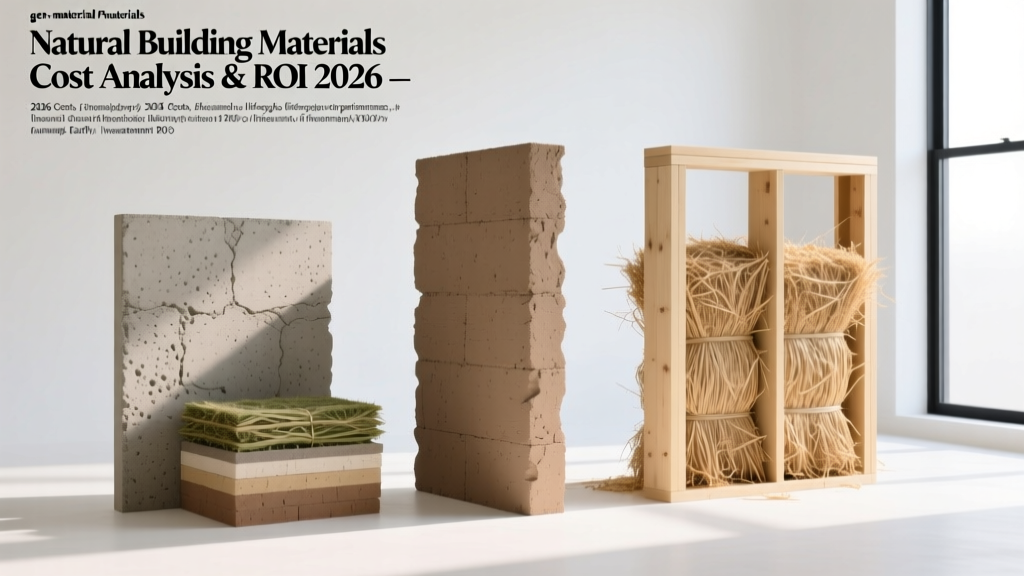
The True Economics of Natural Building Materials
The economic calculus for natural building materials has fundamentally shifted in 2026. Driven by stringent embodied carbon regulations, expanded domestic hemp processing infrastructure, and a severe shortage of skilled conventional framers, biogenic materials are no longer just niche ecological choices—they are competitive financial assets. However, evaluating the cost of natural building materials requires moving beyond simple price-per-square-foot metrics. Builders and architects must account for specialized labor premiums, alternative code compliance engineering, and the substantial downstream ROI generated by thermal mass and HVAC downsizing.
2026 Cost Snapshot: Natural vs. Conventional
Conventional Wood Framing (2x6 + Batt Insulation): $14.00 – $18.50 / sq ft (wall assembly)
Natural Materials Average: $22.00 – $38.00 / sq ft (wall assembly)
HVAC Downsizing Savings: $4,500 – $9,000 per 2,500 sq ft home
Embodied Carbon Reduction: 40% – 85% compared to baseline IECC code builds
Upfront Material & Labor Costs by Assembly Type
Hempcrete (Hemp-Lime Bio-Composite)
Hempcrete is a non-load-bearing insulating infill cast around a structural frame (typically timber or light-gauge steel). In 2026, domestic hemp hurd supply chains have stabilized, dropping raw material costs, but the price of natural hydraulic lime (NHL) binders remains sensitive to European import tariffs and energy costs.
- Material Costs: Raw hemp hurd costs $420 to $550 per ton. A standard 1:4 mix ratio (one part NHL 3.5 binder to four parts hurd by volume) yields a material cost of approximately $3.80 to $5.20 per square foot of wall area (assuming a 12-inch thickness).
- Labor Costs: This is the primary cost driver. Hand-tamping hempcrete into temporary formwork requires 0.15 to 0.20 labor hours per square foot. At prevailing 2026 prevailing wage rates of $65/hour for specialized masons, labor adds $9.75 to $13.00 per square foot.
- Total Assembly Cost: $24.00 – $32.00 per square foot (excluding the structural frame and exterior cladding).
Rammed Earth Construction
Rammed earth utilizes a damp mixture of subsoil (typically 70% aggregate, 30% clay/silt) stabilized with 5% to 8% Portland cement or a geopolymer alternative, compacted inside engineered formwork. The material itself is often sourced directly from the excavation site, rendering raw material costs negligible.
- Material Costs: $0.50 – $1.50 per square foot (accounting only for the cement stabilizer and formwork release agents). Site-sourced soil must pass rigorous sieve and Atterberg limits testing, which costs roughly $1,200 per geotechnical report.
- Labor & Formwork Costs: Formwork erection and pneumatic tamping are intensely laborious. A crew of four can typically complete 150 to 200 square feet of wall per day. Labor and equipment amortization drive costs to $18.00 – $26.00 per square foot.
- Total Assembly Cost: $28.00 – $42.00 per square foot for an 18-inch thick structural wall.
Straw Bale Infill
Straw bale construction utilizes tightly compressed agricultural byproducts as wall infill, finished with a breathable lime or earthen plaster. It offers the highest R-value per dollar of any natural material but demands meticulous moisture management.
- Material Costs: Three-string bales (24" x 16" x 42") cost $12 to $18 each in 2026, translating to roughly $1.20 to $1.80 per square foot of wall. The true material expense lies in the plaster: a three-coat natural hydraulic lime plaster system adds $4.50 to $6.00 per square foot in raw materials (lime, sand, and fiberglass mesh).
- Labor Costs: Stacking and pinning bales is fast, but applying and curing three coats of plaster over a 3-week period requires $12.00 to $16.00 per square foot in skilled labor.
- Total Assembly Cost: $21.00 – $28.00 per square foot.
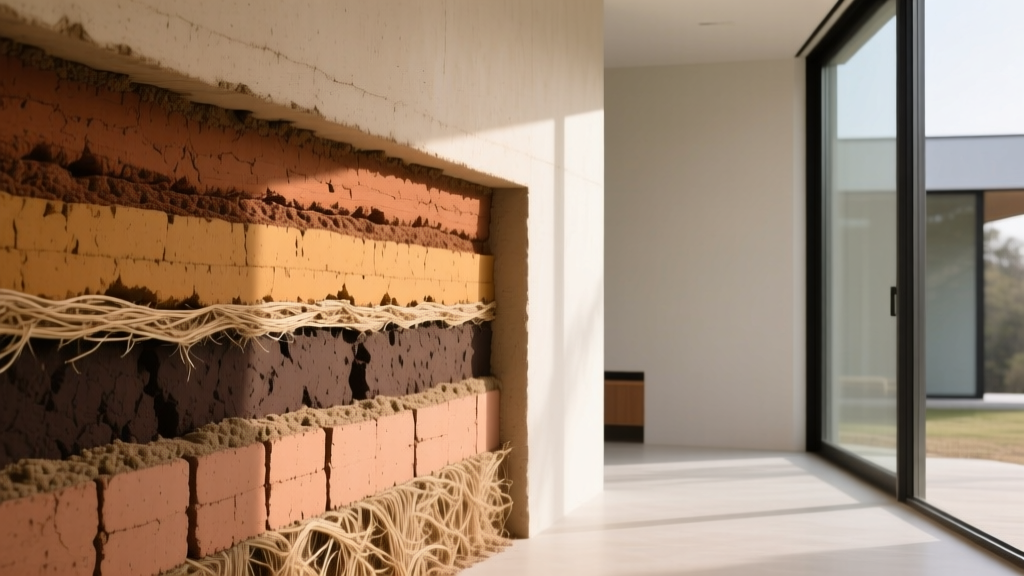
Comparative Cost & Performance Matrix
| Material Assembly | Total Cost / Sq Ft | Effective R-Value | Embodied Carbon | Load-Bearing? |
|---|---|---|---|---|
| Hempcrete (12") | $24 - $32 | R-24 to R-28 | Carbon Negative | No (Infill) |
| Rammed Earth (18") | $28 - $42 | R-3 to R-5 (High Mass) | ~85 kgCO2e/m2 | Yes |
| Straw Bale (24" + Plaster) | $21 - $28 | R-30 to R-45 | Carbon Negative | Yes (Limited) |
| Expanded Cork Board (4") | $16 - $22 | R-15 to R-17 | Carbon Negative | No (Insulation) |
Hidden Costs and Failure Modes in Natural Builds
Budget overruns in natural construction rarely stem from the raw materials; they originate from regulatory friction and moisture mismanagement. When underwriting a project, allocate contingency funds for the following specific edge cases:
- Alternative Means and Methods Engineering: While the International Residential Code (IRC) includes Appendix S for straw bale and Appendix V for natural building, many municipal building departments still require stamped structural calculations for hempcrete or rammed earth assemblies. Expect to pay a specialized structural engineer $4,500 to $8,500 to generate compliance documentation that satisfies local plan reviewers.
- Moisture Trapping in Hempcrete: Hempcrete is highly vapor-permeable. If a contractor mistakenly applies an impermeable acrylic stucco or standard Portland cement plaster to the exterior, moisture will trap inside the wall cavity, leading to biodegradation of the hemp hurd. Always specify a minimum 3-coat NHL (Natural Hydraulic Lime) plaster system, which adds roughly $2.50 per square foot compared to synthetic stucco but prevents catastrophic wall failure.
- Rammed Earth Cold Joints: If a rammed earth crew fails to complete a continuous lift before the underlying layer begins to cure, a "cold joint" forms. This structural weakness requires expensive epoxy injection or localized demolition and re-tamping, costing upwards of $150 per linear foot to remediate.
Long-Term ROI: Energy Savings and Lifecycle Analysis
The upfront premium of natural building materials is frequently offset by operational savings and regulatory incentives. According to the U.S. Department of Energy, high-thermal-mass materials like rammed earth and hempcrete absorb solar heat during the day and release it at night, flattening the building's thermal load profile.
"In passive solar designs, integrating high-mass natural walls can reduce peak heating and cooling loads by up to 25%, allowing for significantly smaller, less expensive HVAC equipment."
HVAC Downsizing: A 3,000-square-foot home built with a 12-inch hempcrete envelope and optimized passive solar orientation typically requires 20% to 30% less HVAC tonnage than a code-minimum wood-framed home. In 2026, with the average installed cost of a high-efficiency cold-climate heat pump sitting at $3,800 per ton, reducing the system size by just 2 tons yields an immediate capital savings of $7,600—effectively neutralizing the material premium of the hempcrete walls.
Carbon Credits and LEED Certification: For commercial developers, the use of biogenic materials directly impacts the bottom line through green building certifications. The U.S. Green Building Council (USGBC) awards substantial points under the LEED v4.1 Building Product Disclosure and Optimization credits for materials with verified Environmental Product Declarations (EPDs) that demonstrate carbon sequestration. This can increase the asset's appraised value by 3% to 7% and unlock favorable green financing rates.
Decision Framework: When to Specify Natural Materials
Use this practical matrix to determine if a natural material aligns with your project's financial and physical constraints:
- Specify Hempcrete IF: You are building in a humid or mixed-humid climate (Zones 3-5) where vapor permeability is critical to prevent mold, and you have access to a specialized plastering crew within a 100-mile radius.
- Specify Rammed Earth IF: You are in an arid or high-desert climate with extreme diurnal temperature swings (e.g., New Mexico, Arizona), the site soil passes geotechnical testing, and the architectural design leverages exposed thermal mass for passive solar heating.
- Specify Straw Bale IF: The project is a rural or owner-builder residence where labor costs can be offset by sweat equity, local agricultural byproducts are abundant, and the budget strictly prohibits the high formwork costs of rammed earth.
- AVOID Natural Assemblies IF: The project is a multi-story commercial build with strict floor-area-ratio (FAR) constraints. The 12-to-24-inch thickness of natural walls consumes rentable square footage that typically cannot be financially justified in high-density urban zones.
Written by
Elena RodriguezElena Rodriguez is a civil engineer and technical writer specializing in concrete technology, masonry systems, and ASTM/ACI compliance. She earned her B.S. in Civil Engineering from Texas A&M University and spent a decade at a materials testing laboratory, performing over 2,000 concrete compressive strength tests and masonry prism evaluations. Elena is an ACI-certified Field Testing Technician (Grade I) and a member of ASTM Committee C12 on Natural Building Stone. She currently consults on forensic engineering cases involving concrete failures and moisture intrusion. Based in San Antonio, TX, Elena is a proud member of the Society of Women Engineers (SWE) and coaches her daughter's FIRST Robotics team.
More from Elena Rodriguez
View all
Walls & Panels
Cost Analysis: Light Gauge Steel Framing Advantages and Disadvantages
Evaluate light gauge steel framing advantages and disadvantages through a strict cost analysis lens, comparing material, labor, and lifecycle expenses.
Aug 4, 2026

Walls & Panels
Gypsum Board Types: Exact Specifications, Thickness & Dimensions
Compare standard, Type X, and moisture-resistant gypsum board types. Get exact specifications, thicknesses, dimensions, and ASTM standards for your project.
Aug 4, 2026

Fire Resistance
Best Fire-Resistant Outdoor Decking Materials: 2026 Buyer Guide
Discover the best fire-resistant outdoor decking materials for 2026. Compare Class A PVC, aluminum, and hardwood options for WUI compliance and safety.
Aug 4, 2026