Hempcrete Building Materials vs Standard Insulation: 2026 Review
Compare hempcrete building materials against fiberglass and spray foam. Analyze 2026 R-values, installed costs, embodied carbon, and moisture risks.

The Core Dilemma: Bio-Based Mass vs. Synthetic Trapped Air
Specifying wall assemblies in 2026 requires balancing steady-state thermal resistance with dynamic hygrothermal performance and embodied carbon. Hempcrete building materials—a biocomposite of hemp hurd (shiv), a lime-based binder, and water—fundamentally alter this calculus. Unlike traditional insulation that relies on trapped gas or air pockets to resist heat flow, hempcrete functions as a lightweight, breathable thermal mass. This comparison evaluates cast-in-place hempcrete against standard cavity insulation (fiberglass batts and closed-cell spray foam) across thermal metrics, installed economics, moisture management, and lifecycle carbon.
Thermal Performance: Steady-State R-Value vs. Dynamic Thermal Lag
When evaluating insulation, architects typically default to steady-state R-values measured under ASTM C518 standards via the US Department of Energy. However, comparing hempcrete solely on this metric misrepresents its field performance.
The R-Value Reality Check
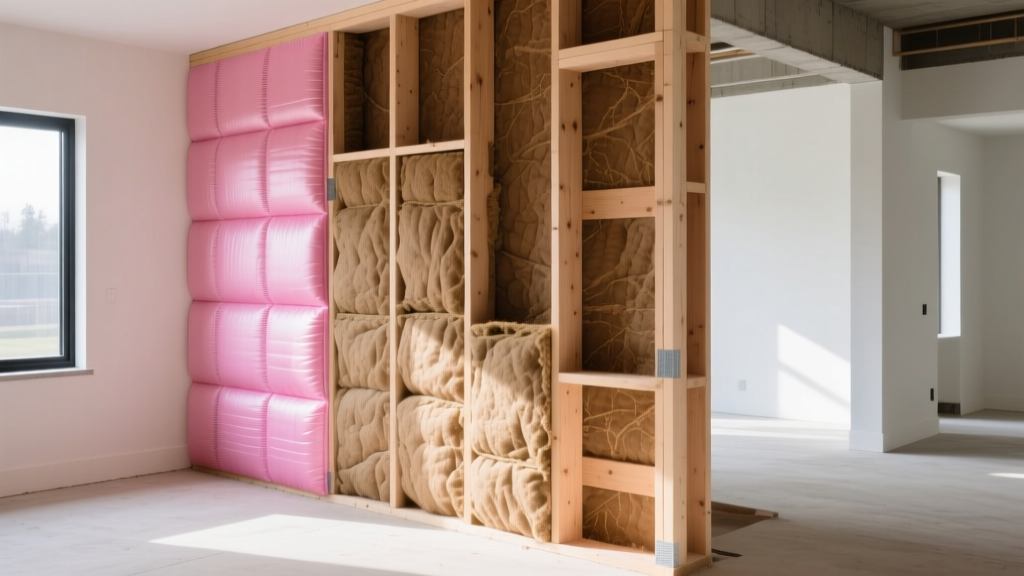
- Cast-in-Place Hempcrete: Yields an R-value of 2.4 to 2.8 per inch. A standard 10-inch thick hempcrete wall achieves an R-24 to R-28 cavity rating.
- Fiberglass Batts (High-Density): Yields R-3.7 to R-4.3 per inch. A 5.5-inch 2x6 cavity achieves R-20 to R-23.
- Closed-Cell Spray Foam (ccSPF): Yields R-6.5 to R-7.0 per inch. A 5.5-inch cavity achieves R-35 to R-38.
While ccSPF wins the raw R-value contest, hempcrete possesses a specific heat capacity of roughly 1,000 to 1,500 J/(kg·K). This high thermal mass creates a significant thermal lag (phase shift). In climates with high diurnal temperature swings, a 10-inch hempcrete wall delays peak heat transfer by 8 to 12 hours, effectively shifting cooling loads to nighttime and reducing peak HVAC sizing requirements by up to 30% compared to a lightweight fiberglass assembly.
2026 Installed Cost Breakdown
Hempcrete building materials carry a premium in material and labor costs, primarily due to specialized mixing equipment and the lack of scaled, automated installation crews in most North American markets. The table below reflects Q1 2026 national average installed costs for a standard single-story residential wall assembly (per square foot of wall area).
| Wall System | Material Cost / sq ft | Labor Cost / sq ft | Total Installed | Assembly Thickness |
|---|---|---|---|---|
| Cast-in-Place Hempcrete (Lime Binder) | $4.50 - $5.50 | $6.00 - $8.50 | $10.50 - $14.00 | 10 - 12 inches |
| Fiberglass Batt (2x6 Framing) | $0.85 - $1.10 | $1.15 - $1.50 | $2.00 - $2.60 | 5.5 inches (cavity) |
| Closed-Cell Spray Foam (2x6 Framing) | $2.20 - $2.80 | $1.50 - $2.00 | $3.70 - $4.80 | 5.5 inches (cavity) |
Hygrothermal Behavior and Moisture Failure Modes
The most critical differentiator between hempcrete and synthetic insulation is vapor permeability. Hempcrete is highly vapor-open (typically 5 to 15 perms depending on density and finish), allowing it to act as a moisture buffer.
WUFI Modeling and Liquid Water Tolerance
Hygrothermal modeling (using WUFI software) demonstrates that hempcrete can absorb and desorb significant amounts of water vapor without structural degradation. If a bulk water leak occurs within a wall cavity:
- Fiberglass: Traps liquid water, compresses, loses up to 50% of its R-value, and promotes mold growth on adjacent wood framing.
- ccSPF: Sheds water but traps it against the wood substrate, accelerating localized rot if the leak is concealed.
- Hempcrete: Absorbs the moisture, distributes it through its capillary network, and safely dries to the interior or exterior once the leak is fixed, provided the wall is finished with vapor-permeable lime or clay plasters.
Embodied Carbon and Lifecycle Analysis
As regulatory frameworks tighten around embodied carbon (such as the Buy Clean initiatives and LEED v5 material credits), hempcrete building materials offer a distinct advantage. According to lifecycle assessments tracked by the EPA's Sustainable Materials Management program, reducing the carbon footprint of building envelopes is paramount.
Hemp sequesters approximately 1.7 kg of CO2 per kg of harvested hurd. While the calcination of limestone to produce the lime binder emits CO2, the binder reabsorbs CO2 as it carbonates back into calcium carbonate over the life of the building. The net result is a carbon-negative wall assembly, typically sequestering 20 to 35 kg of CO2e per square meter of wall. Conversely, ccSPF relies on petrochemical plastics and hydrofluoroolefin (HFO) blowing agents. Although modern HFOs have a drastically lower Global Warming Potential (GWP < 1) than legacy HFCs, the foam remains a high-embodied-carbon, non-recyclable petroleum product.
Decision Framework: When to Specify Hempcrete
Hempcrete is not a universal replacement for all insulation. Use the following framework to determine specification viability for your project:
Specify Hempcrete When:
- The project targets rigorous carbon-neutral or Living Building Challenge certifications.
- The climate features high diurnal temperature swings (e.g., high desert, Mediterranean) where thermal mass reduces HVAC loads.
- The design utilizes a heavy timber frame or post-and-beam structure that requires non-structural, breathable infill.
- Interior air quality and humidity buffering (maintaining 40-60% RH naturally) are primary health priorities.
Specify Fiberglass or Mineral Wool When:
- The budget is strictly constrained, and wall assembly costs must remain below $3.00/sq ft.
- The project is a high-density, multi-family wood-frame build requiring rapid enclosure and immediate drywall installation.
- The design relies on standard 2x6 advanced framing with exterior continuous mineral wool insulation to manage thermal bridging.
Sourcing and Mix Specifications
For cast-in-place applications, specify a binder formulated specifically for hemp, such as Tradical PF70 or a St Astier NHL 3.5 natural hydraulic lime mixed with metakaolin. Standard Portland cement must be avoided; its high compressive strength and low vapor permeability will trap moisture and degrade the hemp hurd over time. The optimal mix ratio by volume is 1 part lime binder to 1.5 or 2 parts hemp hurd, mixed in a horizontal pan mixer to ensure uniform coating without crushing the hurd's cellular structure. Target a tamped density of 20 to 25 lbs/cu ft (320 to 400 kg/m³) to balance structural cohesion with optimal thermal resistance.
Written by
Elena RodriguezElena Rodriguez is a civil engineer and technical writer specializing in concrete technology, masonry systems, and ASTM/ACI compliance. She earned her B.S. in Civil Engineering from Texas A&M University and spent a decade at a materials testing laboratory, performing over 2,000 concrete compressive strength tests and masonry prism evaluations. Elena is an ACI-certified Field Testing Technician (Grade I) and a member of ASTM Committee C12 on Natural Building Stone. She currently consults on forensic engineering cases involving concrete failures and moisture intrusion. Based in San Antonio, TX, Elena is a proud member of the Society of Women Engineers (SWE) and coaches her daughter's FIRST Robotics team.
More from Elena Rodriguez
View all
Walls & Panels
Cost Analysis: Light Gauge Steel Framing Advantages and Disadvantages
Evaluate light gauge steel framing advantages and disadvantages through a strict cost analysis lens, comparing material, labor, and lifecycle expenses.
Aug 4, 2026

Walls & Panels
Gypsum Board Types: Exact Specifications, Thickness & Dimensions
Compare standard, Type X, and moisture-resistant gypsum board types. Get exact specifications, thicknesses, dimensions, and ASTM standards for your project.
Aug 4, 2026

Fire Resistance
Best Fire-Resistant Outdoor Decking Materials: 2026 Buyer Guide
Discover the best fire-resistant outdoor decking materials for 2026. Compare Class A PVC, aluminum, and hardwood options for WUI compliance and safety.
Aug 4, 2026