Jenny Building Material Cladding: Specs and Install Guide
Explore the Jenny Building Material cladding lineup. This guide covers fiber-cement specs, engineered wood costs, and step-by-step installation for 2026.

Understanding the Jenny Building Material Product Line
When specifying exterior cladding and structural sheathing for residential and light commercial projects in 2026, the Jenny Building Material lineup offers a distinct balance of durability, fire resistance, and aesthetic versatility. Unlike generic big-box alternatives, Jenny's proprietary manufacturing process utilizes a high-density autoclave curing method, resulting in fiber-cement and engineered wood composites that consistently outperform standard market offerings in impact resistance and moisture mitigation. This comprehensive guide details the technical specifications, structural requirements, and exact installation protocols for their flagship exterior products.
JennyCore Fiber-Cement vs. JennyWood Engineered Composites
The primary decision point for architects and builders is selecting between the JennyCore fiber-cement series and the JennyWood engineered composite line. JennyCore relies on a Portland cement, silica sand, and cellulose fiber matrix, delivering a Class A fire rating and exceptional dimensional stability in high-humidity environments. Conversely, JennyWood utilizes a proprietary resin-impregnated wood strand technology that offers superior thermal insulation (R-value of 0.85 per inch) and a lighter weight profile, reducing structural framing loads by up to 18% compared to traditional fiber-cement.
| Product Line | Material Composition | Thickness | Fire Rating | Est. Material Cost (per sq. ft.) |
|---|---|---|---|---|
| JennyCore Lap Siding | Portland cement, cellulose | 5/16 inch | Class A (ASTM E84) | $4.50 - $5.80 |
| JennyCore Vertical Panel | Fiber-cement, silica | 1/2 inch | Class A | $6.00 - $7.25 |
| JennyWood Cedar Shake | Engineered wood composite | 5/8 inch | Class C | $5.20 - $6.50 |
| JennyShield WRB | Woven polyolefin membrane | 12 mil | N/A | $0.65 - $0.85 |
Structural Sheathing and Moisture Management
Proper moisture management is non-negotiable when installing Jenny Building Material cladding. The manufacturer explicitly requires a continuous weather-resistive barrier (WRB) behind all siding applications. While the JennyShield WRB is optimized for their cladding systems, any code-compliant membrane meeting ASTM D226 or ASTM E2556 standards is acceptable. For the Department of Energy's Building America best practices in high-moisture climates, a ventilated rain screen gap of at least 3/8 inch is highly recommended behind JennyCore panels to facilitate capillary break and vertical drying.
Cutting JennyCore fiber-cement generates respirable crystalline silica. Per OSHA Standard 1926.1153, contractors must use a polycrystalline diamond (PCD) blade attached to a HEPA-filtered dust extraction system capable of capturing 99.97% of particulates at 0.3 microns. N95 masks are insufficient; a fitted P100 half-face respirator is mandatory for operators.
Step-by-Step Installation Protocol for JennyCore Panels
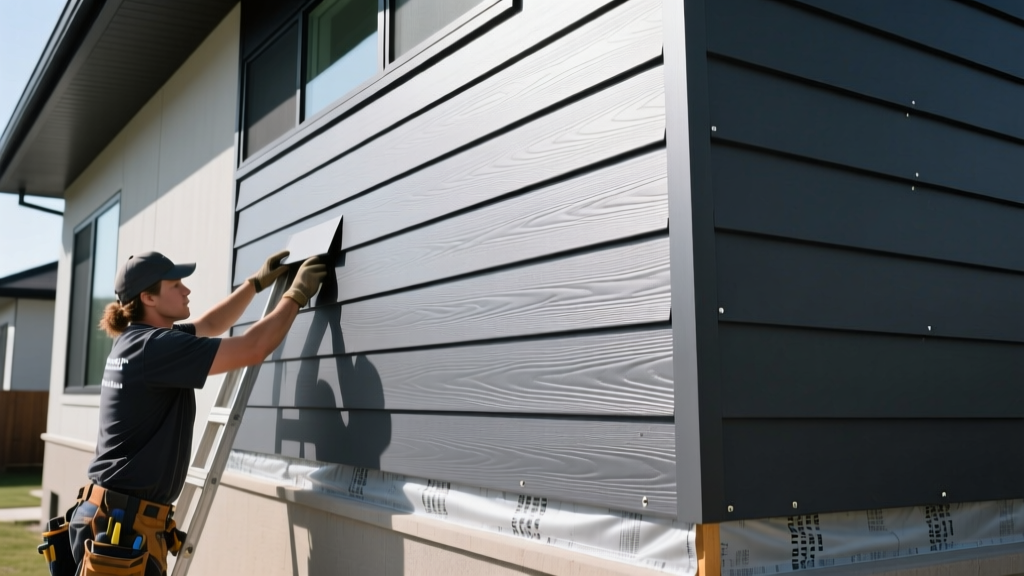
Failure to adhere to the manufacturer's exact fastening and spacing tolerances is the leading cause of warranty voidance. The following protocol applies specifically to the 5/16-inch JennyCore Lap Siding applied over standard 2x4 or 2x6 wood framing at 16 inches on center (o.c.).
- Acclimatization: Store JennyCore panels flat, off the ground, and covered with a breathable tarp for a minimum of 48 hours at temperatures above 50°F (10°C) prior to installation. This prevents post-installation thermal shock and micro-cracking.
- Flashing Integration: Install corrosion-resistant Z-flashing (minimum 26-gauge galvanized steel or 0.019-inch aluminum) at all horizontal panel joints. Do not rely on caulking at horizontal laps; flashing is mechanically required to divert bulk water.
- Fastener Selection: Use only 1-1/4 inch hot-dipped galvanized ring-shank nails (ASTM A153 Class D) or 304 stainless steel equivalents. Electroplated nails will corrode and cause rust bleeding within 18 to 24 months.
- Blind Nailing Technique: Position nails 3/4 inch to 1 inch from the top edge of the board, ensuring the nail is completely covered by the 1-1/4 inch overlap of the course above. Set the nail head flush with the surface—never drive it deeper than the surface (over-driving), which compromises the cement matrix and creates a moisture pocket.
- Expansion Gaps: Maintain a strict 1/8-inch gap at all end-to-end joints and a 3/8-inch gap at vertical abutments (corner boards, window trim). Fill these gaps with a high-grade, paintable polyurethane sealant (such as OSI QUAD Max) rather than acrylic latex, which lacks the necessary elongation properties.
Common Failure Modes and Troubleshooting
Even with premium materials like the Jenny Building Material lineup, environmental variables and installation errors can lead to specific failure modes. Identifying these early prevents catastrophic envelope degradation.
Edge Case: Efflorescence and Alkaline Burn
Efflorescence appears as a white, powdery residue on the surface of unprimed JennyCore panels. This occurs when moisture migrates through the cementitious matrix, carrying soluble salts to the surface. If left untreated and painted over, the high alkalinity (pH 11-13) will cause 'alkaline burn,' degrading the paint binder and causing premature peeling. The Fix: Dry-brush the surface, wash with a diluted muriatic acid solution (1 part acid to 10 parts water), neutralize with a baking soda rinse, and apply an alkali-resistant acrylic masonry primer within 14 days.
Edge Case: High-Wind and Seismic Zone Fastening
In regions subject to wind speeds exceeding 130 mph (Exposure D) or Seismic Design Categories D1 and D2, standard blind nailing is insufficient. Jenny Building Material requires supplemental face-nailing at the bottom edge of the lap siding using color-matched stainless steel screws (minimum #8 x 1-5/8 inch) with a neoprene washer. These fasteners must be placed exactly 1 inch from the bottom edge and 2 inches from the side edges to prevent blow-out during shear events.
Field testing by the APA Engineered Wood Association demonstrates that combining continuous exterior insulation with properly gapped fiber-cement cladding reduces thermal bridging by up to 32%, significantly lowering HVAC loads in mixed-humid climates.
Sourcing and Supply Chain Considerations for 2026
Procuring Jenny Building Material products requires strategic lead-time management. Due to the specialized autoclave curing process, JennyCore panels are manufactured in batch runs rather than continuous extrusion. For custom color-match runs or specialized architectural profiles (such as their deep-shadow bevel series), expect a 6 to 8-week lead time from the regional distribution centers. Standard 5/16-inch lap siding in the core color palette (Slate Gray, Timberline, Coastal White) is typically stocked at Tier 1 distributor yards with a 48-hour fulfillment window. Always order 12% overage for waste, cuts, and future repairs, as dye-lot variations between manufacturing batches can be visually apparent on large, sun-facing elevations.
Frequently Asked Technical Questions
Can JennyCore be installed directly over rigid foam insulation?
No. Fiber-cement requires a solid, code-compliant nailing base. If utilizing continuous exterior rigid foam (like polyiso or EPS), you must install vertical wood furring strips (minimum 1x3, pressure-treated) fastened directly into the structural studs. The JennyCore siding is then nailed through the furring strips into the studs to achieve the required withdrawal resistance of 40 lbs per fastener.
What is the required painting window for factory-primed Jenny materials?
Factory-applied primers on JennyCore products are designed as a temporary moisture barrier, not a finish coat. The topcoat of 100% acrylic latex exterior paint must be applied within 30 days of installation. UV degradation of the primer beyond 30 days compromises adhesion, requiring a full mechanical scuff-sanding and re-priming before painting.
Is JennyWood composite suitable for ground-contact applications?
JennyWood engineered composites are strictly rated for above-grade applications with a minimum 6-inch clearance from the finished soil grade and a 2-inch clearance from horizontal surfaces like decks or roofs. Ground contact will void the 30-year limited warranty due to the risk of capillary moisture uptake and subsequent freeze-thaw delamination.
Written by
Marcus ChenMarcus Chen is a licensed structural engineer (PE) and building materials analyst with over 12 years of experience across residential, commercial, and industrial construction. He holds a Master of Science in Civil Engineering from UC Berkeley and spent six years at Thornton Tomasetti before transitioning to independent consulting and technical writing. Marcus specializes in material selection for seismic-prone regions, concrete reinforcement strategies, and lifecycle cost analysis. His work has been cited by the American Concrete Institute (ACI) and the Structural Engineers Association of California (SEAOC). When he is not on a job site or at his desk, you will find him hiking the Sierra Nevada or restoring a 1920s craftsman bungalow in Oakland, CA.
More from Marcus Chen
View all
Construction Cost
How Much Did the Eiffel Tower Cost to Build?
How much did the Eiffel Tower cost to build in 1889? We adjust for inflation and compare its budget to modern skyscraper construction.
Aug 4, 2026

Fire Resistance
What Is a Fire Resistant Material? Testing & Certification Guide
Discover what is a fire resistant material through ASTM and UL testing. Learn how fire ratings, certifications, and assemblies work in construction.
Aug 4, 2026

Construction Cost
How Much Did the Burj Khalifa Cost to Build?
How much did the Burj Khalifa cost to build? We break down the $1.5B project and extract 5 money-saving strategies for your next build.
Jul 30, 2026