How to Get Building Materials in Mr. Mine vs Real Quarries
Learn how to get building materials in Mr. Mine vs real-world quarries. A 2026 guide on aggregate extraction, ASTM standards, and heavy equipment costs.

Virtual vs. Physical: The Quarry Sourcing Reality
While thousands of gamers search daily for how to get building materials in mr mine to upgrade their virtual shafts and cities, real-world construction demands a far more rigorous approach to material extraction. In the physical construction industry, "mining" for building materials means operating or sourcing from aggregate quarries, dimension stone mines, and sand pits. This application guide transitions from virtual resource management to the hard data, heavy machinery, and regulatory frameworks required to extract and procure real-world building materials in 2026.
In an idle game, you simply tap a screen to assign workers and watch stone and copper accumulate. In reality, procuring raw building materials involves geological surveying, multi-million-dollar capital expenditures, and strict adherence to federal safety standards. Whether you are a landowner looking to develop a private pit or a general contractor seeking direct-from-source aggregate procurement, understanding the physical extraction process is critical for project viability.
Step-by-Step Procurement: From Bedrock to Build Site
Sourcing raw materials directly from a mine or quarry requires a systematic approach that bridges geology, engineering, and logistics. Below is the professional framework for extracting and processing construction-grade materials.
Phase 1: Geological Core Sampling and ASTM Testing
Before any heavy machinery breaks ground, you must verify the material's structural integrity. Geologists extract diamond-drilled core samples to analyze the bedrock. For concrete aggregates, the material must pass ASTM C33 (Standard Specification for Concrete Aggregates), which tests for soundness, abrasion resistance, and deleterious substances. If you are sourcing dimension stone for architectural facades, the stone must meet ASTM C615 for granite, ensuring minimum compressive strength of 19,000 psi and water absorption rates below 0.4%.
Phase 2: Overburden Removal and Primary Extraction
Real-world mining requires stripping the "overburden"—the topsoil and subsoil layer covering the valuable rock. This is typically done using Caterpillar D8 or D9 dozers. Once the bedrock is exposed, extraction begins. Unlike the automated drills in Mr. Mine, physical quarries rely on controlled blasting. Engineers drill 3-inch to 6-inch blast holes in a precise grid pattern, loading them with ANFO (Ammonium Nitrate Fuel Oil) to fracture the rock into manageable boulders without pulverizing it into unusable dust.
Phase 3: Crushing, Screening, and Washing
Raw blasted rock is useless for construction until it is processed. The material is fed into a primary jaw crusher, then passed through secondary and tertiary cone crushers. Vibrating screen decks separate the crushed stone into specific gradations (e.g., #57 stone, crusher run, or manufactured sand). For high-specification concrete or asphalt applications, the aggregates must pass through a log washer to remove clay and silt coatings that weaken the cementitious bond.
Expert Callout: The Hidden Cost of Haul Roads
Novice quarry operators often underestimate haul road maintenance. A poorly graded haul road increases tire wear on articulated dump trucks by up to 40% and reduces fuel efficiency by 15%. In 2026, top-tier operations use automated motor grader systems with GPS machine control to maintain a precise 2% to 3% road crown, ensuring proper drainage and minimizing rolling resistance.
2026 Cost Matrix: Raw Extraction vs. Market Purchase
Deciding whether to open a captive mine for a mega-project or purchase from an established commercial quarry comes down to volume and timeline. The following table breaks down the true costs of material procurement in the current market.
| Material Type | Raw Extraction Cost (Per Ton) | Processing & Washing (Per Ton) | Delivered Market Price (Per Ton) | Primary Construction Use |
|---|---|---|---|---|
| Crushed Limestone | $3.50 - $5.00 | $6.00 - $8.50 | $14.00 - $22.00 | Road base, concrete aggregate |
| Washed River Gravel | $4.00 - $6.50 | $8.00 - $11.00 | $18.00 - $28.00 | Exposed aggregate, drainage |
| Silica Sand (Masonry) | $5.50 - $8.00 | $10.00 - $15.00 | $25.00 - $40.00 | Mortar mix, stucco base |
| Dimension Granite | $45.00 - $70.00 | $120.00 - $250.00 | $400.00 - $800.00+ | Architectural cladding, monuments |
Note: Delivered market prices assume a 25-mile haul radius. Freight costs typically add $0.15 to $0.25 per ton, per mile, making local sourcing a logistical necessity.
Heavy Machinery Specifications for Material Extraction
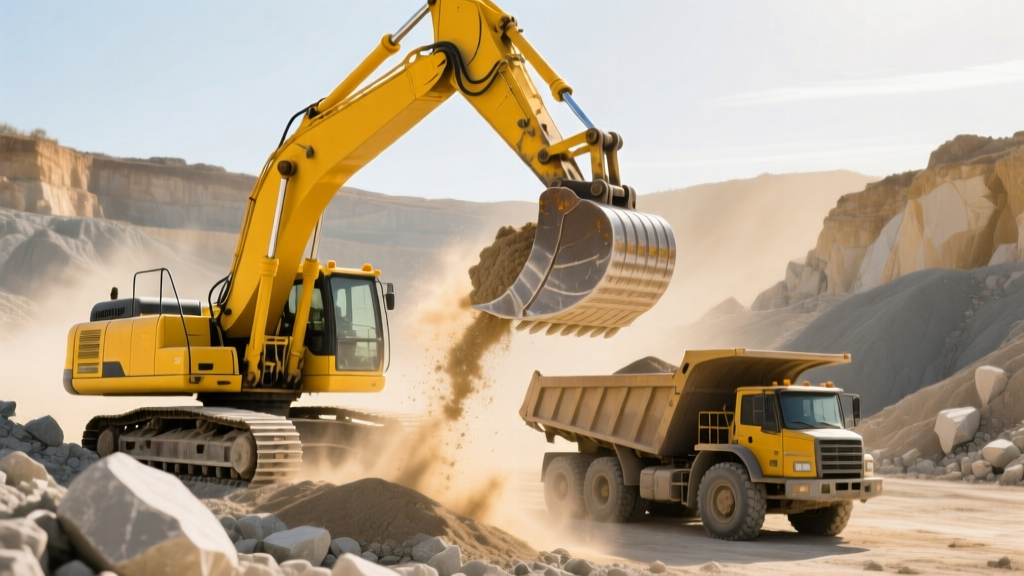
To achieve the extraction rates seen in simulation games, real-world operations rely on highly specialized, high-capacity equipment. Here is the standard fleet for a mid-sized aggregate quarry producing 500,000 tons annually:
- Primary Loading: Caterpillar 980M Wheel Loader. Features a 6.5 cubic-yard bucket and a 51,000 lb tipping load, capable of loading a 40-ton rigid frame truck in three passes.
- Haulage: Volvo A45G Articulated Hauler. With a 45-ton payload capacity and a 6-cylinder engine optimized for steep quarry gradients, it is the backbone of pit-to-plant transport.
- Primary Crushing: Metso Lokotrack LT106 Mobile Jaw Crusher. Processes up to 450 tons per hour (TPH) and features an active setting control (ASC) system that automatically adjusts the crushing gap to prevent stalling from uncrushable tramp iron.
- Drilling: Sandvik Pantera DP1500i. A top-hammer rotary percussive drill rig equipped with automated rod handling and GPS-guided navigation for precise blast hole placement.
Navigating MSHA and Environmental Regulations
Unlike the unregulated environments of mobile games, real-world mining is heavily monitored. In the United States, the Mine Safety and Health Administration (MSHA) enforces strict safety protocols under 30 CFR Part 46 and Part 48. Every worker on a quarry site must undergo 24 hours of initial training and 8 hours of annual refresher training. Furthermore, site operators must submit comprehensive ground control plans to mitigate the risk of highwall collapses and bench failures.
Environmental oversight is equally stringent. The National Stone, Sand & Gravel Association (NSSGA) advocates for sustainable mining practices, but local environmental protection agencies require operators to implement dust suppression systems (such as chemical binders and high-pressure water misting), manage stormwater runoff via retention ponds, and post multi-million-dollar reclamation bonds to guarantee site restoration post-closure.
"The transition from greenfield land to an active, permitted aggregate mine takes an average of 7 to 10 years in North America. Environmental impact studies, hydrological modeling, and community zoning hearings represent the true bottleneck in building material supply chains, not the physical extraction itself."
Strategic Sourcing for Mega-Projects
For general contractors managing infrastructure mega-projects (such as highway expansions or dam constructions), relying on spot-market purchases is a financial risk. The most successful firms in 2026 utilize captive quarrying or long-term reserve contracts. By securing a 10-year lease on an adjacent aggregate deposit and bringing in mobile crushing spreads, contractors can lock in their material costs at the raw extraction rate ($4-$6/ton), entirely bypassing the commercial supplier markup and protecting the project from regional supply chain shocks.
Ultimately, while figuring out how to get building materials in Mr. Mine requires nothing more than an internet connection and a few hours of idle tapping, securing real-world construction materials requires a mastery of geology, heavy equipment logistics, and regulatory compliance. By understanding the true mechanics of the quarry, construction professionals can optimize their supply chains, reduce material waste, and ensure the structural integrity of their builds from the ground up.
Written by
Elena RodriguezElena Rodriguez is a civil engineer and technical writer specializing in concrete technology, masonry systems, and ASTM/ACI compliance. She earned her B.S. in Civil Engineering from Texas A&M University and spent a decade at a materials testing laboratory, performing over 2,000 concrete compressive strength tests and masonry prism evaluations. Elena is an ACI-certified Field Testing Technician (Grade I) and a member of ASTM Committee C12 on Natural Building Stone. She currently consults on forensic engineering cases involving concrete failures and moisture intrusion. Based in San Antonio, TX, Elena is a proud member of the Society of Women Engineers (SWE) and coaches her daughter's FIRST Robotics team.
More from Elena Rodriguez
View all
Walls & Panels
Cost Analysis: Light Gauge Steel Framing Advantages and Disadvantages
Evaluate light gauge steel framing advantages and disadvantages through a strict cost analysis lens, comparing material, labor, and lifecycle expenses.
Aug 4, 2026

Walls & Panels
Gypsum Board Types: Exact Specifications, Thickness & Dimensions
Compare standard, Type X, and moisture-resistant gypsum board types. Get exact specifications, thicknesses, dimensions, and ASTM standards for your project.
Aug 4, 2026

Fire Resistance
Best Fire-Resistant Outdoor Decking Materials: 2026 Buyer Guide
Discover the best fire-resistant outdoor decking materials for 2026. Compare Class A PVC, aluminum, and hardwood options for WUI compliance and safety.
Aug 4, 2026