Township Building Materials: Rural Sourcing & Selection
Discover the best township building materials for rural municipal and residential projects. Compare costs, durability, and sourcing for modern builds.

The Unique Demands of Township Construction
Selecting township building materials requires navigating a distinct set of environmental, logistical, and regulatory challenges. Unlike urban or suburban developments, township-level projects—ranging from municipal equipment sheds and community halls to rural residential builds—must withstand harsher microclimates, extended supply chains, and specific agricultural-adjacent zoning codes. In 2026, the shift toward low-maintenance, high-resilience envelopes has redefined material specifications for these rural and semi-rural jurisdictions.
Core Township Material Constraints
- Extended Frost Lines: Northern and midwestern townships often mandate frost depths of 48 to 60 inches, heavily influencing foundation material volume and type.
- Chemical Exposure: Structures near agricultural zones face accelerated corrosion from airborne ammonia and phosphate fertilizers, requiring specialized metal coatings.
- Open-Terrain Wind Loads: Lack of windbreaks necessitates higher structural shear values and impact-resistant cladding (Exposure C or D wind classifications).
Exterior Cladding and Roofing Systems
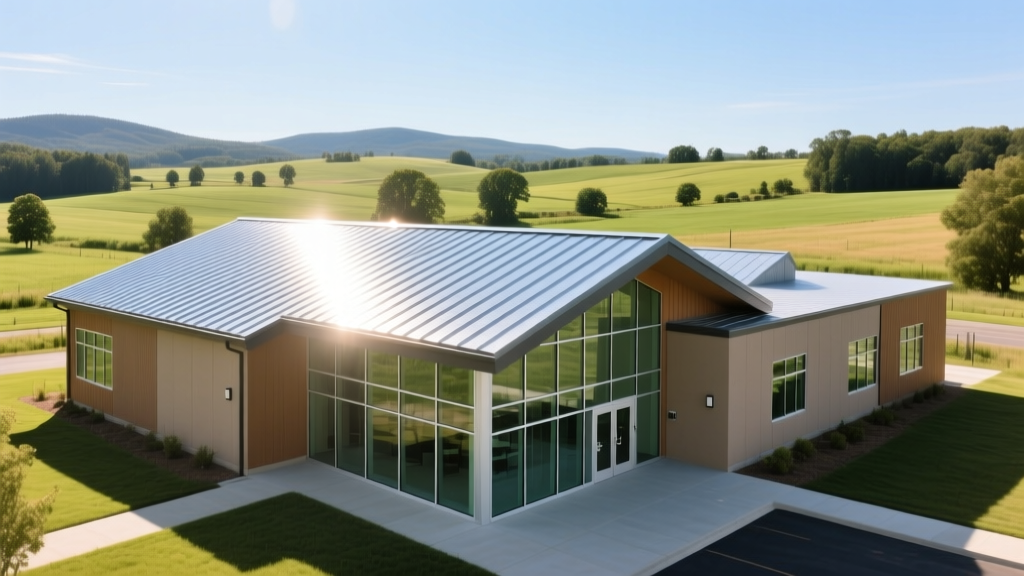
The building envelope in a township setting must prioritize longevity and minimal upkeep, as municipal maintenance budgets are typically constrained and rural homeowners seek generational durability.
Roofing: Standing Seam vs. Corrugated Ag-Panels
While exposed-fastener corrugated panels (often 29-gauge) remain a low-cost staple for agricultural outbuildings, township municipal buildings and modern rural residences are rapidly transitioning to concealed-fastener standing seam systems. A 26-gauge Galvalume standing seam roof (compliant with ASTM A792) offers a 40- to 60-year service life. The Galvalume coating—comprising 55% aluminum, 43.4% zinc, and 1.6% silicone—provides critical cut-edge protection that prevents the creeping rust common in standard galvanized ag-panels. According to the Metal Construction Association, concealed clip systems also accommodate the extreme thermal expansion and contraction experienced in rural areas lacking urban heat island effects.
Siding: Fiber Cement vs. Engineered Wood
For vertical cladding, the choice narrows to fiber cement and engineered wood. Fiber cement (such as James Hardie HardiePlank) is impervious to wood-boring insects and holds a Class A fire rating, making it mandatory for townships overlapping with Wildland-Urban Interface (WUI) zones. However, it is heavy and brittle during transport over unpaved township roads. Engineered wood (like LP SmartSide) offers easier installation and better impact resistance from hail, but it carries a strict failure mode: if installed with less than a 6-inch ground clearance or exposed to chronic splash-back from poorly graded rural soils, the substrate will wick moisture and delaminate.
| Material Type | 2026 Installed Cost (per sq. ft.) | Expected Lifespan | Primary Failure Mode |
|---|---|---|---|
| 26-Gauge Standing Seam Metal | $11.00 - $15.50 | 40 - 60 Years | Fastener back-out (if exposed); oil-canning |
| 29-Gauge Corrugated Ag-Panel | $4.50 - $6.50 | 15 - 25 Years | Neoprene washer degradation; rust at laps |
| Fiber Cement Lap Siding | $8.00 - $12.00 | 30 - 50 Years | Efflorescence; freeze-thaw spalling if unsealed |
| Engineered Wood Siding | $6.50 - $9.50 | 20 - 30 Years | Moisture wicking; fungal decay at bottom courses |
Foundation Solutions for Rural Zones
Traditional poured concrete frost walls are material-intensive and require multiple concrete truck dispatches, which can be cost-prohibitive when the nearest batch plant is 40 miles away. Township builders are increasingly adopting alternative foundation systems to mitigate rural logistics.
- Frost-Protected Shallow Foundations (FPSF): Ideal for unheated township storage buildings and garages. By utilizing rigid expanded polystyrene (EPS) insulation (ASTM C578 Type II) to trap geothermal heat, FPSFs reduce excavation depth to just 12-16 inches, cutting concrete volume by up to 40%.
- Helical Piers: For township community pavilions, boardwalks, and light agricultural structures, galvanized helical piers eliminate the need for concrete entirely. They can be installed with skid-steer mounted drive heads in a single day, bypassing the curing delays associated with rural concrete pours in shoulder seasons.
- ICF (Insulated Concrete Forms): For residential township builds, ICF blocks provide an R-22+ below-grade thermal break, crucial for homes relying on propane or geothermal heating in off-grid or rural-municipal zones.
Sourcing and Logistics: Navigating Rural Supply Chains
Procuring township building materials involves managing the 'last mile' premium. While urban contractors benefit from just-in-time delivery via local lumber yards, township projects often rely on Less-Than-Truckload (LTL) freight or direct mill shipments.
'When sourcing for township projects, always calculate the rural delivery surcharge and offloading requirements. A flatbed delivery of steel trusses to a site without a forklift or skid-steer will result in $800 to $1,200 in manual unloading fees or rejected shipments.' — Logistics Guidelines for Rural Construction, National Association of Home Builders
To optimize material sourcing in 2026, township procurement officers and rural builders are bundling envelope materials (roofing, siding, and trim) through single-source regional distributors to maximize Full-Truckload (FTL) shipping rates. Furthermore, specifying standardized dimensional lengths (e.g., ordering metal panels in exact 2-foot increments) reduces off-cuts and minimizes the waste disposal burden, a critical factor when local township dumps have strict construction-and-demolition (C&D) tonnage limits.
Zoning and Code Compliance Material Requirements
Township zoning boards frequently enforce overlays that dictate material aesthetics and performance. Common mandates include:
- Agricultural Buffers: Structures within 500 feet of active farmland may require non-reflective roofing finishes (matte or granular-coated metal) to prevent glare that disrupts livestock or adjacent highway traffic.
- WUI Fire Codes: Townships bordering national or state forests mandate Class A fire-rated assemblies. This eliminates the use of standard asphalt shingles and cedar shakes, pushing specifications toward standing seam metal, slate, or concrete tile, paired with fire-rated gypsum sheathing (e.g., 5/8-inch Type X).
- Historical Overlays: Some established townships require residential builds to mimic legacy materials. In these cases, composite slate or stamped metal shingles provide the required visual profile without the structural loading penalties of natural stone.
Frequently Asked Questions
What is the most cost-effective insulation for a township pole barn?
Closed-cell spray polyurethane foam (ccSPF) applied at 2 inches (yielding roughly R-13) is the most effective choice for post-frame township buildings. It acts as both a thermal barrier and a vapor retarder, preventing the interstitial condensation that commonly rots the wooden girts in unheated rural structures.
How do I prevent corrosion on metal buildings near township agricultural zones?
Specify aluminum-zinc alloy coatings (Galvalume) rather than standard galvanized steel. Additionally, avoid using copper flashings or untreated copper downspouts, as the galvanic reaction between copper runoff and steel panels will cause rapid, catastrophic corrosion in the presence of agricultural humidity.
Are modular materials viable for township municipal buildings?
Yes. Volumetric modular construction is highly viable for township clinics, voting centers, and administrative offices. Factory-built modules utilizing light-gauge steel framing (ASTM C645) bypass rural labor shortages and reduce on-site weather exposure, delivering a weathertight structure in weeks rather than months.
Written by
Priya KapoorPriya Kapoor is a real estate market analyst and construction economics researcher with expertise in housing affordability, development feasibility, and infrastructure investment. She holds a Master of Regional Planning from Cornell University and previously worked as a senior analyst at CBRE's Investment Properties group, where she modeled returns for $4B in mixed-use development pipelines. Priya now runs an independent research practice advising developers, municipalities, and REITs on construction cost forecasting and market timing. She publishes the quarterly "BuildMat Market Pulse" report tracking material price indices across 12 commodity categories. Based in Austin, TX, Priya serves on the board of Habitat for Humanity Austin and is a marathon runner.
More from Priya Kapoor
View all
Construction Cost
Cost to Build a 1600 Sq Ft Home in 2026: Full Breakdown
Accurate 2026 cost to build a 1600 sq ft home—material, labor, and regional pricing breakdowns included. Plan your budget with real-time estimates.
Aug 11, 2026

Wood & Lumber
Name the Types of Wood for Pressure Treatment and Preservation
Learn how to name the types of wood best suited for pressure treatment. Compare species treatability, chemical retention levels, and 2026 preservation costs.
Aug 4, 2026

Stone & Masonry
Stone Veneer Suppliers Lindenhurst: 2026 Cost Analysis
Analyze 2026 stone veneer costs in Lindenhurst, NY. Compare local supplier pricing, delivery fees, and Suffolk County installation labor rates.
Aug 4, 2026