Building Materials Retail: Decoding Technical Specifications
Master building materials retail procurement by decoding technical specs, ASTM standards, and grading stamps for lumber, drywall, and fasteners.

The Retail Specification Gap: Wholesale Data vs. Shelf Labels
Procuring structural and finish materials through building materials retail channels presents a unique challenge for commercial contractors and specialized builders. While wholesale distributors provide comprehensive technical data sheets (TDS) and mill certificates, retail environments—ranging from big-box home improvement centers to regional lumber yards—often prioritize consumer-friendly packaging over rigorous technical documentation. This creates a 'specification gap' where critical engineering data is obscured by marketing terminology.
For procurement officers and site superintendents, relying solely on retail shelf tags can lead to catastrophic compliance failures, structural deficiencies, or failed municipal inspections. Navigating this landscape requires a deep understanding of how to extract, verify, and translate retail packaging claims into verifiable ASTM, ANSI, and ICC-ES standards.
Decoding Core Material Standards on the Retail Shelf
To maintain structural integrity and code compliance when sourcing from retail inventories, buyers must look past the primary product name and interrogate the secondary markings, stamps, and fine print.
Dimensional Lumber and Engineered Wood Panels
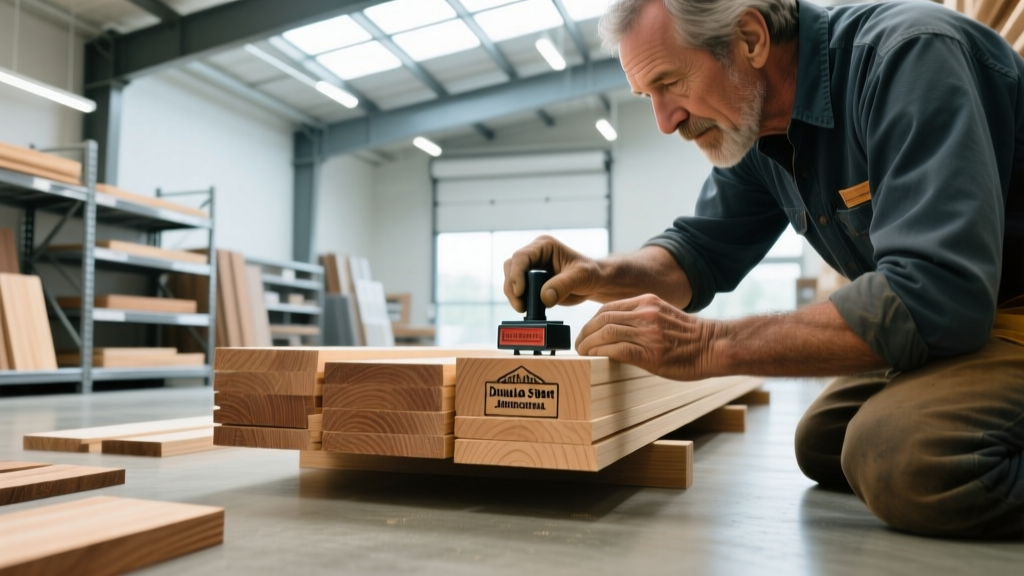
Retail lumber racks are frequently stocked with a mix of species and moisture contents that are indistinguishable to the untrained eye. The critical data is embedded in the ink grading stamps applied at the mill.
- Species Identification: Look for species-specific stamps rather than generic groupings. 'S-P-F' (Spruce-Pine-Fir) has significantly lower load-bearing capacities than 'D.FIR-L' (Douglas Fir-Larch) or 'SOUTHERN PINE'. Always cross-reference the stamp with the structural drawings.
- Moisture Content (MC) Classifications: Retail lumber is typically stamped with one of three moisture designations. S-GRN (Surface Green) indicates an MC above 19%, making it unsuitable for immediate interior framing due to shrinkage risks. S-DRY (Surface Dry) caps MC at 19%. For high-end finish carpentry or cabinetry substrates sourced from retail, demand MC-15 lumber, which guarantees a maximum 15% moisture content at the time of surfacing.
- Engineered Panels: When purchasing plywood or OSB from retail, verify the APA PS 1-09 or PS 2-10 certification marks. The stamp must explicitly state the span rating (e.g., 24/16 for roof/floor) and the bond classification (Exposure 1 vs. Exterior). 'Exposure 1' panels can withstand construction delays but are not rated for permanent weather exposure.
Cementitious Products and Fire-Rated Gypsum
Drywall and cement board retail packaging often highlights 'mold resistance' or 'fire resistance' in large typography, but the technical parameters dictate actual code compliance. Standard gypsum board must conform to ASTM C1396. When fire ratings are required by the building code, retail buyers must specifically locate 'Type X' or 'Type C' designations on the board's end tape.
Type X gypsum board (minimum 5/8-inch thick) contains glass fibers in the core to maintain structural integrity during a fire. To achieve a standard 1-hour fire rating on steel studs, the assembly must utilize specific Type X boards as tested under UL Design U419. Purchasing standard 5/8-inch board without the Type X core designation from a retail shelf will result in a failed fire inspection, regardless of the board's thickness.
Retail Marketing Claims vs. Technical Specifications Matrix
The following matrix translates common retail marketing terminology into the precise technical specifications required for commercial and high-performance residential procurement.
| Retail Marketing Term | Required Technical Specification / Standard | Procurement Verification Method |
|---|---|---|
| Pressure Treated (Ground Contact) | AWPA U1, Use Category UC4A or UC4B. Retention level ≥ 0.60 pcf (CCA) or equivalent. | Check end tag for UC4 designation and chemical retention levels. |
| Waterproof Backer Board | ASTM C473 (Water absorption ≤ 8% for glass mat; ≤ 10% for cementitious). | Request manufacturer TDS; verify ASTM C473 test results. |
| Structural Adhesive | APA AFG-01 or ASTM D3498 for subfloors. Must meet VOC limits. | Verify AFG-01 mark on tube; check SDS for VOC g/L limits. |
| Galvanized Fasteners | ASTM A153 (Hot-Dip) or ASTM B633 (Electroplated). Class D or higher for ACQ lumber. | Check box for 'Hot-Dip' or 'ZMAX'; avoid standard electroplated for treated wood. |
Fasteners and Structural Connectors: The Hidden Retail Liability
Fasteners represent the highest risk category in building materials retail procurement. Retail bins often mix electroplated, hot-dip galvanized, and stainless steel fasteners, sometimes with ambiguous labeling. When fastening modern ACQ (Alkaline Copper Quaternary) or CA-B (Copper Azole) pressure-treated lumber, standard zinc electroplated fasteners (ASTM B633) will corrode rapidly due to the copper in the wood preservative.
Procurement specs must explicitly demand ASTM A153 Class C hot-dip galvanized fasteners, or proprietary multi-layer coatings (like Simpson Strong-Tie's ZMAX or Double-Barrier coatings) that have been tested to ICC-ES AC257 standards. Furthermore, structural joist hangers and hurricane ties purchased at retail pro-desks must bear an active ICC-ES Evaluation Report (ESR) number stamped directly on the metal. If the ESR number is missing or painted over, the inspector has the authority to reject the framing.
Procurement Framework: Verifying Specs at the Point of Sale
To systematize technical verification in retail environments, site procurement teams should implement the following four-step validation protocol before materials are loaded onto the delivery truck:
- Grade Stamp Interrogation: Physically inspect a random 10% sample of the lumber bundle. Verify that the grading agency mark (e.g., WWPA, SPIB, NLGA), species, and moisture content match the submittal package.
- Lot and Batch Tracking: For cementitious products, thinset mortars, and liquid adhesives, record the batch/lot numbers printed on the packaging. This is critical for tracing manufacturing defects and verifying that the product has not exceeded its retail shelf life (typically 6-9 months for Portland cement-based products).
- SDS and TDS Alignment: Cross-reference the Safety Data Sheet (SDS) Section 3 (Composition) with the Technical Data Sheet (TDS). Discrepancies between the chemical composition on the SDS and the performance claims on the TDS often indicate a reformulated product that may no longer meet the original specification.
- Dimensional Tolerance Checks: Retail dimensional lumber is nominally sized. A 2x4 is actually 1.5 x 3.5 inches. However, engineered lumber (LVL, LSL) and manufactured trim (PVC, fiber cement) must meet strict dimensional tolerances (often ±1/16 inch). Use digital calipers at the loading dock to verify thickness before signing the retail delivery manifest.
Frequently Asked Technical Questions
Can I use retail-bought 'Construction Grade' OSB for a structural diaphragm?
Only if the panel bears a specific span rating and design thickness that matches the structural engineer's diaphragm schedule. 'Construction Grade' is a marketing term; the structural capacity is dictated by the APA span rating (e.g., 24/0) and the panel's designated thickness (e.g., 19/32-inch). The fastener schedule (nail size and spacing) must also align with the panel's rated capacity.
How do I verify the fire rating of retail acoustic ceiling tiles?
Acoustic ceiling tiles sold in retail environments must be evaluated for both surface burning characteristics and fire resistance. Look for the UL Classification mark indicating a Class A flame spread rating (ASTM E84, flame spread ≤ 25). If the tiles are part of a rated floor/celling assembly, the specific UL Design number must be printed on the carton, not just a generic 'fire resistant' label.
What is the technical difference between retail 'Thinset' and 'Medium-Bed Mortar'?
Standard thinset mortars (ANSI A118.4 or A118.15) are engineered for applications up to 3/16-inch thick. Exceeding this thickness causes excessive shrinkage and loss of bond strength. Medium-bed mortars (ANSI A118.15) contain larger aggregate and specialized polymers allowing applications up to 3/4-inch thick, which is mandatory for large-format tiles (edges > 15 inches) to prevent lippage and void spaces.
Written by
David NakamuraDavid Nakamura is a licensed architect (AIA) and construction technology writer focused on sustainable building methods, mass timber engineering, and high-performance building envelopes. He holds a Master of Architecture from the University of Washington and is a certified Passive House Consultant (CPHC). David spent eight years at the Seattle firm Mithun, where he led the design of three LEED Platinum projects, before founding his own practice specializing in net-zero residential design. He serves on the editorial advisory board of GreenBuilder Magazine and has authored peer-reviewed papers on cross-laminated timber (CLT) connections for the Journal of Structural Engineering. In his spare time, David teaches woodworking at Pratt Fine Arts Center and kayaks the Puget Sound.
More from David Nakamura
View all
Construction Cost
Labor Cost to Build a Deck Per Sq Ft: 2026 Installation Guide
Discover the exact labor cost to build a deck per sq ft in 2026. This installation guide breaks down contractor rates, complexity factors, and hidden fees.
Aug 4, 2026

Construction Cost
How Much Does It Cost to Build a 3 Bedroom House? Financing Guide
Learn exactly how much it costs to build a 3 bedroom house and explore 2026 financing options, construction loan types, and budget frameworks for your build.
Aug 4, 2026

Construction Cost
Cost to Build a Tennis Court: 2026 Guide
How much does it cost to build a tennis court in 2026? Breakdowns for asphalt, concrete, and synthetic surfaces plus fencing and lighting.
Jul 30, 2026