Building Material of Washington Monument: Complete Stone Guide
Explore the building material of Washington Monument, including the specific marble, granite, and gneiss quarries used, plus modern preservation matching tips.

The Engineering Marvel of the National Mall
When analyzing the building material of Washington Monument, structural engineers and historic preservationists look beyond the towering white facade to examine a complex assembly of 19th-century masonry. Standing at 555 feet, 5 1/8 inches tall, the obelisk is not a solid block of stone. It is a highly engineered rubble masonry core faced with precision-cut ashlar veneer. The selection of these materials was driven by the need for immense compressive strength, weather resistance, and the logistical capabilities of the 1848–1884 construction eras. Understanding the specific geological origins and mechanical properties of these stones provides critical insights for modern masons working in monumental and historic preservation.
The Geological Foundation: Core Building Material of Washington Monument
The monument exerts a staggering total weight of approximately 81,120 tons onto the National Mall's soil. To prevent differential settlement, the original 23-foot-deep foundation was later underpinned and expanded during the 1879–1884 phase to a massive 126-foot square base. This foundation relies on two primary, high-density stones.
Bluestone Gneiss
The bulk of the foundation's rubble core consists of bluestone gneiss quarried locally in Maryland. Gneiss is a high-grade metamorphic rock characterized by its distinct banding and exceptional compressive strength. Its high density and low porosity make it highly resistant to the freeze-thaw cycles and ground moisture inherent to the Potomac River basin.
Quincy Granite
For the critical load-bearing steps and the outer foundation facing, engineers specified Quincy granite from the famous Bunker Hill quarries in Massachusetts. Known in the trade as "American Gray," this granite possesses a compressive strength exceeding 20,000 psi, providing an unyielding base that distributes the monument's dead load evenly across the expanded concrete and rubble sub-foundation.
The Shaft: A Tale of Three Marbles
The visible exterior of the monument is clad entirely in marble, but sourcing this building material of Washington Monument was fraught with logistical and geological challenges, resulting in the use of three distinct marble formations.
Cockeysville Marble (The Lower 150 Feet)
Construction began in 1848 using marble from the Texas Station and Beaver Dam quarries in Baltimore County, Maryland. Geologically known as Cockeysville Marble, this stone is a highly pure, coarsely crystalline dolomitic marble. It was prized for its brilliant white albedo and workability. The lower walls of the shaft are an astonishing 15 feet thick at the base, requiring massive ashlar blocks that were hoisted via steam-powered winches.
Sheffield Marble (The Transition Phase)
When construction resumed in 1876 after a 20-year halt caused by the Civil War and funding shortages, the original Maryland quarries were largely depleted or inaccessible. The Army Corps of Engineers initially sourced marble from Sheffield, Massachusetts. However, this stone proved difficult to match in color and crystalline structure, and only a few courses were laid before the decision was made to switch sources again.
Maine Marble (The Upper Shaft)
To complete the remaining 350+ feet of the obelisk and the pyramidion cap, the Corps of Engineers contracted the Bodwell Granite Company, which supplied a slightly different marble from a quarry in Maine (often referred to in historical records as Knox County or Maine marble). This stone contained trace amounts of iron and different dolomite-to-calcite ratios, which ultimately led to the monument's most famous visual quirk.
The 152-Foot Color Shift: A Lesson in Quarry Sourcing
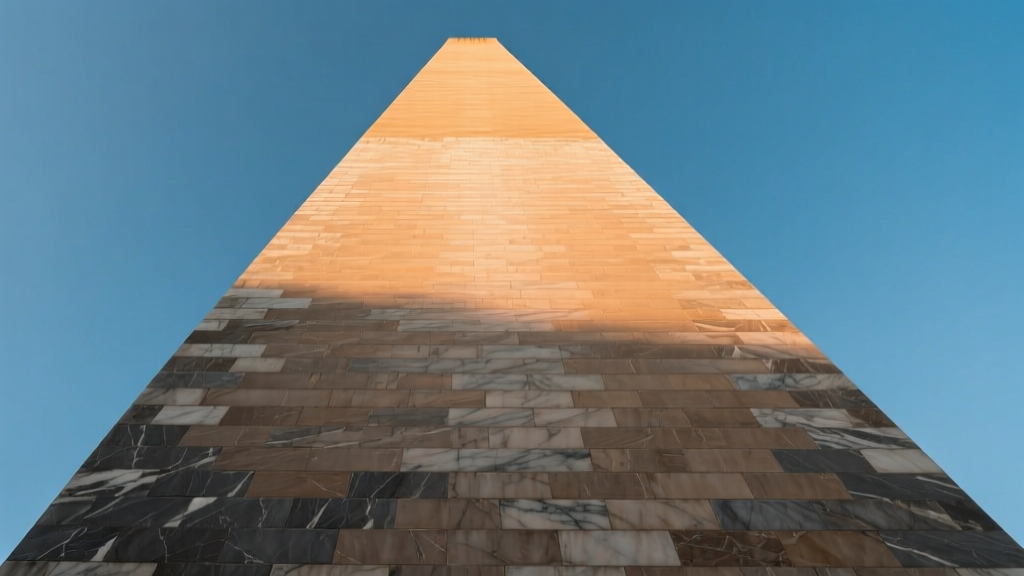
Visitors often notice a distinct horizontal line approximately one-third of the way up the monument. This demarcation occurs at the 152-foot mark, where the original Maryland Cockeysville marble ends and the post-Civil War Maine/Sheffield marble begins. Over decades of exposure to atmospheric pollutants, acid rain, and oxidation, the differing mineral impurities (specifically iron sulfides and varying dolomite concentrations) caused the upper stones to weather to a slightly darker, warmer hue. According to the National Park Service, this color shift is permanent and serves as a physical timeline of the monument's interrupted construction.
Material Properties & Structural Engineering Matrix
For structural engineers and preservation architects specifying stone for high-load obelisks or monumental facades, the mechanical properties of the original materials serve as a benchmark. The following data is derived from historical testing and modern equivalents of the specified geological formations.
| Material | Geological Origin | Compressive Strength | Density (lbs/ft³) | Primary Application |
|---|---|---|---|---|
| Cockeysville Marble | Baltimore County, MD | ~9,000 - 11,000 psi | 170 | Lower Shaft Veneer |
| Quincy Granite | Quincy, MA | ~20,000 - 24,000 psi | 165 | Foundation Steps/Base |
| Bluestone Gneiss | Maryland | ~15,000 psi | 168 | Foundation Rubble Core |
| Maine / Sheffield Marble | Maine / Massachusetts | ~8,500 - 9,500 psi | 168 | Upper Shaft & Pyramidion |
Modern Preservation: Sourcing Match Stone in the 21st Century
The original Texas Station and Beaver Dam quarries in Maryland are no longer operational for monumental-grade stone extraction. When the Natural Stone Institute guidelines are applied to modern Dutchman repairs, patching, or replacement of the monument's lower shaft, preservationists must source geologically and visually compatible alternatives. Using incompatible stone leads to galvanic corrosion, differential weathering, and accelerated spalling.
Approved Modern Equivalents for Repairs
- Georgia Marble (Imperial White): Sourced from the Tate, Georgia quarries, this coarsely crystalline marble closely mimics the light reflectance and grain size of the original Cockeysville marble. It is the standard for high-visibility historic repairs in the Mid-Atlantic region.
- Alabama Marble (Sylacauga): Known for its high purity and brilliant white color, Sylacauga marble is often used for interior patches or areas requiring extreme color matching, though its slightly finer grain requires careful texturing to match the 19th-century hand-tooled finish.
- Danby Marble (Vermont): For upper-shaft repairs where the stone has oxidized to a warmer tone, select grades of Vermont Danby marble can be artificially aged or left to weather to match the Maine marble courses.
Mortar and Anchoring Specifications
A critical failure mode in historic masonry is the use of modern Portland cement for repointing. Portland cement is too rigid and impermeable, trapping moisture inside the marble and causing the faces to spall during freeze-thaw cycles. Preservation masons must use a Type O or Type K lime putty mortar (compliant with ASTM C144 and historic preservation standards) that allows the masonry to breathe. Furthermore, structural pinning for Dutchman repairs should utilize Grade 316 stainless steel or titanium helical anchors to prevent rust jacking, a phenomenon where expanding iron oxides crack the surrounding stone.
Frequently Asked Questions
Is the Washington Monument made of solid marble?
No. The monument utilizes a rubble masonry core consisting of bluestone gneiss, brick, and granite, which is then faced with a marble ashlar veneer. The walls taper from 15 feet thick at the base to just 18 inches thick at the top, significantly reducing the overall dead load while maintaining structural integrity against wind shear.
What is the pyramidion cap made of?
The very top of the monument (the pyramidion) is constructed of the same Maine marble used for the upper shaft, supported by a complex internal web of marble ribs and granite arches. The 9-inch aluminum apex cap, cast in 1884, was chosen for its resistance to corrosion and its status as a rare, precious metal at the time.
How does the monument withstand earthquakes?
During the 2011 Virginia earthquake (magnitude 5.8), the monument sustained significant cracking in the upper marble veneer and mortar joints. Because it is an unreinforced masonry structure, it relies on its massive weight and tapering geometry for stability. Post-earthquake repairs required over 150 individual Dutchman patches and extensive repointing using historically accurate lime mortars to restore structural continuity without altering the monument's flexibility.
Summary for Specifiers
The building material of Washington Monument represents a cross-section of American geology and 19th-century engineering limits. For modern architects and masons, the primary takeaway is the critical importance of petrographic matching and mortar permeability when working with historic dolomitic and calcitic marbles. Always specify ASTM C97 testing for absorption and density when sourcing replacement stone for monumental structures.
Written by
Sarah WhitfieldSarah Whitfield is a chartered quantity surveyor (MRICS) and construction cost analyst with 15 years of experience in material pricing, procurement strategy, and project budgeting. She earned her degree in Construction Management from the University of Reading (UK) and has worked on projects ranging from $2M custom homes to $180M mixed-use developments across North America and Europe. Sarah currently leads cost estimating for BuildMat Insight, maintaining a proprietary database of 4,000+ material price points updated quarterly. She is a frequent contributor to RSMeans cost data panels and has presented at the International Cost Engineering Council (ICEC) congress. Based in Denver, CO, Sarah is an avid trail runner and volunteer mentor for Women in Construction.
More from Sarah Whitfield
View all
Wood & Lumber
What Are the Different Types of Wood? A Builder's Guide
Compare structural softwoods, finish hardwoods, and engineered lumber. Analyze Janka ratings, MOE values, and 2026 pricing for construction.
Aug 4, 2026

Walls & Panels
Steel Framing vs Wood Framing: Corrosion and Moisture Defense
Compare steel framing vs wood framing for moisture resistance. Learn about galvanized coatings, condensation risks, and corrosion protection strategies.
Jul 21, 2026

Stone & Masonry
How to Cut Stone Veneer: Wet Saw vs Grinder Comparison
Compare the best tools for cutting stone veneer. We review wet saws, angle grinders, and chop saws to help you achieve clean, chip-free cuts.
Jul 21, 2026