Sourcing Reclaimed Lumber via Salvage Building Materials Inc
A contractor's guide to sourcing reclaimed timber and masonry from Salvage Building Materials Inc, covering grading, moisture, and 2026 pricing.

The Economics of Architectural Salvage in 2026
Procuring reclaimed building materials has shifted from a niche aesthetic choice to a core strategy for commercial contractors targeting LEED v5 and Living Building Challenge certifications. When sourcing from specialized architectural salvage yards like Salvage Building Materials Inc, general contractors must navigate a complex matrix of embodied carbon savings, premium material costs, and strict structural re-certification protocols. According to the EPA's sustainable management guidelines for C&D debris, reusing heavy timber and masonry diverts millions of tons from landfills annually while drastically reducing the Scope 3 carbon emissions associated with virgin material manufacturing.
However, the financial reality of salvage procurement requires precise budgeting. Reclaimed materials carry a premium due to the labor-intensive deconstruction, denailing, and kiln-drying processes. Below is a comparative cost matrix for high-demand salvage materials versus their virgin counterparts in the current market.
| Material Type | Virgin Material Cost (2026) | Reclaimed Cost (Salvage Yard) | Primary Cost Driver for Salvage |
|---|---|---|---|
| Longleaf Heart Pine (Flooring) | $6.50 - $9.00 / sq ft | $14.00 - $22.00 / sq ft | Deconstruction labor, kiln drying, milling |
| Chicago Common Brick | $0.85 - $1.20 / unit | $1.80 - $2.75 / unit | Hand-cleaning, mortar removal, palletizing |
| Old Growth Douglas Fir (Beams) | $3.50 - $5.00 / bf | $8.50 - $14.00 / bf | Crane extraction, metal detection, re-grading |
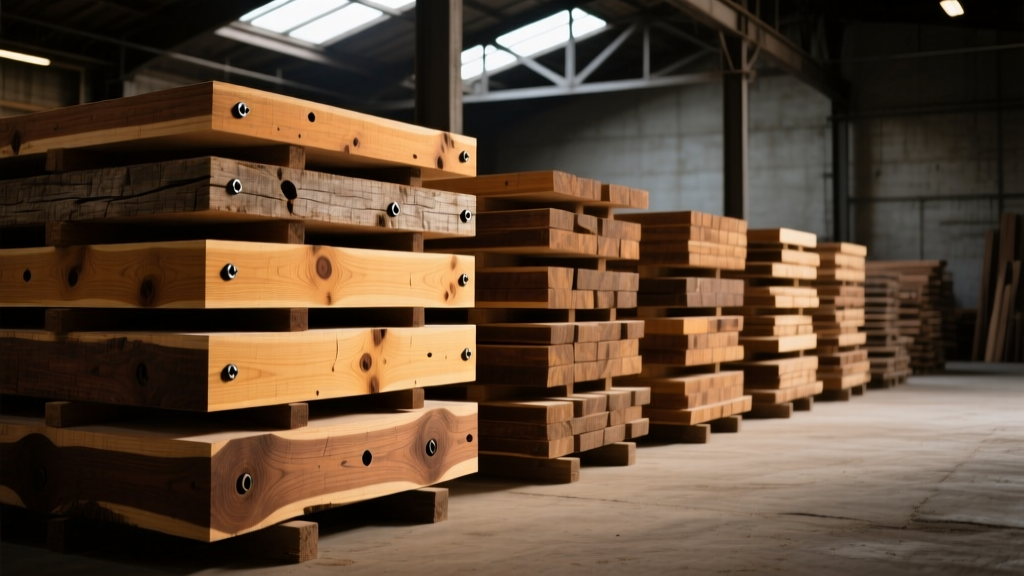
Navigating Inventory and Visual Grading On-Site
When visiting a salvage facility, visual inspection protocols differ significantly from evaluating virgin lumber at a commercial distributor. Reclaimed timber often features surface checking, nail holes, and oxidation that are desirable for aesthetics but can mask structural defects. Contractors must look beyond the patina to assess the core integrity of the wood fibers.
Critical Inspection Metrics for Reclaimed Beams
- End-Grain Checking: Surface checks running parallel to the grain are normal in old-growth timber. However, checks that run diagonally or penetrate more than one-third of the beam's depth compromise shear strength and require structural epoxy consolidation or rejection.
- Ferrous Contamination: Visually scan for broken nail shafts or embedded hardware. While the salvage yard will run stock through industrial metal detectors, heavy timber often hides deep-set lag bolts that can destroy planer knives during final site milling.
- Biological Degradation: Inspect the ends of timbers for soft rot or powderpost beetle frass (fine, sawdust-like powder). Kiln drying at 130°F+ kills active infestations, but structural integrity lost to prior biological activity cannot be reversed.
Structural Re-Grading and Engineering Compliance
A common and costly mistake in commercial salvage projects is assuming that a reclaimed beam retains its original structural grade stamp. The moment a salvage yard re-saws, planes, or resurfaces a timber to remove decay or achieve dimensional uniformity, the original grade stamp is voided. For load-bearing applications, the American Wood Council (AWC) requires that reused lumber be re-evaluated by a certified lumber grader or an engineer using non-destructive testing (NDT) methods.
Pathways to Structural Certification
- Visual Re-Grading: A certified grader from an agency like the Western Wood Products Association (WWPA) inspects the re-milled timber. Because re-sawing exposes the inner core, the grader must assess the new faces for slope of grain, knots, and wane based on current grading rules.
- Machine Stress Rating (MSR): For high-volume salvage projects, passing timbers through an MSR machine measures the modulus of elasticity (MOE) and assigns a reliable bending stress value (Fb), bypassing the subjective nature of visual grading on weathered wood.
- Engineering Over-Sizing: When re-grading is cost-prohibitive, structural engineers often specify reclaimed beams one nominal size larger than calculations require for virgin wood, applying a conservative reduction factor to the allowable stress design (ASD) values.
Milling, Denailing, and Moisture Acclimation
Proper milling of salvage materials requires specialized equipment to handle embedded metals and extreme density variations. Standard high-speed steel (HSS) planer blades will chip instantly upon hitting a forgotten cut nail. Professional salvage mills utilize carbide-tipped helical cutterheads and horizontal resaws equipped with Lenox Tri-Master blades, which can survive minor ferrous impacts without catastrophic failure.
Moisture content (MC) management is equally critical. Reclaimed timber stored in unconditioned warehouses often equilibrates to a moisture content of 14% to 18%. Installing this material directly into a modern, climate-controlled commercial interior (which typically maintains an equilibrium moisture content of 6% to 8%) will result in severe shrinkage, joint failure, and finish cracking.
Do not rely solely on the salvage yard's kiln-drying certificate. Once kiln-dried timber is stored in a humid, unconditioned staging warehouse, it will re-absorb ambient moisture. Mandate that the supplier delivers the material in vapor-sealed polyurethane wrapping, and verify the MC with a pin-type moisture meter (e.g., Wagner Meters Orion) upon delivery to the job site. Target 6-8% for interior millwork and 12-15% for exterior cladding.
Reclaimed Masonry: Sourcing Chicago Common Brick
Beyond timber, Salvage Building Materials Inc and similar yards are primary suppliers of reclaimed masonry, most notably Chicago Common Brick. Produced from the region's unique blue-clay deposits between 1870 and 1930, these bricks feature a distinct buff, pink, and grey color palette that cannot be replicated with modern manufacturing techniques.
When specifying reclaimed brick for structural or veneer applications, contractors must account for the variability in compressive strength and absorption rates. Unlike modern ASTM C62 standardized bricks, salvage bricks were fired in coal-burning clamp kilns, resulting in a wide spectrum of hardness. "Pavers" or "Hard" bricks from the center of the kiln possess high compressive strength (often exceeding 8,000 psi) and low absorption, making them suitable for exterior load-bearing walls. "Salmon" or "Soft" bricks from the kiln's edges are highly porous and must be strictly limited to interior, non-load-bearing veneer applications.
To ensure structural viability, utilize the NIST BEES (Building for Environmental and Economic Sustainability) software to model the lifecycle environmental impact of your masonry choices, balancing the high initial labor cost of hand-cleaning reclaimed mortar against the massive carbon savings of avoiding new clay firing.
Logistics and Freight Calculations
Freight costs can easily add 15% to 25% to the total budget of a salvage procurement if miscalculated. Old-growth reclaimed timber is significantly denser than modern second-growth lumber. For example, reclaimed Longleaf Southern Yellow Pine averages 4.5 pounds per board foot, compared to just 2.8 pounds per board foot for modern plantation-grown SYP. A standard flatbed truck legally limited to 45,000 pounds of cargo will carry roughly 30% less board footage of old-growth salvage timber than virgin lumber. Always calculate freight limits by weight, not by volume, when negotiating delivery contracts with salvage suppliers.
Frequently Asked Questions
Can reclaimed wood be used for fire-rated assemblies?
Yes, but the wood itself does not inherently carry a fire rating. Reclaimed timber must be treated with an intumescent coating or incorporated into a tested fire-rated assembly (such as a Type IV heavy timber construction) where the charring rate of the specific wood species is calculated by a fire protection engineer to meet the required hourly rating.
How do I handle lead paint on salvaged materials?
Any salvaged wood or masonry sourced from pre-1978 structures must be tested for lead-based paint using XRF (X-ray fluorescence) analyzers. If lead is detected, the material must be processed by an EPA-certified lead abatement contractor who will mechanically strip or encapsulate the surface before it can be legally milled and installed in residential or commercial spaces.
What is the standard lead time for large salvage orders?
For standardized inventory like dimensional flooring, expect 4 to 6 weeks for milling and kiln-drying. For massive structural timbers or specific architectural elements (e.g., cast-iron columns or terracotta facades), lead times frequently extend to 12 to 16 weeks, as these items require custom deconstruction scheduling and specialized freight routing.
Written by
Elena RodriguezElena Rodriguez is a civil engineer and technical writer specializing in concrete technology, masonry systems, and ASTM/ACI compliance. She earned her B.S. in Civil Engineering from Texas A&M University and spent a decade at a materials testing laboratory, performing over 2,000 concrete compressive strength tests and masonry prism evaluations. Elena is an ACI-certified Field Testing Technician (Grade I) and a member of ASTM Committee C12 on Natural Building Stone. She currently consults on forensic engineering cases involving concrete failures and moisture intrusion. Based in San Antonio, TX, Elena is a proud member of the Society of Women Engineers (SWE) and coaches her daughter's FIRST Robotics team.
More from Elena Rodriguez
View all
Walls & Panels
Cost Analysis: Light Gauge Steel Framing Advantages and Disadvantages
Evaluate light gauge steel framing advantages and disadvantages through a strict cost analysis lens, comparing material, labor, and lifecycle expenses.
Aug 4, 2026

Walls & Panels
Gypsum Board Types: Exact Specifications, Thickness & Dimensions
Compare standard, Type X, and moisture-resistant gypsum board types. Get exact specifications, thicknesses, dimensions, and ASTM standards for your project.
Aug 4, 2026

Fire Resistance
Best Fire-Resistant Outdoor Decking Materials: 2026 Buyer Guide
Discover the best fire-resistant outdoor decking materials for 2026. Compare Class A PVC, aluminum, and hardwood options for WUI compliance and safety.
Aug 4, 2026