How to Coordinate a Building Material Delivery Service for Job Sites
Master job site logistics with our application guide to managing a building material delivery service, from staging prep to receiving protocols.

Pre-Delivery Site Assessment and Staging Zone Engineering
Coordinating heavy freight to an active job site requires precise spatial planning and rigorous ground preparation. Before scheduling a building material delivery service, the site superintendent must engineer the staging zone to accommodate the physical footprint and weight distribution of commercial transport vehicles. A standard 53-foot flatbed trailer requires a minimum 45-foot outside turning radius to navigate safely without tracking mud onto public roads or striking temporary fencing.
Ground bearing capacity is the most frequently overlooked variable in delivery logistics. A fully loaded tandem-axle flatbed exerts up to 34,000 pounds on its rear axles. If the staging area consists of uncompacted native soil with a California Bearing Ratio (CBR) of less than 5, the truck will rut, potentially damaging the undercarriage and stranding the freight. To prevent this, prepare the staging zone with a minimum of 6 inches of compacted crushed aggregate base (ABC) or lay down a temporary matting system of 12-inch by 12-foot crane mats for soft-soil conditions.
Selecting the Right Building Material Delivery Service Tier
Not all freight requires the same level of logistical intervention. Matching the delivery tier to the material's fragility and the project's critical path prevents both budget overruns and schedule delays. The matrix below outlines the three primary service tiers utilized in commercial and high-end residential construction.
| Service Tier | Vehicle Type | Lead Time | Cost Profile | Best Application |
|---|---|---|---|---|
| Standard LTL (Less-Than-Truckload) | 53' Dry Van / Box Truck | 3–5 Days | Lowest ($2.50–$4.00/mi) | Bulk consumables, fasteners, standard insulation, non-fragile plumbing rough-in. |
| Dedicated Flatbed | 48'–53' Flatbed / Step-deck | 1–2 Days | Medium ($4.50–$6.50/mi) | Dimensional lumber, steel I-beams, roof trusses, oversized masonry pallets. |
| Just-In-Time (JIT) Hot Shot | 24'–40' Gooseneck / Box Truck | Same Day / 4 Hours | Premium ($7.00–$10.00+/mi) | Custom millwork, HVAC units, emergency drywall replenishment, finish materials. |
Scheduling and Phasing: The 48-Hour Communication Loop
A successful delivery relies on a strict 48-hour communication protocol between the site superintendent and the supplier's dispatch desk. Relying solely on automated tracking portals is insufficient for complex sites. Implement the following scheduling framework:
- T-Minus 48 Hours: Confirm the delivery window and verify that the preceding trade has cleared the staging zone. If the framers are still occupying the lumber drop zone, the delivery must be rescheduled immediately to avoid demurrage fees.
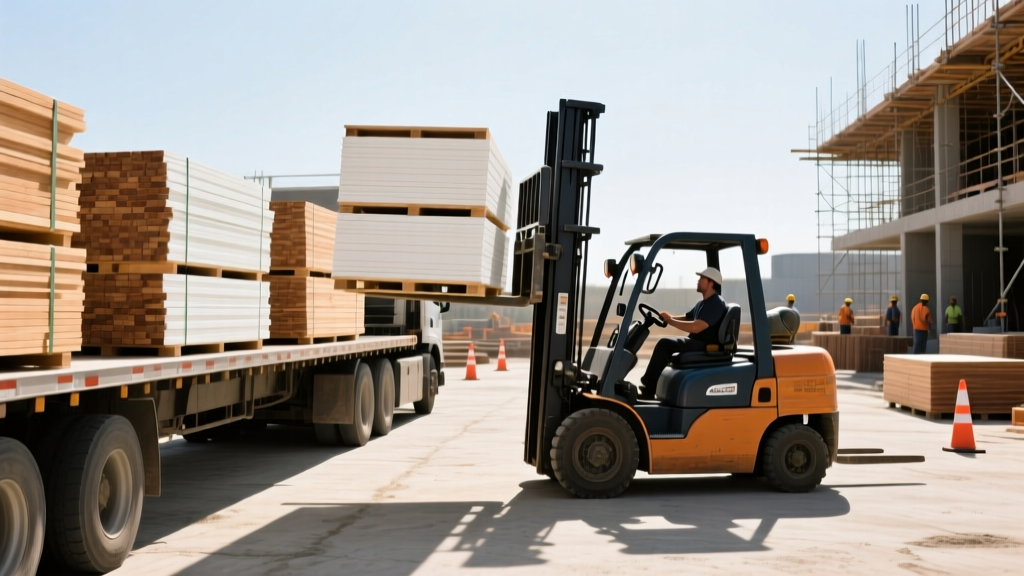
- T-Minus 24 Hours: Dispatch the site's material handling equipment. Ensure the telehandler or forklift is fueled, inspected, and fitted with the correct pallet forks (standard 48-inch or 72-inch forks for wide-load masonry pallets).
- T-Minus 2 Hours: The driver should provide a geofenced ETA. The site traffic control supervisor must clear the access route of subcontractor vehicles and secure the swing radius for offloading.
Receiving and Inspecting Freight: A Step-by-Step Protocol
The Bill of Lading (BOL) is a legally binding receipt. Signing it without notation transfers all liability for transit damage from the carrier to the general contractor. Train your receiving personnel to execute this exact inspection sequence before the driver leaves the site.
- Verify the Piece Count and SKU: Cross-reference the physical pallet count against the BOL. Do not rely on the supplier's packing slip; the BOL dictates the carrier's legal responsibility.
- Inspect Banding and Shrink Wrap Tension: For dimensional lumber and masonry, check that steel or poly banding is tight. Snapped bands indicate shifting during transit, which compromises the structural integrity of the stack and creates a severe strike hazard during offloading.
- Check for Concealed Moisture Damage: Water stains on drywall or OSB sheathing often wick upward from the bottom of the pallet. Use a pinless moisture meter on the bottom sheets. Reject any gypsum board registering above 12% moisture content, as it will harbor mold once enclosed in wall cavities.
- Document and Note Exceptions: If damage is found, write 'SUBJECT TO INSPECTION FOR CONCEALED DAMAGE' or specify the exact damaged items (e.g., '3 pallets of 5/8" Type X drywall water-damaged') directly on the driver's BOL. Take timestamped photographs of the damage and the truck's trailer number.
Under the FMCSA Cargo Securement Rules, carriers are responsible for ensuring loads are immobilized. If materials arrive shifted due to failed dunnage or snapped straps, the carrier's insurance is liable for replacement, provided the receiver properly noted the securement failure on the BOL at the time of delivery.
Managing Returns and Reverse Logistics
Over-ordering is a common buffer strategy, but returning unused materials requires navigating complex reverse logistics. Most wholesale suppliers enforce strict return windows and restocking fees to offset the cost of inspecting and repalletizing returned freight.
- Standard Commodities (Lumber, Drywall, Insulation): 15% to 25% restocking fee. Must be returned in original, unopened packaging within 30 days.
- Mechanical & Electrical (HVAC, Panels): 20% to 30% restocking fee. Wire spools must retain at least 90% of their original length.
- Custom Millwork & Doors: 40% to 100% (Non-returnable). Custom-sized items are generally considered final sale unless defective.
To minimize reverse logistics costs, integrate material takeoff software with your procurement workflow to reduce variance. For unavoidable returns, coordinate the pickup with the supplier's next scheduled delivery route to your zip code, effectively reducing the return freight charge to near zero. Ensure all returned materials are staged in a dry, secure area to prevent degradation while awaiting the reverse logistics pickup, aligning with EPA guidelines for sustainable C&D material management to prevent usable goods from entering the waste stream.
Expert Troubleshooting for Common Delivery Failures
Even with meticulous planning, freight anomalies occur. Use this decision matrix to resolve common delivery service failures without halting the critical path.
| Symptom / Failure | Root Cause | Immediate Corrective Action |
|---|---|---|
| Truck cannot access site; driver refuses to offload. | Access road is too soft, overhead clearance is blocked by temp power lines, or turning radius is obstructed. | Do not force the driver. Deploy a site skid-steer or telehandler to the truck's location on the public right-of-way to transload the pallets. Note 'Driver refused access' on the BOL to avoid detention fees. |
| Short-shipped materials (BOL says 10 pallets, only 8 arrive). | Supplier warehouse picking error or materials fell off during transit. | Note the exact shortage on the BOL before signing. Immediately email the supplier's dispatch with the signed BOL to trigger an emergency hot-shot delivery for the missing items at the supplier's expense. |
| Liftgate service requested but truck arrives without a liftgate. | Dispatch routing error; flatbed assigned instead of box truck with hydraulic liftgate. | If the material is palletized and you have a forklift, offload manually and file a service level agreement (SLA) claim for the liftgate fee refund. If unpalletized (e.g., loose bundles), reject the load and demand redelivery. |
Mastering the application of a building material delivery service transforms a potential job site bottleneck into a synchronized operational advantage. By engineering the staging zone, enforcing rigorous BOL inspection protocols, and strategically managing reverse logistics, superintendents can protect project margins and maintain uninterrupted workflow momentum.
Written by
Elena RodriguezElena Rodriguez is a civil engineer and technical writer specializing in concrete technology, masonry systems, and ASTM/ACI compliance. She earned her B.S. in Civil Engineering from Texas A&M University and spent a decade at a materials testing laboratory, performing over 2,000 concrete compressive strength tests and masonry prism evaluations. Elena is an ACI-certified Field Testing Technician (Grade I) and a member of ASTM Committee C12 on Natural Building Stone. She currently consults on forensic engineering cases involving concrete failures and moisture intrusion. Based in San Antonio, TX, Elena is a proud member of the Society of Women Engineers (SWE) and coaches her daughter's FIRST Robotics team.
More from Elena Rodriguez
View all
Walls & Panels
Cost Analysis: Light Gauge Steel Framing Advantages and Disadvantages
Evaluate light gauge steel framing advantages and disadvantages through a strict cost analysis lens, comparing material, labor, and lifecycle expenses.
Aug 4, 2026

Walls & Panels
Gypsum Board Types: Exact Specifications, Thickness & Dimensions
Compare standard, Type X, and moisture-resistant gypsum board types. Get exact specifications, thicknesses, dimensions, and ASTM standards for your project.
Aug 4, 2026

Fire Resistance
Best Fire-Resistant Outdoor Decking Materials: 2026 Buyer Guide
Discover the best fire-resistant outdoor decking materials for 2026. Compare Class A PVC, aluminum, and hardwood options for WUI compliance and safety.
Aug 4, 2026