Building Materials Holding: Comprehensive Job Site Storage Guide
Master building materials holding with our comprehensive guide on job site storage, moisture control, shrinkage prevention, and JIT staging strategies.

The True Cost of Building Materials Holding
Effective building materials holding is not merely about finding empty space on a job site; it is a critical financial and operational lever. In commercial and large-scale residential construction, inventory holding costs typically consume 15% to 30% of the total material value annually. These costs encompass capital tie-up, physical handling, insurance premiums, spatial footprint, and the hidden expense of material degradation.
When superintendents and project managers treat the staging area as an afterthought, the result is accelerated depreciation of assets. A bundle of kiln-dried (KD) spruce-pine-fir (SPF) framing lumber left directly on grade can wick moisture, raising its moisture content (MC) from the optimal 15-19% to over 25%. Once installed, this lumber shrinks as it acclimates to the conditioned interior, causing drywall nail pops, truss uplift, and door binding. Proper holding protocols prevent these cascading failures, protecting both the material integrity and the project's bottom line.
Material-Specific Storage and Environmental Protocols
Different material classes react uniquely to environmental stressors. A one-size-fits-all tarping strategy will result in catastrophic failures for hygroscopic and reactive materials.
Portland Cement and Hydraulic Binders
Portland cement (ASTM C150) is highly hygroscopic. Even brief exposure to high humidity causes pre-hydration, where cement particles react with atmospheric moisture to form weak, non-cementitious calcium silicate hydrates. According to the Portland Cement Association, bagged cement stored in a dry, climate-controlled warehouse has a maximum shelf life of six months. On an active job site, this window shrinks dramatically.
- Elevation: Pallets must be elevated a minimum of 6 inches above the ground or concrete slab using treated dunnage.
- Enclosure: Materials must be enclosed in a weather-tight structure or wrapped in heavy-duty (minimum 6-mil) polyethylene sheeting, with seams taped to prevent wind intrusion.
- Rotation: Implement a strict First-In, First-Out (FIFO) protocol. Job site holding time for cement should never exceed 30 days.
Engineered Lumber and Dimensional Framing
While traditional dimensional lumber can tolerate some moisture fluctuation, engineered products like Laminated Veneer Lumber (LVL), I-joists, and Oriented Strand Board (OSB) are highly susceptible to edge swelling and delamination when subjected to standing water.
- OSB Subflooring: Must be stored flat and elevated. If edge swelling occurs (often visible as a 'raised ridge' along the tongue-and-groove), panels must be sanded flat before installing finish flooring to prevent telegraphing.
- I-Joists: Store vertically on their ends whenever possible to prevent web buckling and flange warping. If stacked horizontally, limit the stack height to 4 feet and support them every 4 feet to prevent sagging.
Gypsum Board and Acoustic Panels
The Gypsum Association explicitly warns against storing gypsum board in areas exposed to direct weather or uncontrolled humidity. Type X fire-rated gypsum board (ASTM C1396) relies on its paper facing for structural tension. If the facing absorbs moisture, it loses its bond to the gypsum core, leading to paper delamination and compromised fire ratings.
Never lean gypsum board vertically against framing unless it is secured and angled safely. When stacked flat, do not exceed a height of 9 inches (approximately 18 sheets of 1/2-inch board) to prevent edge crushing and core fracturing at the bottom of the stack.
Material Holding and Degradation Matrix
Use the following framework to establish site-specific holding limits and mitigation strategies for high-risk materials.
| Material Class | Max Uncovered Exposure | Primary Degradation Risk | Required Holding Infrastructure |
|---|---|---|---|
| Bagged Portland Cement | 0 Hours (Immediate cover) | Pre-hydration, lumping, loss of compressive strength | Climate-controlled lockbox or 6-mil sealed poly wrap on 6" dunnage |
| OSB Subfloor Panels | 48 Hours (during active framing) | Edge swelling, panel buckling, fastener pop-through | Flat stacking, elevated 4", covered with breathable tarps if held >48h |
| Copper Piping & Wire | N/A (Theft risk) | Shrinkage, site theft, oxidation in high-salinity air | Hard-walled locking container, RFID tracked, restricted access |
| PVC & CPVC Pipe | 30 Days | UV degradation, embrittlement, impact fracturing | Opaque UV-resistant covers, stored horizontally on flat racks |
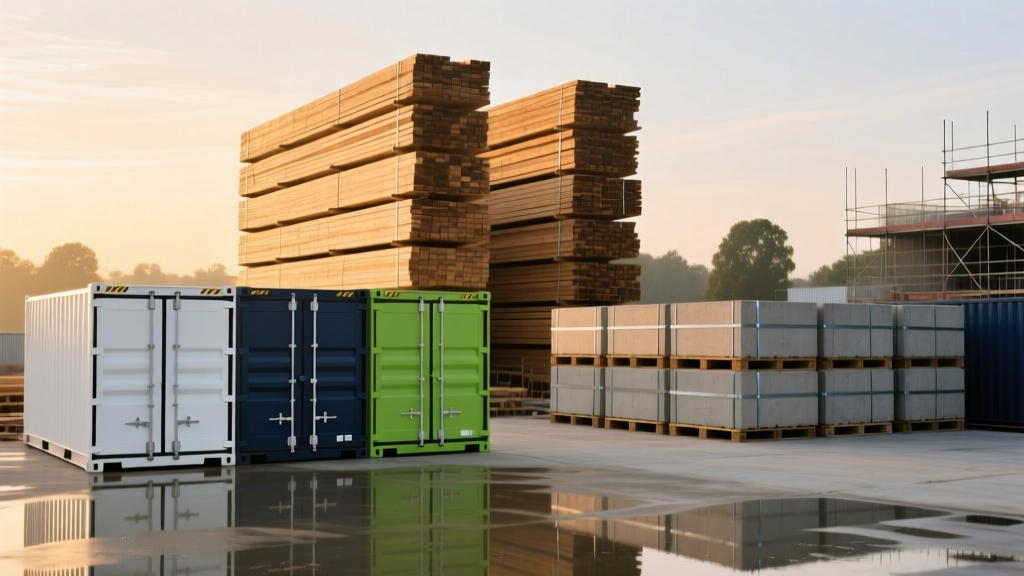
Shrinkage, Security, and Chain of Custody
Inventory shrinkage—the loss of materials due to theft, administrative error, or vendor fraud—accounts for 1% to 3% of total project costs in commercial construction. High-value, easily liquidated items such as copper wire, mini-split HVAC condensers, smart electrical panels, and brass plumbing fixtures require stringent holding security.
Implementing a robust chain of custody requires moving beyond simple padlocks. Modern job sites utilize geofenced RFID tags on high-value pallets. When a tagged HVAC unit crosses the virtual perimeter of the staging zone without an authorized digital sign-out from the site superintendent, an automated alert is triggered. For physical security, modular, steel-walled storage containers equipped with hidden-shackle padlocks (which resist bolt cutter attacks) should be anchored to concrete deadmen or ballasted with water barriers to prevent crane-assisted theft.
Just-in-Time (JIT) vs. Bulk Holding: A Decision Framework
Determining whether to hold bulk materials on-site or utilize Just-in-Time (JIT) delivery depends on a matrix of site constraints, lead times, and weather windows. Use this decision tree to optimize your holding strategy:
- Assess Site Footprint: If the site coverage ratio (building footprint vs. total lot size) exceeds 70%, bulk holding is physically impossible. Mandate JIT delivery with a strict 4-hour staging window.
- Evaluate Supply Chain Volatility: For materials with highly volatile lead times (e.g., custom switchgear, specialized glazing, or imported stone), bulk holding upon arrival is mandatory. Do not rely on JIT for critical-path items with single-source supply chains.
- Calculate Handling Costs: If JIT delivery requires materials to be hoisted to the 14th floor via a crane multiple times a week, the crane rental and rigger labor costs will eclipse the savings of off-site holding. In this scenario, bulk hold materials in a designated floor-by-floor staging zone once the building is dried-in.
- Factor in Weather Windows: In regions with predictable seasonal disruptions (e.g., heavy snow, monsoon seasons), transition to bulk holding 45 days prior to the weather event to prevent work stoppages.
OSHA Compliance and Stacking Safety
Improper material holding is a leading cause of struck-by and crushing injuries on construction sites. OSHA Standard 1926.250 dictates strict parameters for material storage to ensure structural stability and worker safety.
- Lumber: Manual stacking height is limited to 16 feet. If using mechanical equipment (forklifts), the limit increases to 20 feet. All protruding nails must be removed or bent over before stacking.
- Bricks and Masonry: Stacks must not exceed 7 feet in height. A taper of 2 inches per foot of height above 4 feet is required to maintain the center of gravity.
- Steel and Rebar: Must be stored on level, solidly supported sills. Stacks must be cross-tied or secured to prevent rolling or collapsing.
Frequently Asked Questions
Can exposed rebar be salvaged if it develops surface rust during holding?
Yes, within limits. Light, powdery surface rust (mill scale oxidation) on epoxy-coated or uncoated rebar does not compromise the bond strength with concrete and can actually improve mechanical interlocking. However, if the rust is flaky, pitted, or reduces the rebar's nominal diameter, it must be wire-brushed or sandblasted. If pitting is deep, the structural engineer must evaluate the rebar for potential rejection.
How should we handle holding and staging of liquid chemical admixtures in freezing temperatures?
Liquid concrete admixtures (like superplasticizers and accelerators) must be stored in heated, insulated enclosures if temperatures drop below 40°F (4°C). Freezing can cause the active polymers to precipitate out of the suspension. Once thawed, the chemical separation is often irreversible, rendering the admixture ineffective or causing unpredictable flash-setting in the concrete mix.
What is the protocol for holding excess insulation that won't be installed for several months?
Fiberglass and mineral wool batts must be kept in their original compressed packaging until the exact day of installation. Premature opening allows the material to expand and absorb ambient humidity, which reduces its R-value and makes it difficult to fit into standard 16-inch or 24-inch framing cavities. Store uncompressed rigid foam boards (XPS/EPS) flat, weighted evenly, and away from direct sunlight to prevent UV degradation and warping.
Written by
Marcus ChenMarcus Chen is a licensed structural engineer (PE) and building materials analyst with over 12 years of experience across residential, commercial, and industrial construction. He holds a Master of Science in Civil Engineering from UC Berkeley and spent six years at Thornton Tomasetti before transitioning to independent consulting and technical writing. Marcus specializes in material selection for seismic-prone regions, concrete reinforcement strategies, and lifecycle cost analysis. His work has been cited by the American Concrete Institute (ACI) and the Structural Engineers Association of California (SEAOC). When he is not on a job site or at his desk, you will find him hiking the Sierra Nevada or restoring a 1920s craftsman bungalow in Oakland, CA.
More from Marcus Chen
View all
Construction Cost
How Much Did the Eiffel Tower Cost to Build?
How much did the Eiffel Tower cost to build in 1889? We adjust for inflation and compare its budget to modern skyscraper construction.
Aug 4, 2026

Fire Resistance
What Is a Fire Resistant Material? Testing & Certification Guide
Discover what is a fire resistant material through ASTM and UL testing. Learn how fire ratings, certifications, and assemblies work in construction.
Aug 4, 2026

Construction Cost
How Much Did the Burj Khalifa Cost to Build?
How much did the Burj Khalifa cost to build? We break down the $1.5B project and extract 5 money-saving strategies for your next build.
Jul 30, 2026