Yonkers Building Material Sourcing & Supply Guide 2026
Explore the 2026 Yonkers building material market. Discover local sourcing strategies, Westchester code compliance, and logistics for Hudson Valley projects.

The Yonkers Construction Landscape: What's Driving Material Demand?
Yonkers represents one of the most dynamic construction markets in the New York metropolitan area. As the third-most populous city in New York State, its building sector is characterized by a sharp dichotomy: large-scale, high-density multi-family developments along the Hudson River waterfront, and meticulous historic masonry renovations in established neighborhoods like Park Hill and Getty Square. For general contractors and procurement managers, sourcing the right Yonkers building material inventory requires navigating a complex web of Westchester County zoning laws, stringent state energy codes, and highly constrained urban logistics.
In 2026, the shift toward sustainable, high-performance building envelopes has fundamentally altered local supply chains. Developers are moving away from standard cavity wall construction toward prefabricated metal panels, terracotta rainscreens, and advanced continuous insulation systems. Understanding which materials are readily available at regional distribution hubs versus those requiring long-lead custom fabrication is critical for maintaining project schedules in this densely populated corridor.
Core Material Categories for Westchester County Projects
Material selection in Yonkers is heavily dictated by the local architectural vernacular and the New York State Department of State Building Codes. Procurement teams must prioritize products that satisfy both aesthetic requirements and rigorous performance thresholds.
Masonry and Rainscreen Facades
Despite the rise of modern high-rises, masonry remains a dominant facade material in Yonkers, particularly for mid-rise residential and commercial retrofits. Sourcing face brick that complies with ASTM C216 (Standard Specification for Facing Brick) is essential to withstand the region's freeze-thaw cycles. Local architectural boards frequently mandate custom color blends to match historic palettes, requiring contractors to order from specialized manufacturers in the Hudson Valley or Pennsylvania rather than relying on generic big-box inventory. For larger waterfront developments, terracotta rainscreen panels and architectural precast concrete have become the standard, offering lighter weight loads on structural steel frames while providing superior moisture management.
High-Performance Envelope Systems
Window and insulation procurement has become the most critical path item for Yonkers projects. To meet local sustainability mandates, builders are specifying triple-pane fiberglass or thermally broken aluminum window systems. For continuous exterior insulation, high-density mineral wool boards (such as Rockwool Comfortboard 80) and polyisocyanurate (polyiso) rigid foam are heavily specified to eliminate thermal bridging in steel-framed structures.
Code Alert: NYStretch Energy Compliance
Yonkers and the broader Westchester County frequently adopt the NYSERDA NYStretch Energy Code, which surpasses baseline state requirements. For 2026 projects, this typically mandates a maximum window U-factor of 0.22 or lower and requires rigorous blower-door testing for air leakage. Procurement teams must verify that all fenestration products carry NFRC (National Fenestration Rating Council) certifications that explicitly meet these stretched thresholds, as standard builder-grade windows will fail municipal inspections.
Navigating Yonkers Logistics and Supply Chains
The physical delivery of a Yonkers building material order is often more challenging than the procurement itself. Yonkers is geographically bisected by major arteries, including the NYS Thruway (I-87), the Saw Mill River Parkway, and the Cross County Parkway. However, the Cross County Parkway enforces strict commercial vehicle weight and height restrictions, effectively banning heavy flatbeds and material delivery trucks.
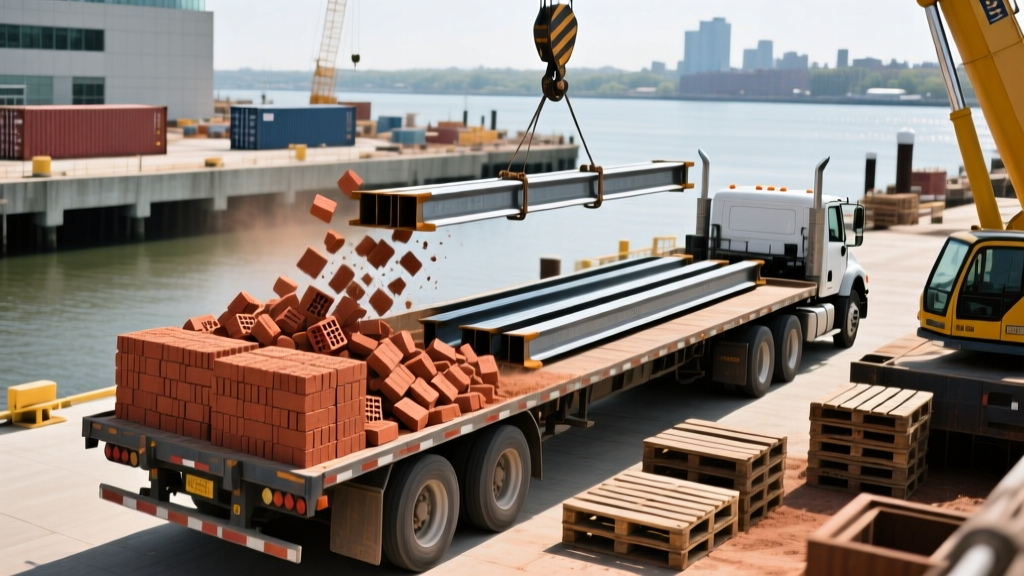
Consequently, heavy structural steel, bulk masonry, and large glass crates must be routed via the Thruway or Route 9A, which frequently suffer from severe congestion. Furthermore, staging materials in dense urban grids like Getty Square or the steep, narrow streets of Park Hill is virtually impossible. Contractors must utilize just-in-time (JIT) delivery protocols, off-site consolidation yards in nearby Greenburgh or Elmsford, or secure expensive municipal street occupancy permits for temporary crane and flatbed staging. Failure to account for these logistical bottlenecks routinely results in demurrage charges and idle labor costs.
2026 Material Lead Times & Pricing Matrix
Market volatility has stabilized compared to the early 2020s, but localized demand in the Hudson Valley keeps specific high-performance materials on extended lead times. The table below outlines current 2026 baseline pricing and procurement windows for the Yonkers metro area.
| Material Category | Specification / Standard | Est. Unit Cost (2026) | Lead Time |
|---|---|---|---|
| Structural Steel (W-Shapes) | ASTM A992 | $1,250 - $1,400 / ton | 10 - 14 weeks |
| Face Brick (Standard Modular) | ASTM C216, Grade SW | $700 - $950 / M | 4 - 8 weeks |
| High-Perf Window Systems | Triple-Pane, U-0.22 | $95 - $140 / sq. ft. | 18 - 26 weeks |
| Mineral Wool Continuous Insulation | 8lb density, 3-inch | $3.20 - $4.10 / sq. ft. | 2 - 4 weeks |
| Engineered Lumber (LVL Beams) | 1.75" x 11.875" | $45 - $60 / lin. ft. | 3 - 5 weeks |
Sourcing Strategies: Local Yards vs. Regional Distributors
When procuring a Yonkers building material, contractors must choose between local supply yards and massive regional distributors. Local suppliers, often clustered along the Nepperhan Avenue and Yonkers Avenue corridors, offer distinct advantages for quick-turnaround needs. They provide same-day delivery for standard dimensional lumber, drywall, and basic masonry supplies, and their dispatchers understand the intricacies of local street parking and alleyway access.
However, for specialized, high-volume, or custom-fabricated materials, regional distributors located in Newburgh, Newark, or the Bronx are necessary. These hubs possess the deep inventory required for large-scale multi-family projects and offer specialized logistics fleets equipped with boom trucks and crane-unloading capabilities. According to the National Institute of Building Sciences, optimizing the supply chain by balancing local quick-ship yards for consumables with regional hubs for structural components reduces overall project material waste and transportation emissions, a key metric for developers pursuing LEED or WELL certifications in Westchester County.
FAQ: Procuring Materials for Yonkers Job Sites
Do I need special permits for material staging on Yonkers streets?
Yes. If your delivery requires occupying a public right-of-way, blocking a travel lane, or setting up a temporary crane, you must secure a Street Occupancy Permit from the Yonkers Department of Public Works. Furthermore, if your staging area is near the Old Croton Aqueduct trail or the Hudson River waterfront, you may face additional environmental runoff restrictions enforced by the NYS DEC, requiring specialized silt fencing and washout containment systems.
How do I verify that my insulation meets Westchester's energy codes?
Do not rely solely on the manufacturer's marketing literature. Request the specific product data sheet and the independent third-party thermal resistance (R-value) test results. Ensure the installed assembly accounts for thermal bridging through steel studs, which can reduce the effective R-value by up to 50%. Specify continuous exterior insulation (ci) to meet the strict NYStretch mandates enforced by local building inspectors.
What is the best strategy for managing long lead times on custom windows?
For high-performance triple-pane window systems, lead times can exceed six months. The most effective strategy is to finalize rough opening dimensions during the schematic design phase and issue a purchase order to the fenestration manufacturer before the foundation is even poured. Utilize temporary, insulated weatherproof enclosures if the building must be dried in before the custom glazing arrives on site.
Written by
Marcus ChenMarcus Chen is a licensed structural engineer (PE) and building materials analyst with over 12 years of experience across residential, commercial, and industrial construction. He holds a Master of Science in Civil Engineering from UC Berkeley and spent six years at Thornton Tomasetti before transitioning to independent consulting and technical writing. Marcus specializes in material selection for seismic-prone regions, concrete reinforcement strategies, and lifecycle cost analysis. His work has been cited by the American Concrete Institute (ACI) and the Structural Engineers Association of California (SEAOC). When he is not on a job site or at his desk, you will find him hiking the Sierra Nevada or restoring a 1920s craftsman bungalow in Oakland, CA.
More from Marcus Chen
View all
Construction Cost
How Much Did the Eiffel Tower Cost to Build?
How much did the Eiffel Tower cost to build in 1889? We adjust for inflation and compare its budget to modern skyscraper construction.
Aug 4, 2026

Fire Resistance
What Is a Fire Resistant Material? Testing & Certification Guide
Discover what is a fire resistant material through ASTM and UL testing. Learn how fire ratings, certifications, and assemblies work in construction.
Aug 4, 2026

Construction Cost
How Much Did the Burj Khalifa Cost to Build?
How much did the Burj Khalifa cost to build? We break down the $1.5B project and extract 5 money-saving strategies for your next build.
Jul 30, 2026