Selecting the Best Bamboo Building Material for Construction
Compare structural poles, laminated bamboo lumber, and strand-woven panels. Use our selection matrix to pick the right bamboo building material.
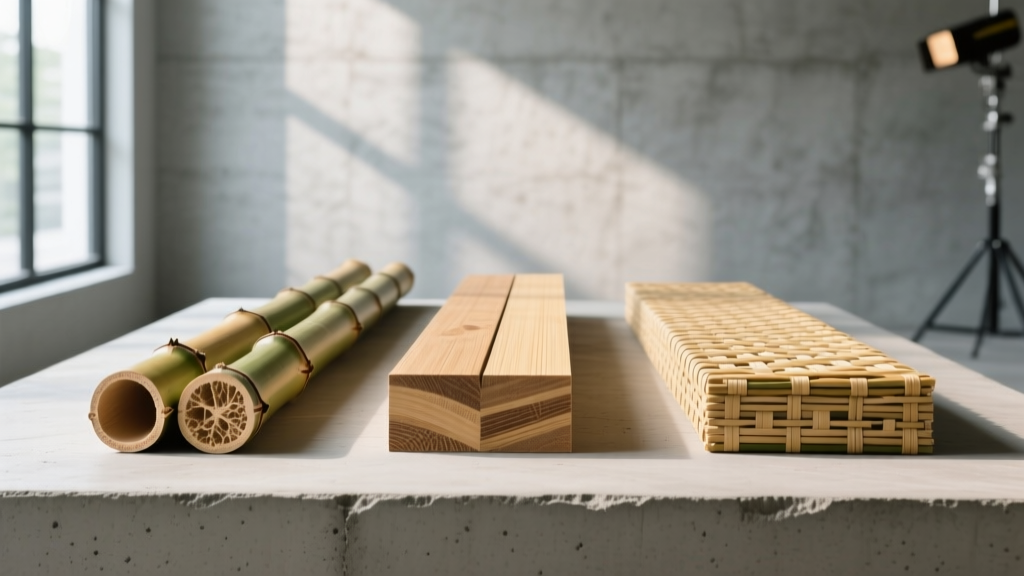
The Core Divide: Raw Culms vs. Engineered Bamboo
Selecting the correct bamboo building material requires navigating the fundamental split between raw culms (poles) and engineered composites. Raw culms offer high tensile strength and organic aesthetics but suffer from dimensional irregularity, tapering, and susceptibility to biological degradation if untreated. Engineered bamboo products—such as Laminated Bamboo Lumber (LBL), strand-woven panels, and plybamboo—standardize the material into predictable, code-compliant dimensional lumber, albeit at a higher embodied energy cost due to processing and adhesives.
Architects and structural engineers must align the material choice with the structural load path, local building codes, and environmental exposure. The following guide breaks down the mechanical properties, treatment requirements, and 2026 procurement realities for both categories.
Structural Poles: Species, Sizing, and ISO Compliance
When utilizing raw bamboo for load-bearing frames, roof trusses, or space grids, species selection dictates the structural capacity. The two dominant species in global construction are Guadua angustifolia and Phyllostachys edulis (Moso).
Guadua angustifolia: The Tropical Structural Standard
Native to Central and South America, Guadua is the premier choice for raw pole construction. It exhibits a compressive strength parallel to the grain of 40–60 MPa and a tensile strength exceeding 150 MPa. For structural applications, specify culms harvested at 4 to 5 years of age, which ensures optimal lignin content and wall thickness. Culms younger than 3 years have high moisture content and will shrink and split upon drying, while those older than 6 years become brittle.
Phyllostachys edulis (Moso): The Temperate Alternative
While Moso is primarily cultivated in China for engineered products, large-diameter Moso poles (80–120mm at the base) are increasingly used in temperate climates for secondary structures, pergolas, and light framing. Moso has a slightly lower tensile strength than Guadua but offers superior straightness and uniform internode lengths, simplifying joinery.
Raw bamboo contains high levels of starch and sugars, making it highly susceptible to powderpost beetles (Lyctidae) and fungal rot. All structural poles must undergo a borax/boric acid dip treatment (minimum 5% solution concentration) for 7 to 14 days post-harvest. Alternatively, specify vertically heated or smoked bamboo, though chemical borate treatment remains the industry standard for long-term structural integrity.
Engineered Bamboo Building Material: LBL and Strand-Woven
For projects requiring predictable modulus of elasticity (MOE), standard dimensional sizing, and compatibility with conventional timber fasteners, engineered bamboo is mandatory.
Laminated Bamboo Lumber (LBL)
LBL is manufactured by slicing bamboo culms into flat strips, treating them, and gluing them under high pressure into beams, columns, and panels. The mechanical properties of LBL rival or exceed traditional softwood glulam. The MOE of structural LBL typically ranges from 10,000 to 14,000 MPa, with a modulus of rupture (MOR) of 80–120 MPa.
Adhesive Specification: For exterior or high-humidity applications (e.g., exposed beams, exterior cladding substrates), specify LBL manufactured with phenol-formaldehyde (PF) or polyurethane (PUR) adhesives. These provide Type I waterproof bonds. For interior applications, polyvinyl acetate (PVA) or soy-based bio-adhesives are acceptable and offer lower VOC emissions.
Strand-Woven Bamboo and Plybamboo
Strand-woven bamboo is created by crushing culms into fibers, mixing them with resin, and compressing them under extreme heat. This process yields a material with a Janka hardness rating of 3,000–4,000 lbf, making it significantly harder than oak or maple. It is the default choice for heavy-duty commercial flooring and stair treads. Plybamboo, constructed similarly to plywood but using cross-laminated bamboo veneers, is utilized for shear wall sheathing, subflooring, and concrete formwork due to its high dimensional stability and reusability.
Material Comparison Matrix
| Material Type | Primary Application | Compressive Strength | Dimensional Stability | Fastener Compatibility |
|---|---|---|---|---|
| Raw Guadua Poles | Roof trusses, space frames, columns | 40–60 MPa | Low (tapering, natural curvature) | Requires specialized lashing or bolted gussets |
| Laminated Bamboo (LBL) | Beams, headers, post-and-beam frames | 60–80 MPa | High (standardized dimensional lumber) | Standard timber screws, bolts, and joist hangers |
| Strand-Woven Panels | Flooring, stair treads, heavy-duty decking | N/A (Rated for hardness: 3000+ lbf) | Very High (minimal expansion/contraction) | Requires pre-drilling; blind-nailing for flooring |
| Plybamboo Sheathing | Shear walls, subfloors, concrete formwork | 15–25 MPa (perpendicular to grain) | High (cross-laminated stability) | Standard ring-shank nails, staples |
Application-Specific Selection Framework
Use the following decision parameters to specify the correct bamboo building material for your 2026 project pipeline:
- Primary Structural Framing (Commercial): Specify LBL beams and columns. Raw poles rarely pass local building department plan reviews for commercial occupancies without extensive, costly peer-review engineering exceptions. LBL integrates seamlessly with steel moment frames and conventional concrete foundations.
- Residential Roof Trusses: Raw Guadua is highly effective for residential or pavilion structures, provided the design utilizes bolted steel gusset plates at the nodes rather than traditional lashings, which loosen over time due to seasonal humidity fluctuations.
- Exterior Cladding Substrate: Use exterior-grade plybamboo. It provides a stable, rot-resistant nailing base for rain-screen systems and does not warp like OSB or standard plywood when exposed to bulk moisture during construction delays.
- Interior Flooring: Specify strand-woven bamboo with a UV-cured aluminum oxide finish. Ensure the moisture content of the delivered product is acclimated to the site's equilibrium moisture content (EMC), typically 6-9% for climate-controlled interiors, for a minimum of 72 hours before installation.
2026 Procurement Costs and Certification Requirements
Market pricing for bamboo materials has stabilized following the supply chain disruptions of the early 2020s, though freight costs remain a significant variable for projects outside of Asia and South America. Below are baseline material costs (excluding shipping and installation) for the North American and European markets:
Current Material Pricing Estimates
- Structural Guadua Poles (4-6" diameter, treated): $12.00 – $22.00 per linear foot.
- Structural LBL Beams (3.5" x 11.75" standard): $14.00 – $24.00 per linear foot.
- Strand-Woven Flooring (5/8" thick, T&G): $6.50 – $11.00 per square foot.
- Exterior Plybamboo Sheathing (3/4" thick, 4x8 sheets): $85.00 – $130.00 per sheet.
Sustainability and Certification
To qualify for LEED v4.1 Materials and Resources (MR) credits or BREEAM equivalents, the bamboo building material must carry Forest Stewardship Council (FSC) certification. While bamboo is technically a grass and regenerates rapidly, FSC certification ensures that the harvesting practices do not degrade the local ecosystem, that worker safety standards are met, and that the chemical treatments used (like borates) are managed responsibly to prevent groundwater contamination.
Furthermore, when specifying engineered bamboo, request the manufacturer's Environmental Product Declaration (EPD) and formaldehyde emission test results. Ensure the product meets CARB Phase 2 or EPA TSCA Title VI standards for composite wood products, guaranteeing ultra-low emitting material (ULEM) status for indoor air quality compliance.
"The transition of bamboo from an alternative, vernacular material to a mainstream structural component relies entirely on the adoption of engineered composites and strict adherence to ISO grading standards. Raw poles have their place in architectural expression, but LBL is what will scale bamboo into multi-story urban construction." — World Bamboo Organization Technical Committee
Common Procurement Mistakes to Avoid
1. Ignoring Moisture Content (MC) at Delivery: Bamboo is highly hygroscopic. If LBL or strand-woven products are shipped in unsealed containers and absorb moisture during transit, they will warp upon acclimation. Always specify that the supplier must wrap engineered bamboo in vapor-barrier plastic and include silica gel desiccants for ocean freight.
2. Using Interior Adhesives in Exterior Applications: A common failure mode in bamboo decking and exterior beams is delamination. This occurs when contractors source cheaper, interior-grade PVA-glued LBL for outdoor use. Always verify the adhesive type on the mill certificate; exterior applications strictly require PF or PUR resins.
3. Failing to Seal End Grains: Whether using raw poles or LBL, the end grain acts as a capillary network, drawing moisture deep into the material. All cut ends must be sealed immediately on-site with a high-solids polyurethane or epoxy end-sealer to prevent checking, splitting, and internal fungal growth.
Written by
Sarah WhitfieldSarah Whitfield is a chartered quantity surveyor (MRICS) and construction cost analyst with 15 years of experience in material pricing, procurement strategy, and project budgeting. She earned her degree in Construction Management from the University of Reading (UK) and has worked on projects ranging from $2M custom homes to $180M mixed-use developments across North America and Europe. Sarah currently leads cost estimating for BuildMat Insight, maintaining a proprietary database of 4,000+ material price points updated quarterly. She is a frequent contributor to RSMeans cost data panels and has presented at the International Cost Engineering Council (ICEC) congress. Based in Denver, CO, Sarah is an avid trail runner and volunteer mentor for Women in Construction.
More from Sarah Whitfield
View all
Wood & Lumber
What Are the Different Types of Wood? A Builder's Guide
Compare structural softwoods, finish hardwoods, and engineered lumber. Analyze Janka ratings, MOE values, and 2026 pricing for construction.
Aug 4, 2026

Walls & Panels
Steel Framing vs Wood Framing: Corrosion and Moisture Defense
Compare steel framing vs wood framing for moisture resistance. Learn about galvanized coatings, condensation risks, and corrosion protection strategies.
Jul 21, 2026

Stone & Masonry
How to Cut Stone Veneer: Wet Saw vs Grinder Comparison
Compare the best tools for cutting stone veneer. We review wet saws, angle grinders, and chop saws to help you achieve clean, chip-free cuts.
Jul 21, 2026