Bamboo Cut Wind Build: Sustainable Wind-Resistant Structures
Analyze the sustainability of the bamboo cut wind build methodology, covering harvest timing, wind-load engineering, and carbon data.

The Intersection of Harvesting and Aerodynamic Engineering
In the niche of sustainable architecture, the bamboo cut wind build methodology refers to the integrated practice of precision harvesting (the cut) combined with flexible, aerodynamic structural engineering (the wind build) to create hurricane and typhoon-resistant structures. Unlike rigid concrete or steel frames that resist wind loads through sheer mass and stiffness, bamboo structures dissipate kinetic energy through high tensile flexibility and structural damping. When evaluated through a 2026 lifecycle assessment (LCA) lens, this approach yields a net-negative carbon footprint, provided the harvesting and treatment protocols are strictly adhered to.
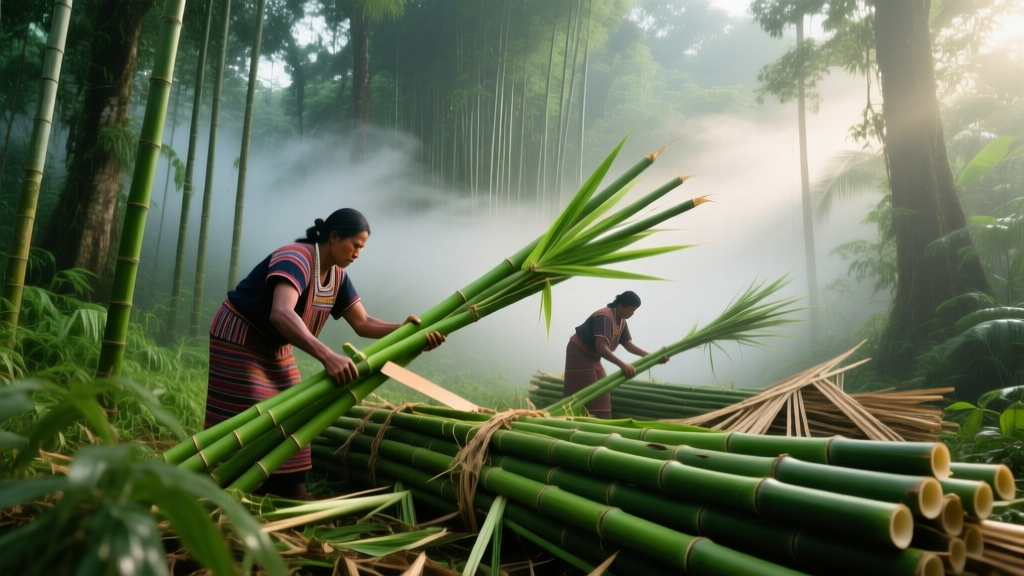
Executing a proper bamboo cut wind build requires understanding that structural integrity begins in the forest, not on the job site. The modulus of elasticity (MOE) and silica content—which dictate how well a culm will bend under extreme wind shear without snapping—are entirely dependent on the exact age, season, and time of day the bamboo is harvested.
The Science of the Bamboo Cut: Timing and Silica Content
For structural wind builds, Guadua angustifolia remains the premier species due to its exceptional tensile strength (up to 400 MPa) and large diameter. However, its performance in high-wind zones is compromised if harvested incorrectly.
Maturity and Lignification
Bamboo must be harvested between 36 and 60 months of age. Before 36 months, the culm lacks sufficient lignin and silica, making it prone to buckling under wind loads and highly susceptible to fungal decay. After 60 months, the outer fibers become brittle, reducing the damping ratio required for wind resistance.
Starch Depletion and Harvest Timing
To prevent attacks from the bamboo borer (Dinoderus minutus), which can hollow out the inner walls and catastrophically weaken the culm's shear capacity, harvesting must occur during the dry season. Cutting at dawn, when photosynthesis is inactive and starch levels in the culm are at their lowest, is a critical biological safeguard.
Carbon Sequestration Highlight
A managed Guadua plantation sequesters approximately 12 to 15 tonnes of CO2 per hectare annually. Because the 'bamboo cut' only removes mature culms, the root system (rhizome) remains intact, immediately triggering the growth of new shoots and maintaining continuous carbon drawdown—a stark contrast to the clear-cutting required for timber windbreaks.
Engineering the Wind Build: Flexibility and Jointing
The 'wind build' aspect of this methodology relies on the principles outlined in ISO 22156:2021 (Bamboo — Structural design). High-wind events, such as Category 4 hurricanes, generate immense lateral loads and uplift forces. Bamboo's high strength-to-weight ratio allows the structure to sway, dissipating wind energy rather than fighting it.
The Vulnerability of Connections
The culms themselves rarely fail in high winds; the joints do. Traditional lashing techniques are insufficient for modern wind-load requirements (such as ASCE 7-22 standards). Modern bamboo cut wind builds utilize injection-molded node joints, threaded steel rebar driven through the diaphragms, and structural epoxy grout. This prevents the culm from splitting under torsional wind stress while maintaining the overall flexibility of the frame.
Material Comparison for High-Wind Zones
How does the bamboo cut wind build methodology compare to conventional materials when designing for 150+ mph wind zones? The table below illustrates the structural and environmental trade-offs.
| Material | Tensile Strength | Wind Damping Ratio | Embodied Carbon (kg CO2e/kg) | 2026 Avg. Material Cost |
|---|---|---|---|---|
| Guadua Bamboo (Treated) | 150 - 400 MPa | High (Flexible) | -0.5 (Net Negative) | $3.50 - $8.00 / linear meter |
| Structural Steel (W-shape) | 400 - 550 MPa | Low (Rigid) | +1.8 to +2.5 | $1.20 - $1.80 / kg |
| Cross-Laminated Timber (CLT) | 15 - 30 MPa | Medium | -0.2 to +0.4 | $45.00 - $65.00 / sq ft |
Preservation: Ensuring Longevity in High-Moisture Wind Zones
Wind builds are frequently located in coastal or tropical environments where high wind is accompanied by high humidity and salt spray. Untreated bamboo will lose its structural shear strength within 18 to 24 months due to fungal rot. The World Bamboo Organization strongly advocates for non-toxic, boron-based preservation methods for structural applications.
The Boucherie Method
For raw culm treatment, the Boucherie method is the industry standard. By attaching a pressure pump to the freshly cut base of the bamboo, the natural sap is displaced with a solution of borax and boric acid. This treatment penetrates the entire vascular bundle, providing deep-termite resistance and fungal protection without introducing heavy metals or volatile organic compounds (VOCs) into the environment. Expect to add $1.50 to $2.50 per linear meter to your budget for professional Boucherie treatment.
Warning: Avoid CCA Treatment
Chromated Copper Arsenate (CCA) is sometimes illegally or ignorantly used to treat bamboo in developing regions. CCA is highly toxic, leaches into the soil, and makes the bamboo impossible to safely burn or compost at the end of its life, entirely negating the sustainability benefits of the bamboo cut wind build approach. Always specify boron-based salts (e.g., Tim-bor or Bora-Care equivalents).
Lifecycle Assessment (LCA) and End-of-Life
The true sustainability of the bamboo cut wind build methodology is realized at the end of the structure's lifecycle. According to data aggregated by the International Bamboo and Rattan Organization (INBAR), bamboo structures can last 50+ years if kept dry (e.g., elevated on concrete footings and protected by wide roof overhangs). When the structure is eventually decommissioned, boron-treated bamboo can be safely chipped and used as agricultural mulch, returning its sequestered carbon to the soil food web. In contrast, wind-damaged steel requires energy-intensive recycling, and pressure-treated timber ends up in landfills, leaching chemicals.
Frequently Asked Questions
Can bamboo structures pass modern building codes in hurricane zones?
Yes, but it requires rigorous engineering. While bamboo is not explicitly covered in all regional residential codes, structures can be permitted using alternative materials provisions (such as Section 104.11 of the IBC). Engineers must provide specific wind-load calculations, tensile testing certificates for the exact batch of bamboo, and stamped joint-design schematics to local authorities.
How does bamboo handle wind-driven rain and moisture intrusion?
Bamboo itself is highly resistant to water penetration through its outer epidermal layer due to high silica content. The vulnerability lies in the joints and the end-grains. Wind builds must utilize sealed, epoxy-capped end-grains and elevated steel shoe joints to prevent capillary action from drawing wind-driven rain up into the culm walls.
Is it more sustainable to use engineered bamboo lumber instead of raw culms?
Engineered bamboo (laminated bamboo lumber or LBL) offers more predictable structural grading for wind loads but carries a higher embodied carbon cost due to the heat, pressure, and synthetic resins (often formaldehyde-based, though bio-resins are emerging in 2026) required for manufacturing. For pure carbon sequestration and minimal processing, raw culm wind builds remain superior, provided the architectural design accommodates the natural taper and irregularities of the raw material.
Written by
Priya KapoorPriya Kapoor is a real estate market analyst and construction economics researcher with expertise in housing affordability, development feasibility, and infrastructure investment. She holds a Master of Regional Planning from Cornell University and previously worked as a senior analyst at CBRE's Investment Properties group, where she modeled returns for $4B in mixed-use development pipelines. Priya now runs an independent research practice advising developers, municipalities, and REITs on construction cost forecasting and market timing. She publishes the quarterly "BuildMat Market Pulse" report tracking material price indices across 12 commodity categories. Based in Austin, TX, Priya serves on the board of Habitat for Humanity Austin and is a marathon runner.
More from Priya Kapoor
View all
Construction Cost
Cost to Build a 1600 Sq Ft Home in 2026: Full Breakdown
Accurate 2026 cost to build a 1600 sq ft home—material, labor, and regional pricing breakdowns included. Plan your budget with real-time estimates.
Aug 11, 2026

Wood & Lumber
Name the Types of Wood for Pressure Treatment and Preservation
Learn how to name the types of wood best suited for pressure treatment. Compare species treatability, chemical retention levels, and 2026 preservation costs.
Aug 4, 2026

Stone & Masonry
Stone Veneer Suppliers Lindenhurst: 2026 Cost Analysis
Analyze 2026 stone veneer costs in Lindenhurst, NY. Compare local supplier pricing, delivery fees, and Suffolk County installation labor rates.
Aug 4, 2026