The Best Brown Material for Compost From Construction Site Debris
Discover the best brown material for compost by repurposing construction site debris. Learn C:N ratios, particle sizing, and SWMP integration for 2026.

The Engineering of Carbon: Repurposing C&D Waste for Site Composting
Construction and demolition (C&D) debris generation continues to climb, with millions of tons of organic waste sent to landfills annually. For large-scale developers, commercial landscapers, and sustainable builders, on-site composting has evolved from a niche eco-practice into a core component of Site Waste Management Plans (SWMP). Diverting organic waste avoids escalating 2026 landfill tipping fees—which now average $68 to $85 per ton for C&D materials—and directly contributes to LEED v4.1 Construction and Demolition Waste Management credits.
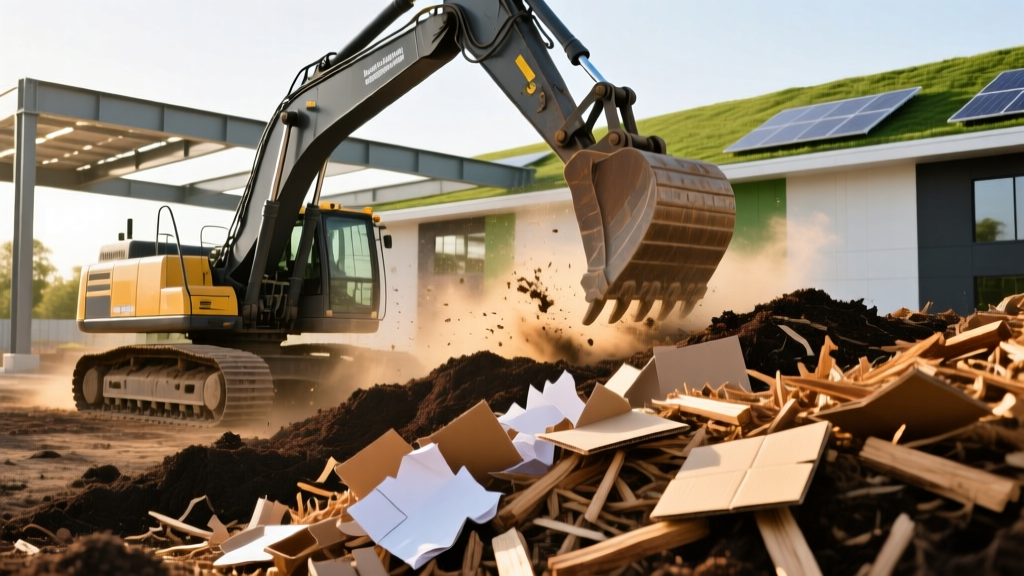
The primary bottleneck in large-scale composting is sourcing sufficient carbon-rich bulking agents, commonly known as "browns." While municipal operations rely on autumn leaf litter, construction sites must look to their own waste streams. Identifying the best brown material for compost requires analyzing the carbon-to-nitrogen (C:N) ratio, lignin content, and structural porosity of available site debris. When engineered correctly, these materials provide the energy skeleton for thermophilic bacteria to break down nitrogen-heavy "greens" (like site-clearing brush and crew food waste) into stable, Grade-A compost for final landscaping.
Material Matrix: Evaluating Construction Debris for Composting
Not all carbon sources behave identically in a windrow. The physical structure and chemical composition of the brown material dictate aeration, moisture retention, and decomposition velocity. Below is a comparative matrix of the most viable C&D brown materials.
| Material Source | C:N Ratio | Target Particle Size | Optimal Volume % in Pile | Breakdown Timeline |
|---|---|---|---|---|
| Corrugated Cardboard (Packaging) | 350:1 | 2-inch strips | 15% - 20% | 2 - 4 Months |
| Untreated Wood Chips (SPF Offcuts) | 300:1 | 0.5 - 1 inch | 30% - 40% | 6 - 12 Months |
| Straw Erosion Blankets / Wattles | 75:1 | 4-inch segments | 20% - 30% | 3 - 5 Months |
| Drywall Paper Facing (Gypsum Waste) | 200:1 | Shredded < 1 inch | < 5% (Strict Limit) | 1 - 2 Months |
1. Corrugated Cardboard from Appliance and Material Packaging
Construction sites generate massive volumes of corrugated cardboard from appliance deliveries, HVAC equipment, and finish material packaging. As a highly concentrated carbon source (350:1), cardboard is an exceptional brown material, provided it is processed correctly. The waxy exterior and synthetic adhesives used in heavy-duty packaging can repel water and stall microbial action.
Processing Protocol: Cardboard must be shredded into 2-inch strips using an industrial shear or slow-speed shredder. Leaving cardboard in large sheets creates anaerobic pockets where water pools and oxygen is excluded. According to the Cornell Waste Management Institute, shredded corrugated paper provides excellent initial porosity, though it collapses quickly as the hemicellulose breaks down, requiring a secondary bulking agent like wood chips to maintain long-term aeration.
2. Untreated Dimensional Lumber Offcuts and Sawdust
Scrap spruce-pine-fir (SPF) and Douglas fir from framing operations represent the most abundant and structurally stable brown material on a job site. Wood provides the essential lignin and carbon required to sustain the thermophilic (high-heat) phase of composting. However, raw 2x4 offcuts take years to decompose.
Processing Protocol: All untreated lumber must be fed through a horizontal grinder (such as a Vermeer HG6000 or equivalent) to achieve a uniform particle size of 0.5 to 1 inch. Sapwood breaks down significantly faster than heartwood due to lower lignin concentrations and higher starch content. Sawdust from site miter saws should be used sparingly; its microscopic particle size drastically reduces pile porosity, leading to anaerobic conditions unless heavily mixed with coarse straw or wood chips.
3. Straw Erosion Control Blankets and Wattles
Following site stabilization and the establishment of permanent vegetation, straw wattles and erosion control blankets are often removed or left to degrade. Straw is arguably the most balanced brown material available on a construction site, boasting a C:N ratio of roughly 75:1. Unlike wood, the hollow stems of straw provide natural, rigid aeration channels that prevent pile compaction.
Processing Protocol: The waxy cuticle on straw stems protects the inner cellulose from microbial attack. Mechanical abrasion via a tub grinder or flail mower is mandatory to fracture the stems into 4-inch segments, exposing the inner carbon to decomposing fungi and bacteria.
⚠ Toxicity Warning: Prohibited C&D Materials
Never introduce pressure-treated lumber (ACQ, CA-C, or legacy CCA), engineered wood products (OSB, plywood, LVL), or asphalt shingles into a compost windrow. Engineered woods contain urea-formaldehyde and phenol-formaldehyde resins that are highly toxic to soil microbiology. Copper-based wood preservatives (like ACQ) will accumulate in the finished compost, rendering it phytotoxic and lethal to sensitive plant species.
Managing Gypsum Board (Drywall) Waste in Compost Systems
Gypsum board is a frequent target for C&D diversion, but it presents unique chemical challenges in a composting environment. While the paper facing is a viable brown material, the calcium sulfate dihydrate core introduces high levels of sulfur. Under aerobic conditions, gypsum is relatively benign and can provide beneficial calcium to the final soil amendment. However, if the compost pile becomes compacted and shifts to anaerobic conditions, sulfate-reducing bacteria (such as Desulfovibrio) will convert the sulfate into hydrogen sulfide (H2S) gas.
H2S is highly toxic, smells intensely of rotten eggs, and will trigger immediate complaints from neighboring properties. To mitigate this risk, limit drywall waste to less than 5% of the total pile volume, ensure it is thoroughly crushed and mixed with high-porosity wood chips, and monitor pile oxygen levels to ensure they remain above 5%.
Financial Impact: Tipping Fees vs. On-Site Composting
The economic argument for integrating composting into site development is substantial. According to the U.S. Environmental Protection Agency (EPA), sustainable management of C&D debris significantly reduces the environmental footprint of development projects. In 2026, the financial mechanics are equally compelling:
- Avoided Tipping Fees: A mid-sized 50-lot subdivision clearing and framing operation can generate upwards of 150 tons of organic and packaging waste. At an average regional tipping fee of $75/ton, diverting this material saves the general contractor $11,250 in direct disposal costs.
- LEED Certification Credits: Under USGBC LEED v4.1, diverting 50% to 75% of C&D waste earns critical points toward certification, increasing the asset value and marketability of commercial and high-end residential builds.
- Offset Topsoil Purchases: The finished compost can be blended with on-site subsoils to manufacture engineered topsoil for final grading, eliminating the cost of importing commercial topsoil, which frequently exceeds $45 per cubic yard delivered.
Step-by-Step: Integrating Composting into Site Waste Management Plans
Successful on-site composting requires rigorous operational discipline. Site superintendents must treat the compost windrow as an active biological reactor, not a passive trash pile.
- Source Separation at the Point of Generation: Deploy clearly labeled, color-coded bins for untreated wood, cardboard, and general C&D waste. Contamination with plastics, metal fasteners, or treated wood at the source will ruin the final compost batch and damage grinding equipment.
- Batch Mixing and C:N Calibration: Use a front-end loader to mix browns and greens in a 3:1 ratio by volume. Target a starting C:N ratio of 30:1. If the pile fails to heat up, add nitrogen-rich greens (e.g., grass clippings from site clearing). If the pile smells of ammonia, incorporate more shredded cardboard or wood chips.
- Moisture Management: The biological breakdown requires a moisture content of 50% to 60%. Perform the "squeeze test": grab a handful of compost while wearing a glove and squeeze firmly. Exactly one to two drops of water should escape. If it is dry, irrigate the windrow during the turning process using a water truck.
- Active Aeration and Temperature Monitoring: Turn the windrows every 3 to 5 days using an excavator or dedicated windrow turner to introduce oxygen. Insert a 36-inch compost temperature probe into the core of the pile. The target temperature for the thermophilic phase is 135°F to 160°F. Maintaining 135°F for at least 72 consecutive hours is mandatory to eradicate invasive weed seeds from site-clearing brush and neutralize human pathogens.
Frequently Asked Questions
Can I use painted or stained wood offcuts as a brown material?
No. Paints, stains, and primers contain heavy metals, volatile organic compounds (VOCs), and synthetic binders that will contaminate the compost and harm soil biology. Only raw, untreated, and unpainted dimensional lumber should be chipped for the windrow.
How long does it take for construction site compost to cure?
The active thermophilic phase lasts 21 to 60 days, depending on aeration and moisture. However, the compost must then enter a curing phase for an additional 2 to 4 months. Curing allows mesophilic fungi to break down complex lignins and stabilizes the pH, ensuring the material will not tie up soil nitrogen or burn plant roots when applied to the final landscape.
Is site-generated compost safe for use in vegetable gardens on residential builds?
If the compost is strictly limited to untreated wood, straw, and cardboard, and achieves the required 135°F pathogen-kill threshold, it is safe for all agricultural uses. However, if there is any risk of cross-contamination with treated wood, asphalt, or unknown demolition debris, restrict the use of the compost to ornamental landscaping, turf establishment, and tree planting beds.
Written by
Priya KapoorPriya Kapoor is a real estate market analyst and construction economics researcher with expertise in housing affordability, development feasibility, and infrastructure investment. She holds a Master of Regional Planning from Cornell University and previously worked as a senior analyst at CBRE's Investment Properties group, where she modeled returns for $4B in mixed-use development pipelines. Priya now runs an independent research practice advising developers, municipalities, and REITs on construction cost forecasting and market timing. She publishes the quarterly "BuildMat Market Pulse" report tracking material price indices across 12 commodity categories. Based in Austin, TX, Priya serves on the board of Habitat for Humanity Austin and is a marathon runner.
More from Priya Kapoor
View all
Construction Cost
Cost to Build a 1600 Sq Ft Home in 2026: Full Breakdown
Accurate 2026 cost to build a 1600 sq ft home—material, labor, and regional pricing breakdowns included. Plan your budget with real-time estimates.
Aug 11, 2026

Wood & Lumber
Name the Types of Wood for Pressure Treatment and Preservation
Learn how to name the types of wood best suited for pressure treatment. Compare species treatability, chemical retention levels, and 2026 preservation costs.
Aug 4, 2026

Stone & Masonry
Stone Veneer Suppliers Lindenhurst: 2026 Cost Analysis
Analyze 2026 stone veneer costs in Lindenhurst, NY. Compare local supplier pricing, delivery fees, and Suffolk County installation labor rates.
Aug 4, 2026