Choosing the Best Material for Drill Bits: A Pro Application Guide
Discover the best material for drill bits based on your substrate. This application guide covers HSS, cobalt, carbide, and diamond bits for construction.

Drilling through 5,000 PSI reinforced concrete requires vastly different metallurgy than boring through 316 stainless steel or dense Ipe hardwood. Selecting the best material for drill bits is not about finding a single universal tool; it requires matching the bit's core substrate, geometry, and coating to the workpiece's hardness, abrasiveness, and thermal conductivity. Using the wrong metallurgy results in rapid edge degradation, work-hardening of metals, or catastrophic bit shattering. This application guide breaks down the exact drill bit materials required for specific construction and fabrication tasks, providing actionable specifications for professional contractors and fabricators.
Substrate-to-Bit Decision Matrix
Before evaluating specific alloy grades, use this matrix to identify the optimal bit material class for your primary workpiece. This framework eliminates guesswork on the job site.
| Workpiece Material | Recommended Bit Core | Optimal Coating | Primary Failure Mode to Avoid |
|---|---|---|---|
| Mild Steel & Aluminum | High-Speed Steel (M2) | Black Oxide or TiN | Chip welding (aluminum) |
| Stainless Steel (304/316) | Cobalt Alloy (M35 / M42) | TiAlN (Violet) | Thermal softening & work-hardening |
| Brick, Block, & Soft Masonry | Carbide-Tipped (YG8) | Uncoated / Bright | Carbide tip braze failure |
| Poured Concrete & Rebar | Solid Carbide (SDS-Max) | Uncoated / Bright | Flute packing & torsional snapping |
| Porcelain Tile & Glass | Diamond Grit (Electroplated) | N/A | Thermal shock & edge chipping |
| Reinforced Concrete Core | Diamond Segmented (Sintered) | N/A | Matrix glazing over rebar |
High-Speed Steel (HSS) & Cobalt Alloys: Metal and Wood Workhorses
For structural steel framing, HVAC ductwork, and dense timber, High-Speed Steel (HSS) remains the baseline. However, standard HSS is not a monolith. The molybdenum and tungsten ratios dictate the bit's red-hardness—the ability to retain its cutting edge at elevated temperatures.
M2, M35, and M42 Grades Explained
- M2 (Standard HSS): Contains roughly 6% tungsten and 5% molybdenum. Excellent for mild steel, aluminum, and wood. Maximum operating temperature before edge softening is approximately 1,050°F (565°C).
- M35 (5% Cobalt): The addition of 5% cobalt increases red-hardness to roughly 1,110°F. This is the mandatory minimum for drilling stainless steel (like 304 or 316 grade handrail mounts), as stainless steel acts as a thermal insulator, trapping heat at the cutting edge.
- M42 (8% Cobalt): With 8% cobalt and higher carbon content, M42 bits maintain hardness up to 1,150°F. Use these specifically for hardened structural bolts, cast iron, and titanium alloys.
Never rely on trigger-feel for metal drilling. Use the standard formula to prevent burning out M2 and M35 bits:
RPM = (3.82 × SFM) / Drill DiameterFor 316 Stainless Steel, target an SFM (Surface Feet per Minute) of 25-35. For a 1/4" (0.25") bit: RPM = (3.82 × 30) / 0.25 = 458 RPM. Use cutting oil continuously to suppress heat.
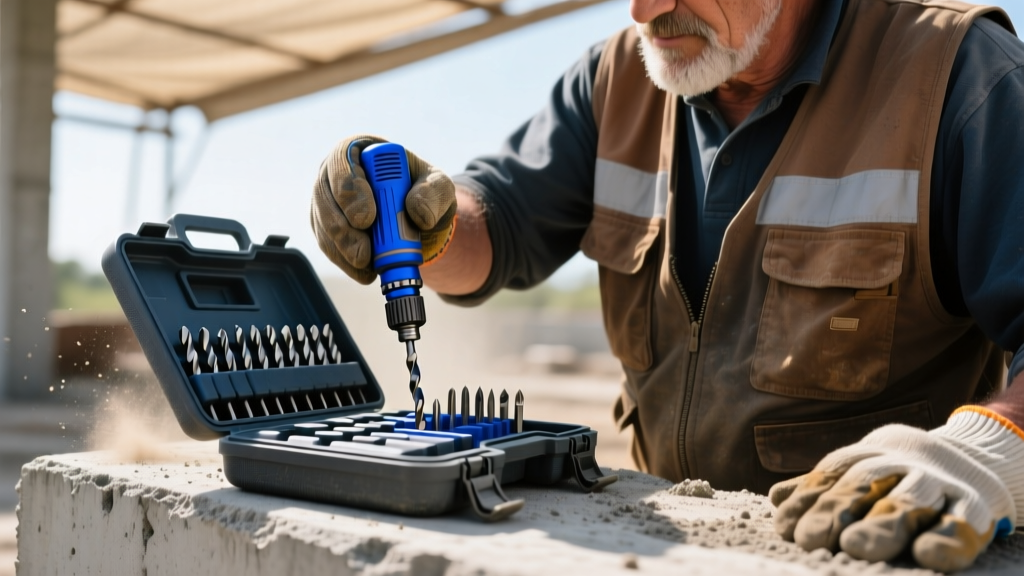
Carbide-Tipped vs. Solid Carbide: Masonry and Concrete Applications
When anchoring sill plates, running conduit through foundations, or installing structural tie-downs, masonry bits are required. These bits utilize Tungsten Carbide (WC) bonded with cobalt. The ratio of carbide to cobalt dictates the balance between impact resistance and wear resistance.
Decoding Carbide Grades (YG8 vs. YG6)
Manufacturers use ISO grading systems to classify carbide toughness. For construction drilling, you will primarily encounter YG-class carbides:
- YG8 (8% Cobalt Binder): Higher cobalt content makes the carbide tip tougher and more resistant to chipping under high-impact hammer drilling. This is the best material for drill bits targeting soft masonry, cinder block, and older, degraded brick.
- YG6 (6% Cobalt Binder): Lower cobalt yields a harder, more wear-resistant tip that holds a sharp edge longer but is more brittle. Deploy YG6 bits for modern high-PSI poured concrete and abrasive aggregate.
Shank Selection: SDS-Plus vs. SDS-Max
The bit material is only half the equation; the shank must match the hammer drill's torque output. SDS-Plus shanks (10mm) are rated for holes up to 5/8" in diameter. For structural anchor bolts requiring 3/4" to 1-1/4" holes, you must transition to SDS-Max (18mm) shanks paired with solid carbide 4-cutter heads to prevent the bit from snapping under the torsional load of hitting rebar.
"When drilling into engineered concrete, the silica dust generated is a severe respiratory hazard. Always pair rotary hammer drilling with shrouded dust extraction systems to comply with strict permissible exposure limits (PEL)." — Occupational Safety and Health Administration (OSHA)
Diamond Grit and Core Bits: Tile, Glass, and Reinforced Concrete
For finishing trades and heavy civil work, traditional cutting edges fail entirely. Diamond bits do not cut; they grind. The best material for drill bits in these scenarios depends on how the diamonds are bonded to the steel blank.
Electroplated vs. Sintered Diamond Bonds
- Electroplated (Single-Layer): Diamonds are bonded to the surface via a nickel electroplating process. These bits are aggressive and cut cleanly through porcelain tile, ceramic, and glass without chipping the edges. However, once the single layer of diamonds wears away, the bit is dead. Use strictly for finish carpentry and tile setting.
- Sintered (Metal-Bonded Segments): Diamonds are mixed into a powdered metal matrix and sintered under high heat and pressure into segments welded to a steel core barrel. As the metal matrix wears away during drilling, fresh, sharp diamonds are continuously exposed. This is the only viable option for core drilling through reinforced concrete, asphalt, and natural stone.
Wet vs. Dry Diamond Drilling
Sintered diamond core bits used in heavy construction must be water-cooled. Water serves three critical functions: it suppresses hazardous silica dust, cools the steel core to prevent warping, and flushes the abrasive slurry from the kerf. Dry diamond bits exist but are strictly limited to small-diameter masonry work and soft brick; attempting to dry-core 6" reinforced concrete will melt the segment braze and destroy the bit in seconds.
The Role of Coatings: TiN, TiAlN, and Black Oxide
Coatings do not change the core material of the bit, but they drastically alter surface friction, heat dissipation, and chip flow. According to advanced machining data from Sandvik Coromant, selecting the correct physical vapor deposition (PVD) coating can increase bit life by up to 300% in high-volume production.
- Black Oxide: A cheap, porous conversion coating that holds cutting oil. Excellent for aluminum and mild steel to prevent chip welding. Offers no real thermal protection.
- TiN (Titanium Nitride): The classic gold coating. Hardness of 80-85 HRC. Low friction coefficient makes it ideal for wood and plastics, but it degrades at temperatures above 1,000°F, making it unsuitable for dry-drilling stainless steel.
- TiAlN (Titanium Aluminum Nitride): Recognizable by its violet/bronze hue. This is the premium coating for hard metals. When heated, the aluminum in the coating forms a protective ceramic oxide layer on the bit's surface, allowing it to withstand cutting temperatures up to 1,470°F (800°C). This is the mandatory coating for M35 and M42 cobalt bits used in structural steel fabrication.
Troubleshooting Premature Bit Failure
Even the best material for drill bits will fail if the application parameters are ignored. Use this diagnostic framework to identify and correct job-site bit destruction.
Symptom 1: The Bit Burns the Wood or Melts the Plastic
- Cause: RPM is too high, or the bit is not being retracted frequently enough to clear chips (peck drilling). The flutes are packed, creating friction instead of cutting.
- Fix: Reduce RPM by 30%. Implement a strict peck-drilling cycle, retracting the bit fully every 1/2 inch of depth to clear the swarf.
Symptom 2: The Masonry Bit Tip Shatters Upon Impact
- Cause: Using a standard straight-shank carbide bit in a high-joule SDS-Max rotary hammer, or striking hardened rebar with a 2-cutter (chisel) tip instead of a 4-cutter (cross) tip.
- Fix: Upgrade to an SDS-Max 4-cutter solid carbide bit. The 4-cutter geometry distributes the impact force evenly across the rebar, preventing the carbide from catching and snapping.
Symptom 3: The HSS Bit Dulls Instantly in Stainless Steel
- Cause: Running the drill too fast with insufficient feed pressure. This work-hardens the austenitic stainless steel surface, making it harder than the drill bit itself.
- Fix: Switch to an M42 cobalt bit with a TiAlN coating. Apply heavy, consistent downward pressure to ensure the bit is actually cutting metal, not just rubbing it, and flood the zone with sulfurized cutting oil.
Written by
Marcus ChenMarcus Chen is a licensed structural engineer (PE) and building materials analyst with over 12 years of experience across residential, commercial, and industrial construction. He holds a Master of Science in Civil Engineering from UC Berkeley and spent six years at Thornton Tomasetti before transitioning to independent consulting and technical writing. Marcus specializes in material selection for seismic-prone regions, concrete reinforcement strategies, and lifecycle cost analysis. His work has been cited by the American Concrete Institute (ACI) and the Structural Engineers Association of California (SEAOC). When he is not on a job site or at his desk, you will find him hiking the Sierra Nevada or restoring a 1920s craftsman bungalow in Oakland, CA.
More from Marcus Chen
View all
Construction Cost
How Much Did the Eiffel Tower Cost to Build?
How much did the Eiffel Tower cost to build in 1889? We adjust for inflation and compare its budget to modern skyscraper construction.
Aug 4, 2026

Fire Resistance
What Is a Fire Resistant Material? Testing & Certification Guide
Discover what is a fire resistant material through ASTM and UL testing. Learn how fire ratings, certifications, and assemblies work in construction.
Aug 4, 2026

Construction Cost
How Much Did the Burj Khalifa Cost to Build?
How much did the Burj Khalifa cost to build? We break down the $1.5B project and extract 5 money-saving strategies for your next build.
Jul 30, 2026