Leading Companies for Green-Building Turf Materials & LEED Credits
Discover the leading companies for green-building turf materials that earn LEED credits. Compare eco-friendly synthetic grass specs, costs, and certs.

The LEED v4.1 Framework for Synthetic Turf
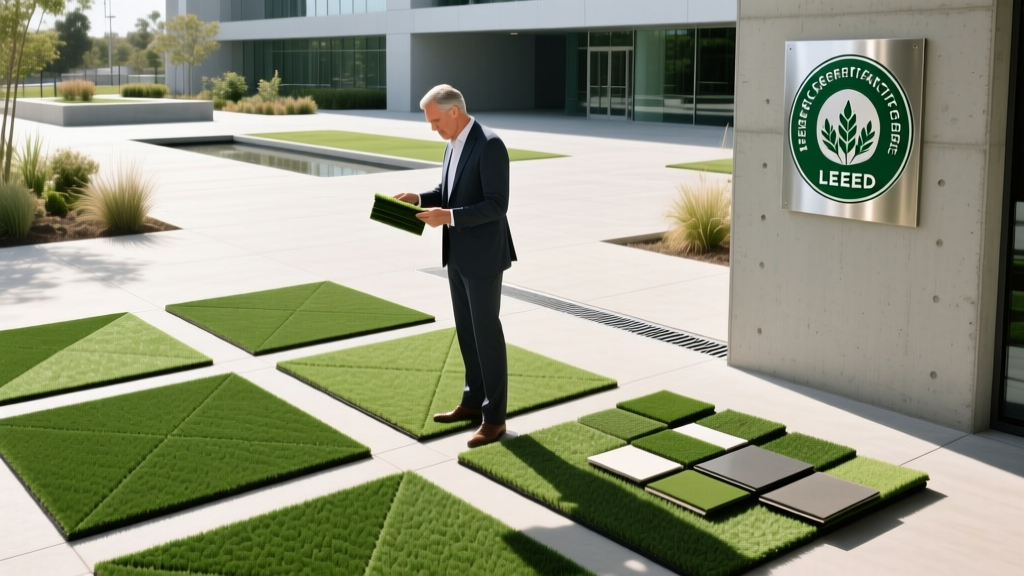
Integrating synthetic turf into LEED-certified commercial, educational, and municipal projects requires navigating a complex matrix of environmental standards. While artificial grass inherently supports Water Efficiency (WE) credits by eliminating irrigation, it historically struggles with Sustainable Sites (SS) Heat Island Reduction and Materials & Resources (MR) transparency mandates. Selecting the right system means moving beyond basic aesthetics and specifying products engineered for environmental compliance. According to the USGBC LEED Framework, material selection must now account for full lifecycle impacts, supply chain transparency, and microclimate effects.
Target LEED Credits for Turf Specifications
- SS Credit: Heat Island Reduction: Non-roof surfaces must achieve a Solar Reflectance Index (SRI) of at least 29. Standard polyethylene turf typically yields an SRI between 10 and 15, failing this credit. You must specify infrared-reflective (IR) yarns and specialized thatch layers to approach the threshold, while mitigating the localized heat island effect documented by the EPA Heat Island Effect guidelines.
- WE Credit: Outdoor Water Use Reduction: Replacing natural grass with synthetic turf in non-playing field zones easily secures the 100% water reduction benchmark for those specific landscape areas, contributing heavily to the overall site water budget.
- MR Credit: Building Product Disclosure: Requires Environmental Product Declarations (EPDs) and Health Product Declarations (HPDs) to verify the absence of red-list chemicals, document lifecycle impacts, and prove responsible sourcing.
Evaluating Leading Companies Green-Building Turf Materials LEED Portfolios
When sourcing leading companies green-building turf materials LEED project managers should prioritize manufacturers that publish third-party verified EPDs and offer alternative, non-petroleum infill systems. The Synthetic Turf Council emphasizes that modern sustainable turf relies heavily on the synergy between the face fiber, the backing system, and the infill matrix. Below are the top-tier manufacturers currently dominating the sustainable turf sector in 2026.
1. Tarkett Sports (FieldTurf)
Flagship Product: FieldTurf Revolution 360 with CoolPlay Technology.
LEED Advantage: Tarkett provides comprehensive EPDs for their FieldTurf lines. Their proprietary CoolPlay top-dressing utilizes a cork and sand mixture instead of crumb rubber, significantly reducing volatile organic compound (VOC) emissions and lowering surface temperatures by up to 35°F. The IR-reflective yarn options help push the SRI closer to the required threshold, while the tuft-bind strength exceeds 8 lbs, ensuring longevity and reducing replacement cycles.
2. Shaw Sports Turf
Flagship Product: Legion 46 with GeoFill and HydroChill.
LEED Advantage: Shaw is a pioneer in Cradle-to-Cradle (C2C) certified flooring, and this philosophy extends to their turf systems. GeoFill utilizes organic cork and coconut fibers, providing a 100% natural infill that sequesters carbon. Shaw publishes detailed HPDs, making it exceptionally easy for specifiers to earn MR credits for material ingredient transparency. Their HydroChill evaporative cooling technology further addresses the Heat Island credit requirements.
3. SYNLawn
Flagship Product: SYNLawn Commercial Landscape Series with SoyBACK.
LEED Advantage: SYNLawn replaces up to 60% of the petroleum-based polyurethane backing with soybean oil. This bio-based backing drastically reduces the embodied carbon of the product. Furthermore, SYNLawn utilizes plant-based infill options and provides robust documentation for LEED’s Building Product Disclosure and Optimization credits, specifically targeting the bio-based materials pathway.
Comparative Selection Matrix
Use the following matrix to compare the leading companies green-building turf materials LEED specifications side-by-side for your 2026 project bids.
| Manufacturer | LEED-Optimized Product | Infill System | EPD / HPD Status | Est. Cost (Installed) |
|---|---|---|---|---|
| Tarkett / FieldTurf | Revolution 360 (CoolPlay) | Cork / Sand Mix | EPD Verified | $11.50 - $14.00 / sq ft |
| Shaw Sports Turf | Legion 46 | GeoFill (Cork/Coconut) | EPD & HPD Available | $10.00 - $13.50 / sq ft |
| SYNLawn | Commercial Landscape | Envirofill / Organic | HPD Published | $9.50 - $12.50 / sq ft |
Infill & Shock Pad Specifications for Material Transparency
The turf face fiber is only one component of the system. The infill and underlying shock pads represent the bulk of the system's weight and environmental impact. To maximize LEED MR credits, avoid traditional SBR (Styrene Butadiene Rubber) crumb rubber, which often contains heavy metals and VOCs that can disqualify a project from indoor/outdoor air quality and material transparency credits.
Recommended Sustainable Infills
- Thermoplastic Elastomer (TPE): A virgin, engineered polymer that is 100% recyclable at the end of its life. TPE infill does not leach heavy metals and maintains consistent G-max (shock absorption) ratings over time.
- Organic Cork and Coconut: Naturally resistant to microbial growth, these infills require no chemical treatments. They also retain moisture, which facilitates evaporative cooling, directly supporting Heat Island Reduction strategies.
- Acrylic-Coated Sand (e.g., Envirofill): While heavier, high-quality coated sands prevent dust migration and are fully inert, ensuring no chemical leaching into the site's stormwater management system.
The Role of Shock Pads
For projects requiring ASTM F1292 impact attenuation (common in playgrounds and recreational plazas), specify closed-cell foam shock pads made from recycled polyolefins. Brock PowerBase systems, for example, are engineered to provide drainage rates exceeding 50 inches per hour, which aids in LEED Sustainable Sites Rainwater Management credits by allowing rapid permeation into underlying French drains or bioswales.
2026 Pricing & Lifecycle ROI
While LEED-compliant turf systems carry a higher initial capital expenditure compared to basic residential-grade turf, the lifecycle ROI justifies the investment for commercial properties.
Cost Breakdown (Per Square Foot)
- Base Preparation & Grading: $2.50 - $4.00 (Includes permeable aggregate base for stormwater management).
- LEED-Grade Turf Material: $4.50 - $7.00 (Reflects IR-yarns and bio-based backings).
- Sustainable Infill & Shock Pad: $2.00 - $3.50 (Cork, TPE, or specialized shock pads).
- Labor & Installation: $2.50 - $4.50.
Total Installed Cost: $11.50 to $19.00 per square foot, depending on site complexity and shock attenuation requirements.
The ROI is realized through the elimination of irrigation (saving $0.50 - $1.20 per sq ft annually in water-scarce regions), zero chemical fertilizers, and the elimination of gas-powered mowing equipment maintenance. Furthermore, achieving LEED Platinum or Gold certification can increase commercial property valuations by 7% to 12% in major metropolitan markets.
Final Procurement Checklist
- Request the manufacturer's most current EPD (ISO 14025 compliant) and HPD (v2.3 or later).
- Demand a written PFAS-Free Guarantee covering both the yarn extrusion and the backing adhesive.
- Verify the SRI value of the specific colorway chosen; darker greens will require more aggressive IR-reflective technology to meet the SRI 29 threshold.
- Specify a permeable aggregate base (e.g., ASTM D448 No. 57 stone) to ensure the turf system does not negatively impact the site's overall runoff coefficient.
Written by
Sarah WhitfieldSarah Whitfield is a chartered quantity surveyor (MRICS) and construction cost analyst with 15 years of experience in material pricing, procurement strategy, and project budgeting. She earned her degree in Construction Management from the University of Reading (UK) and has worked on projects ranging from $2M custom homes to $180M mixed-use developments across North America and Europe. Sarah currently leads cost estimating for BuildMat Insight, maintaining a proprietary database of 4,000+ material price points updated quarterly. She is a frequent contributor to RSMeans cost data panels and has presented at the International Cost Engineering Council (ICEC) congress. Based in Denver, CO, Sarah is an avid trail runner and volunteer mentor for Women in Construction.
More from Sarah Whitfield
View all
Wood & Lumber
What Are the Different Types of Wood? A Builder's Guide
Compare structural softwoods, finish hardwoods, and engineered lumber. Analyze Janka ratings, MOE values, and 2026 pricing for construction.
Aug 4, 2026

Walls & Panels
Steel Framing vs Wood Framing: Corrosion and Moisture Defense
Compare steel framing vs wood framing for moisture resistance. Learn about galvanized coatings, condensation risks, and corrosion protection strategies.
Jul 21, 2026

Stone & Masonry
How to Cut Stone Veneer: Wet Saw vs Grinder Comparison
Compare the best tools for cutting stone veneer. We review wet saws, angle grinders, and chop saws to help you achieve clean, chip-free cuts.
Jul 21, 2026