Materials Science and Engineering Building Material Selection
Explore applied materials science and engineering building techniques, from self-healing bio-concrete to ASR mitigation and embodied carbon metrics.
The Intersection of Materials Science and Structural Engineering
Traditional civil engineering relies on macro-level empirical testing to validate structural integrity. However, modern construction demands a shift toward the micro and nano scales. The discipline of materials science and engineering building integration bridges this gap, focusing on the atomic and molecular structures that dictate a material's macroscopic performance. By understanding crystalline phase transitions, pore network geometries, and chemical degradation pathways, engineers can specify advanced building materials that actively respond to environmental stressors rather than merely resisting them.
This comprehensive guide details the practical application of advanced materials science in building envelopes, structural frameworks, and thermal management systems, providing actionable specifications for modern construction projects.
Advanced Material Matrices for Modern Construction
Selecting the right advanced material requires balancing microstructural benefits against project economics. The matrix below outlines four leading material innovations currently transitioning from laboratory environments to commercial building applications.
| Material Class | Microstructural Mechanism | Primary Performance Metric | Cost Premium vs. Standard |
|---|---|---|---|
| Self-Healing Bio-Concrete | Bacterial precipitation of calcium carbonate | Autogenous crack sealing up to 0.8mm | +18% to 22% |
| Silica Aerogel Blankets | Nanoporous network restricting gas conduction | Thermal conductivity: 14 mW/m·K | +300% to 400% |
| Phase Change Materials (PCMs) | Latent heat absorption during solid-liquid transition | Peak load shifting: 15-25% HVAC reduction | +12% to 15% (wall assembly) |
| UHPFRC (Ultra-High Performance) | Dense particle packing, steel micro-fibers | Compressive strength: >21,000 psi | +150% to 200% |
Deep Dive: Self-Healing Bio-Concrete Specifications
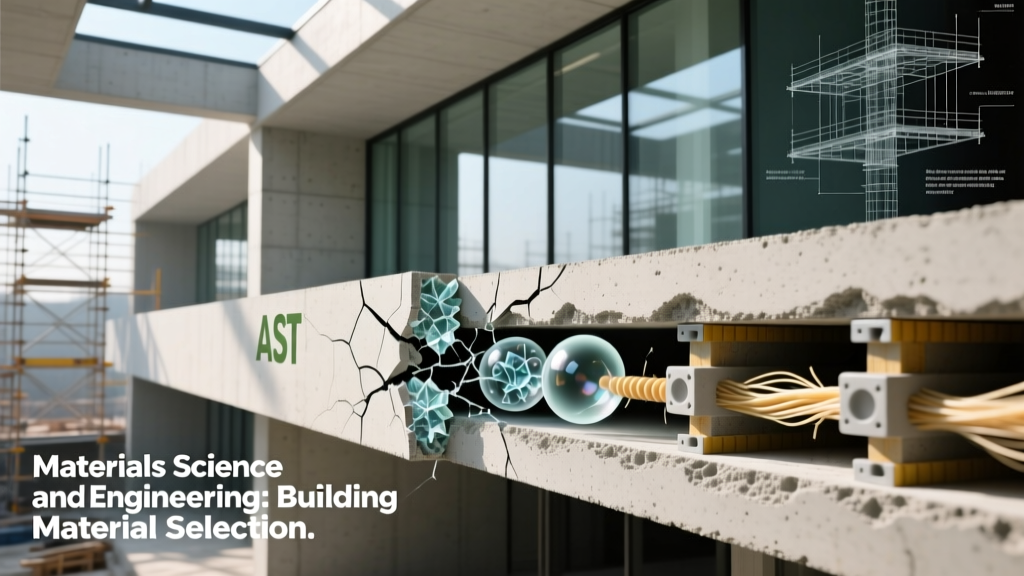
Standard Ordinary Portland Cement (OPC) concrete is inherently brittle and prone to micro-cracking, which accelerates chloride ingress and rebar corrosion. Self-healing concrete integrates alkaliphilic bacteria—specifically Bacillus pseudofirmus or Bacillus cohnii—encapsulated within expanded clay aggregates alongside a calcium lactate nutrient source.
When a crack forms and water enters, the bacteria germinate, metabolize the calcium lactate, and precipitate limestone (calcium carbonate), effectively sealing the crack. For structural engineers specifying this material, the target application is below-grade foundations and marine environments where crack injection is cost-prohibitive. Expect a material cost of approximately $165 to $185 per cubic yard, compared to $135 for standard 4,000 PSI OPC mixes. According to research published by the MIT Concrete Sustainability Hub, the lifecycle extension of bio-concrete in aggressive chloride environments offsets the initial capital premium within 12 to 15 years by eliminating epoxy injection maintenance cycles.
Deep Dive: Aerogel Insulation in High-Performance Envelopes
Silica aerogels are synthesized via supercritical drying, replacing the liquid phase of a silica gel with gas without collapsing the solid nanoporous network. This results in a material composed of up to 95% air, with pore diameters smaller than the mean free path of air molecules (70 nanometers), effectively eliminating gaseous thermal conduction.
Products like Aspen Aerogels' Spaceloft offer an R-value of approximately 10.3 per inch, compared to R-5 per inch for closed-cell spray foam. While the upfront cost is substantial (often exceeding $4.50 per board foot equivalent), aerogels are strictly specified in historical retrofits or high-density urban builds where maximizing interior leasable square footage outweighs the material cost. A 2-inch aerogel blanket achieves the same thermal resistance as a 4-inch polyiso board, reclaiming critical interior volume.
Failure Modes and Microstructural Analysis
Understanding why building materials fail at the micro-level is critical for preventative specification. One of the most insidious degradation mechanisms in concrete structures is the Alkali-Silica Reaction (ASR).
ASR occurs when amorphous silica in certain aggregates reacts with alkali hydroxides in the cement pore solution, forming a hygroscopic gel. This gel absorbs water, swells, and induces internal tensile stresses that exceed the concrete's tensile strength, leading to map cracking and spalling.
Actionable Specification: If local aggregate testing (ASTM C1260) indicates high reactivity, mandate a minimum 25% replacement of OPC with Class F fly ash or a 50% replacement with Ground Granulated Blast-furnace Slag (GGBS). This reduces the alkalinity of the pore solution and refines the capillary pore structure, starving the ASR gel of the moisture required for expansion. Refer to the Portland Cement Association's durability guidelines for precise mix design adjustments.
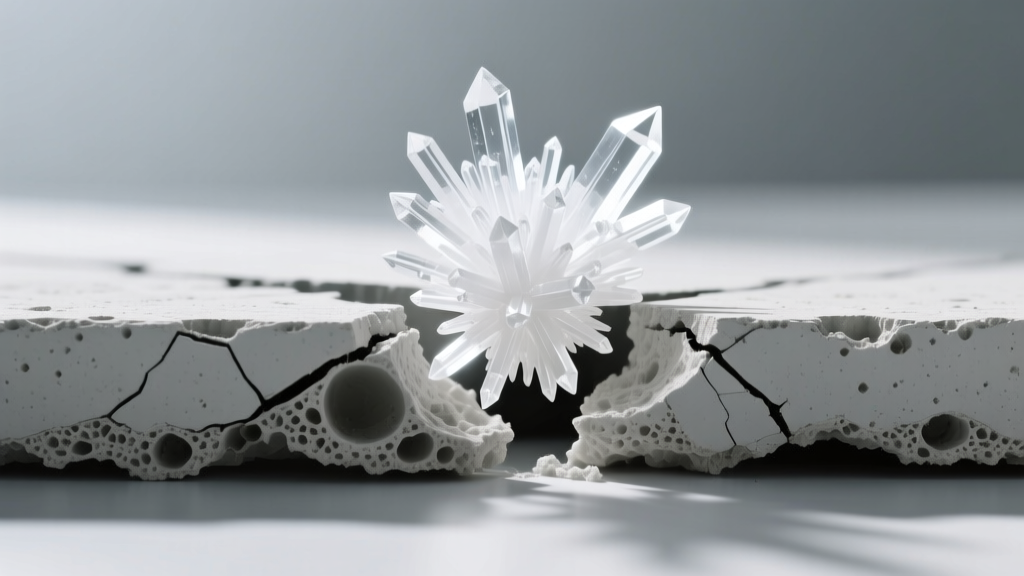
Another critical failure mode is delayed ettringite formation (DEF). If concrete curing temperatures exceed 70°C (158°F) during early hydration, ettringite crystals dissolve and fail to form properly. Years later, as the structure cools and absorbs moisture, ettringite reprecipitates in the hardened paste, causing severe expansion. To prevent DEF in mass concrete pours (e.g., thick mat foundations), engineers must specify Type IV cement or utilize liquid nitrogen cooling of the mixing water to ensure peak internal temperatures remain below 65°C.
Lifecycle Assessment (LCA) and Embodied Carbon Metrics
Materials science is increasingly driven by decarbonization. Evaluating building materials now requires rigorous Environmental Product Declarations (EPDs). The National Institute of Standards and Technology (NIST) provides foundational frameworks for measuring these impacts.
- Ordinary Portland Cement (OPC): Produces approximately 300 to 350 kgCO2e per cubic meter of concrete. The calcination of limestone (CaCO3 → CaO + CO2) accounts for roughly 60% of these emissions.
- Portland-Limestone Cement (Type IL): Replaces 5-15% of clinker with uncalcined limestone, reducing embodied carbon by 8-12% without compromising 28-day compressive strength.
- Geopolymer Concrete: Utilizes aluminosilicate precursors (fly ash, slag) activated by alkaline solutions. Eliminates OPC entirely, yielding embodied carbon reductions of 60% to 80%, though curing requires strict thermal management and availability is currently limited to regional markets.
Specifying Materials: A Decision Framework
Use the following logic flow to determine the optimal advanced material specification for your building envelope or structural framework:
- Assess Environmental Exposure: Is the structure within 5 miles of a coastline or exposed to de-icing salts?
If Yes: Specify UHPFRC or bio-concrete to eliminate micro-cracking and prevent chloride diffusion. Set maximum water-to-cementitious ratio (w/cm) to 0.35. - Evaluate Spatial Constraints: Is the project a zero-lot-line urban retrofit where wall thickness directly impacts leasable area?
If Yes: Specify silica aerogel blankets for continuous insulation (ci) to meet IECC R-value requirements within a 2-inch cavity. - Analyze Thermal Mass Requirements: Does the building rely on passive solar design with high diurnal temperature swings?
If Yes: Integrate microencapsulated Phase Change Materials (PCMs) into the interior gypsum board or concrete topping slabs to flatten peak HVAC loads.
Frequently Asked Questions
Can self-healing concrete repair structural macro-cracks?
No. The bacterial precipitation mechanism is strictly limited to autogenous healing of micro-cracks, typically up to 0.8mm in width. Structural macro-cracks resulting from shear failure, excessive deflection, or foundation settlement require traditional epoxy injection or carbon fiber reinforced polymer (CFRP) wrapping. Bio-concrete is a durability enhancement, not a structural fail-safe.
How does materials science address the fire performance of advanced composites?
Advanced composites, such as Fiber Reinforced Polymers (FRP), possess high strength-to-weight ratios but degrade rapidly at elevated temperatures due to the glass transition (Tg) of the polymer matrix. Materials engineers address this by incorporating intumescent coatings that expand to form a protective char layer at 200°C, or by utilizing inorganic geopolymer matrices instead of organic epoxies to achieve non-combustible fire ratings.
What is the primary limitation of using aerogel insulation in commercial builds?
Beyond the high initial capital cost, aerogel blankets are highly hydrophobic but possess low compressive strength. They cannot be used in below-grade applications where hydrostatic pressure or physical backfill compression is present, nor can they serve as structural sheathing. They must be protected by rigid cladding or interior furring channels to prevent mechanical crushing during occupancy.
Written by
Sarah WhitfieldSarah Whitfield is a chartered quantity surveyor (MRICS) and construction cost analyst with 15 years of experience in material pricing, procurement strategy, and project budgeting. She earned her degree in Construction Management from the University of Reading (UK) and has worked on projects ranging from $2M custom homes to $180M mixed-use developments across North America and Europe. Sarah currently leads cost estimating for BuildMat Insight, maintaining a proprietary database of 4,000+ material price points updated quarterly. She is a frequent contributor to RSMeans cost data panels and has presented at the International Cost Engineering Council (ICEC) congress. Based in Denver, CO, Sarah is an avid trail runner and volunteer mentor for Women in Construction.
More from Sarah Whitfield
View all
Wood & Lumber
What Are the Different Types of Wood? A Builder's Guide
Compare structural softwoods, finish hardwoods, and engineered lumber. Analyze Janka ratings, MOE values, and 2026 pricing for construction.
Aug 4, 2026

Walls & Panels
Steel Framing vs Wood Framing: Corrosion and Moisture Defense
Compare steel framing vs wood framing for moisture resistance. Learn about galvanized coatings, condensation risks, and corrosion protection strategies.
Jul 21, 2026

Stone & Masonry
How to Cut Stone Veneer: Wet Saw vs Grinder Comparison
Compare the best tools for cutting stone veneer. We review wet saws, angle grinders, and chop saws to help you achieve clean, chip-free cuts.
Jul 21, 2026