Best Material for Pants: 2026 Construction Workwear Guide
Discover the best material for pants on the job site. Compare canvas, ripstop, and FR fabrics for durability, safety, and mobility in construction.

The Physics of Job Site Trousers: Beyond Basic Cotton
Selecting the best material for pants on a construction site is not a matter of aesthetic preference; it is a calculated decision involving abrasion resistance, thermal degradation thresholds, and biomechanical mobility. A framing crew operating in the Pacific Northwest faces vastly different textile requirements than a structural welding team in Texas. In 2026, advancements in yarn-spinning technology and durable water repellent (DWR) chemistries have fundamentally shifted the workwear landscape, moving the industry away from heavy, restrictive fabrics toward high-tenacity, lightweight composites.
The wrong fabric choice leads to premature garment failure, restricted range of motion during deep squats, and in high-risk trades, severe burn injuries. This guide deconstructs the exact material specifications, weave structures, and safety compliance metrics required to match work pants to specific construction disciplines.
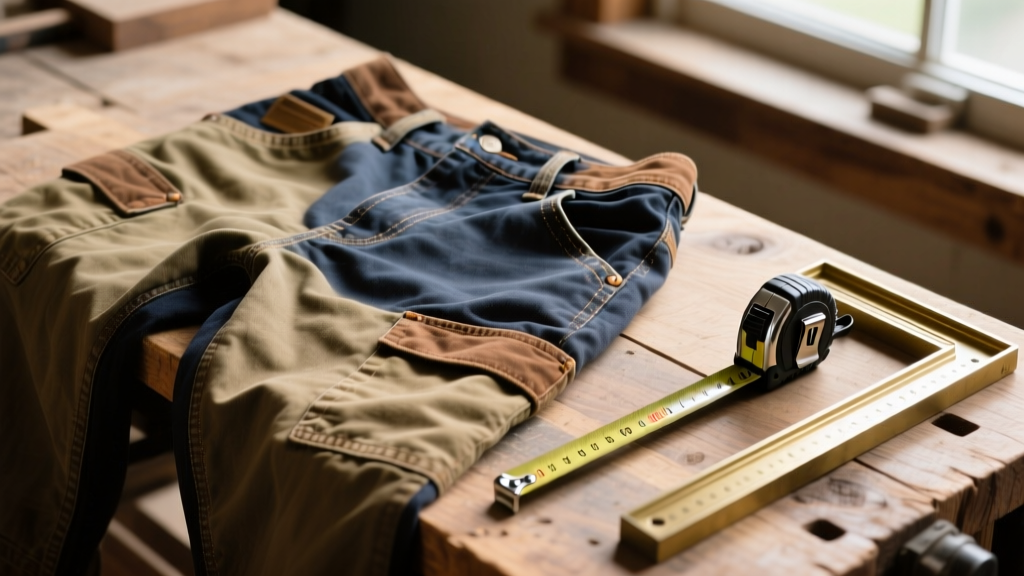
The Core Contenders: Fabric Breakdown for Job Sites
The foundation of any work pant dictates its baseline durability and environmental suitability. Here is how the primary textile categories perform under rigorous job site conditions.
1. Ring-Spun Cotton Duck Canvas (12 oz to 14 oz/yd²)
The traditional benchmark for heavy-duty workwear. Cotton duck utilizes a plain weave where the warp and weft yarns cross alternately, creating a dense, highly abrasion-resistant surface. Ring-spun cotton is significantly stronger and softer than open-end cotton because the fibers are continuously twisted into a smooth, unbroken yarn. While a 14-ounce canvas offers exceptional protection against splinters and sharp edges, it lacks mechanical stretch, absorbs moisture aggressively (becoming heavy and freezing in cold weather), and requires a lengthy break-in period.
2. Ripstop Poly-Cotton Blends (65/35 or 50/50, 7 oz to 9 oz/yd²)
Ripstop fabrics integrate a reinforcement yarn in a crosshatch pattern, typically at 1/4-inch intervals. If a puncture occurs from a protruding nail or rebar, the tear is isolated to a single grid square, preventing catastrophic seam blowouts. A 65% polyester / 35% cotton blend offers superior moisture-wicking, rapid dry times, and high colorfastness compared to 100% cotton. This is the optimal baseline material for high-mobility trades operating in warm climates.
3. High-Tenacity Nylon (Cordura®) Overlays (500D to 1000D)
While rarely used for the entire garment due to its low melting point and lack of breathability, 500-Denier or 1000-Denier nylon is the mandatory standard for high-wear overlays. Applied to knee panels, cuff hems, and tool pocket edges, Cordura nylon provides up to 10 times the abrasion resistance of standard cotton duck when tested under ASTM D3884 rotary platform standards.
4. Inherent FR Blends (Modacrylic / Cotton / Nylon)
For electricians and welders, flame-resistant (FR) materials are non-negotiable. Unlike treated FR cotton (which loses its protective qualities after repeated industrial washings), inherent FR blends utilize fibers like modacrylic that are naturally flame-resistant at the molecular level. A common specification is an 88% cotton / 12% high-tenacity nylon blend, which provides the comfort of cotton with the structural integrity and arc-flash protection required for electrical work.
Material Selection Matrix by Trade
Use this decision matrix to align the best material for pants with your specific construction discipline and environmental hazards.
| Trade / Discipline | Optimal Primary Material | Weight / Denier | Critical Feature Requirement |
|---|---|---|---|
| Carpentry / Framing | Ripstop Poly-Cotton Blend | 8 oz/yd² | Gusseted crotch, mechanical stretch, hammer loop |
| Heavy Civil / Concrete | 100% Ring-Spun Cotton Duck | 12-14 oz/yd² | Double-front panels, 1000D nylon knee overlays |
| Electrical / Utilities | Inherent FR Modacrylic Blend | 7.5 oz/yd² (ATPV 8+ cal/cm²) | NFPA 70E Cat 2 compliant, non-melting hardware |
| HVAC / Plumbing | Canvas with Spandex Blend | 9 oz/yd² (2% elastane) | Articulated knees, high moisture-wicking capability |
Understanding Fabric Weights, Weaves, and Hardware
The raw fiber is only half the equation. How the yarn is woven and the hardware attached dictates the garment's real-world lifespan.
Twill vs. Plain Weave Mechanics
While canvas uses a plain weave (over-under), twill weaves (like denim or specific work pant fabrics) pass the weft thread over one or more warp threads, creating a diagonal rib pattern. Twill fabrics drape better, resist wrinkling, and hide stains more effectively than plain weaves, making them highly favored for finish carpenters and site supervisors who require a cleaner appearance without sacrificing durability.
Hardware: Zippers and Rivets
A fabric rated for 500 days of wear is useless if the zipper fails in month two. For heavy construction, specify YKK brass coil or metal-tooth zippers. Nylon coil zippers degrade under UV exposure and snap under lateral tension when workers kneel. Furthermore, all stress points—specifically the corners of utility pockets and the base of the fly—must be reinforced with bartack stitching (a dense, zigzag stitch pattern) or copper rivets to prevent tear propagation.
Real-World Failure Modes: Why Work Pants Blow Out
Understanding where and why pants fail allows you to select design features that mitigate specific textile weaknesses.
- The Crotch Blowout: Caused by tensile stress during deep squats or ladder climbing. The Fix: Mandate a gusseted crotch. A gusset is a diamond or triangular piece of fabric sewn into the inseam intersection, redistributing stress across four seams instead of one and providing an extra 3 to 4 inches of biomechanical give.
- Knee Abrasion and Blowouts: Kneeling on concrete or gravel rapidly degrades the front thigh fabric. The Fix: Look for double-front construction with bottom openings to insert closed-cell foam or hard-cap knee pads. The outer layer should be reinforced with 500D Cordura.
- Cuff Fraying: The back hem drags on the ground and catches on boot heels. The Fix: Select pants with a kick patch (a hidden layer of 1000D nylon at the inner back hem) or a slightly longer inseam that can be hemmed with a heavy-duty chain stitch.
Cost vs. Lifespan Analysis
Purchasing the cheapest work pants often results in a higher annualized cost due to rapid replacement cycles. Below is a comparative cost analysis based on average job site wear (5 days a week).
| Material Tier | Avg. Upfront Cost | Expected Lifespan | Cost Per Month |
|---|---|---|---|
| Discount Store Canvas (10 oz) | $35.00 | 3 Months | $11.66 |
| Premium Ripstop Blend (8 oz) | $75.00 | 9 Months | $8.33 |
| Heavy-Duty Duck w/ Cordura (14 oz) | $95.00 | 14 Months | $6.78 |
| Inherent FR Modacrylic Blend | $130.00 | 18 Months | $7.22 |
Compliance and Safety Standards
For specialized trades, material selection is governed by strict regulatory frameworks. According to OSHA's PPE guidelines, employers must assess workplace hazards and ensure workers are provided with appropriate protective clothing. For electrical workers, compliance with NFPA 70E (Standard for Electrical Safety in the Workplace) is critical.
When purchasing FR pants, verify the garment's ATPV (Arc Thermal Performance Value) or EBT (Energy Breakopen Threshold) rating, measured in cal/cm². A Category 2 (Cat 2) task requires a minimum ATPV of 8 cal/cm². Ensure the garment label explicitly states compliance with ASTM F1506 (Standard Performance Specification for Flame-Resistant and Electric Arc-Rated Protective Textile Materials for Workers Exposed to Momentary Electric Arc and Related Thermal Hazards). Never rely on a retailer's verbal assurance; the compliance data must be printed on the interior waist tag.
- Verify yarn composition (Ring-spun vs. Open-end; Mechanical vs. Chemical stretch).
- Confirm high-wear overlays utilize minimum 500D nylon.
- Inspect for bartacked stress points and YKK brass hardware.
- Match ATPV ratings to the site's specific arc-flash hazard analysis for electrical crews.
Ultimately, the best material for pants is the one that perfectly balances the triad of abrasion resistance, environmental suitability, and joint mobility required by your specific trade. By prioritizing advanced weaves, targeted nylon reinforcements, and strict adherence to safety ratings, construction professionals can drastically reduce replacement costs while maximizing on-site safety and productivity.
Written by
David NakamuraDavid Nakamura is a licensed architect (AIA) and construction technology writer focused on sustainable building methods, mass timber engineering, and high-performance building envelopes. He holds a Master of Architecture from the University of Washington and is a certified Passive House Consultant (CPHC). David spent eight years at the Seattle firm Mithun, where he led the design of three LEED Platinum projects, before founding his own practice specializing in net-zero residential design. He serves on the editorial advisory board of GreenBuilder Magazine and has authored peer-reviewed papers on cross-laminated timber (CLT) connections for the Journal of Structural Engineering. In his spare time, David teaches woodworking at Pratt Fine Arts Center and kayaks the Puget Sound.
More from David Nakamura
View all
Construction Cost
Labor Cost to Build a Deck Per Sq Ft: 2026 Installation Guide
Discover the exact labor cost to build a deck per sq ft in 2026. This installation guide breaks down contractor rates, complexity factors, and hidden fees.
Aug 4, 2026

Construction Cost
How Much Does It Cost to Build a 3 Bedroom House? Financing Guide
Learn exactly how much it costs to build a 3 bedroom house and explore 2026 financing options, construction loan types, and budget frameworks for your build.
Aug 4, 2026

Construction Cost
Cost to Build a Tennis Court: 2026 Guide
How much does it cost to build a tennis court in 2026? Breakdowns for asphalt, concrete, and synthetic surfaces plus fencing and lighting.
Jul 30, 2026