Structural Engineering: Best Material for Bra Construction
Analyzing load-bearing frameworks, tensile strength, and material fatigue to determine the best material for bra construction and structural support.

The Architecture of Support: Load Distribution and Tensile Frameworks
In structural engineering, the design of any load-bearing framework requires a precise balance between rigid support and dynamic flexibility. When analyzing the micro-architecture of intimate apparel, the same principles of civil and mechanical engineering apply. The search for the best material for bra construction is not merely a question of textile comfort; it is a complex materials science challenge involving cantilever mechanics, tensile stress distribution, and fatigue resistance.
A standard D-cup garment must support approximately 4.5 to 6.8 kilograms of dynamic, shifting mass, transferring that load from the anterior chest wall to the posterior thoracic band. This requires a chassis capable of withstanding high tensile forces without permanent deformation (creep). Engineers and pattern-makers must select materials that exhibit specific elastic recovery rates, measured under standardized testing conditions such as ISO 13934-1 for textile tensile properties.
Material Science: Evaluating the Best Material for Bra Construction
To determine the optimal structural components, we must break down the garment into its primary engineering zones: the load-bearing chassis, the dynamic tension system, and the rigid cantilever supports.
Polyamide (Nylon) 6,6: The Load-Bearing Chassis
The primary structural shell requires a material with high tensile strength and excellent abrasion resistance. Polyamide 6,6 (Nylon 6,6) remains the industry standard for the chassis. According to the British Plastics Federation, Nylon 6,6 offers superior mechanical strength, high melting points, and exceptional resistance to cyclic loading compared to standard polyesters. Its molecular structure allows for significant energy absorption before yielding, making it ideal for the high-stress posterior band where 80% of the structural load is anchored.
Elastane (Spandex): The Dynamic Tension System
Rigid structures fail under dynamic movement. To accommodate respiratory expansion and kinetic motion, the chassis must integrate a dynamic tension system. Elastane (commonly known by the trade name Lycra) provides the necessary elastic recovery. A structural blend of 75% Nylon 6,6 and 25% Elastane ensures that the posterior band maintains a constant clamping force against the ribcage without restricting thoracic expansion. The critical metric here is the "elastic recovery percentage" after 500 extension cycles; high-grade structural elastane must recover to within 2% of its original baseline length to prevent structural sagging over time.
Memory Titanium and Carbon-Steel: Cantilever Underwire Mechanics
The underwire functions as a flexible cantilever beam, distributing the inferior load of the bust outward and upward into the lateral chassis. Traditional carbon-steel wires offer high yield strength but are prone to catastrophic fatigue failure (snapping) when subjected to repetitive torsional stress. In advanced structural construction, memory titanium alloys are increasingly specified. Titanium provides a superior strength-to-weight ratio and can endure extreme torsional deformation without reaching its yield point, effectively eliminating the risk of sudden structural fracture.
Material Performance Matrix
The following table outlines the mechanical properties of primary structural materials used in heavy-load garment construction.
| Material Component | Primary Function | Tensile Strength (MPa) | Elastic Recovery Rate | Fatigue Resistance |
|---|---|---|---|---|
| Nylon 6,6 (Woven) | Posterior Chassis / Anchor | 70 - 85 | 92% | High |
| Polyester (Tricot Knit) | Cup Shell / Secondary Support | 50 - 65 | 85% | Medium |
| Elastane (Core-spun) | Dynamic Tension / Clamping | 15 - 25 | 98% | Degrades with Heat |
| Carbon-Steel Wire | Inferior Cantilever Beam | 400 - 500 | N/A (Rigid) | Low (Torsional Fatigue) |
| Memory Titanium Alloy | Dynamic Cantilever Beam | 800 - 900 | N/A (Flexible) | Exceptional |
Environmental Degradation and Lifecycle Analysis
Structural integrity is heavily influenced by environmental stressors. The micro-climate between the garment and the epidermal layer introduces high humidity, saline (sweat), and thermal fluctuations.
Furthermore, exposure to ultraviolet (UV) radiation and alkaline detergents accelerates the hydrolysis of polyurethane-based elastane fibers. To maximize the lifecycle of the structural framework, engineers recommend neutral-pH textile cleansers and strict avoidance of optical brighteners, which chemically degrade nylon polymers over repeated wash cycles. For a deeper understanding of polymer degradation in textiles, material scientists frequently reference data from the British Plastics Federation's polyester and polymer lifecycle reports, which detail the chemical vulnerabilities of synthetic fibers.
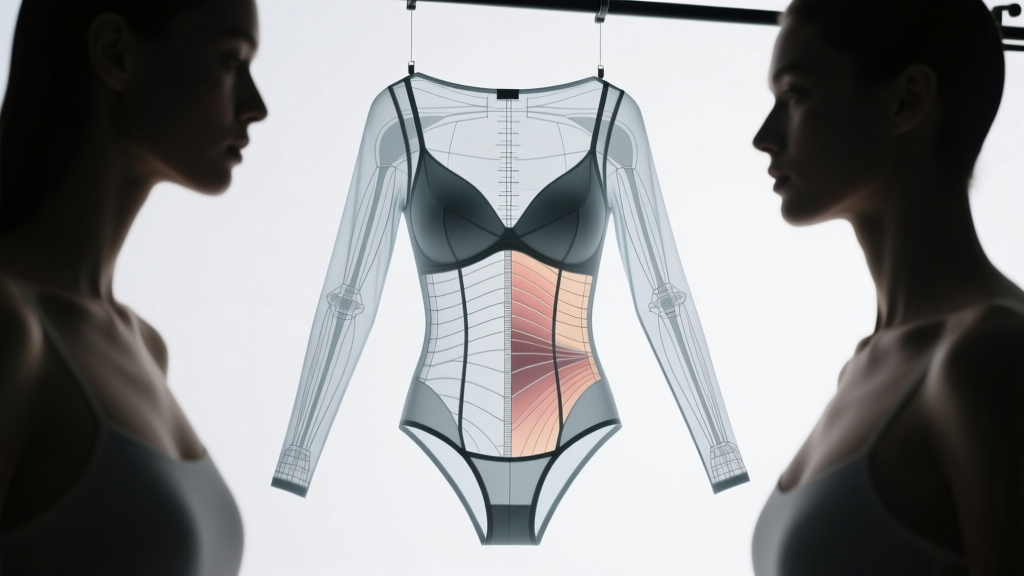
Seam Engineering and Load Transfer Points
The transition of kinetic forces from the flexible textile chassis to the rigid cantilever wires occurs at critical structural nodes: the seams. In heavy-load construction, standard lockstitch seams (ISO 4915 Class 300) are insufficient, as they lack the elongation properties of the surrounding elastomeric fabric, leading to thread snap under peak tensile stress.
Structural engineers specify multi-thread chainstitch seams (Class 400) or overedge safety stitches (Class 500) for high-stress junctions. These stitch formations allow the seam to elongate in unison with the Nylon/Elastane blend without compromising the structural bond. Furthermore, the integration of high-density polyethylene (HDPE) or thermoplastic polyurethane (TPU) film laminates at the lateral wire casing junctions distributes the localized point-loads across a wider surface area, preventing the wire from breaching the textile containment field.
Decision Matrix: Selecting Materials by Structural Load Requirement
When specifying materials for construction, the load profile dictates the material selection. Use the following framework to determine the best material for bra construction based on the required structural support tier:
- Low-Load / Low-Impact (A-B Cups): A seamless tricot polyester blend (80/20 Poly/Spandex) provides adequate containment with minimal chassis rigidity. Focus on breathability and moisture-wicking cross-sections.
- Medium-Load / Dynamic (C-D Cups): Requires a reinforced Nylon 6,6 posterior band with dual-layered elastane integration. Underwire channels must be lined with high-density polyethylene (HDPE) fleece to prevent friction-based abrasion of the chassis.
- High-Load / High-Kinetic (DD+ Cups): Demands a rigid, non-stretch anterior frame (often utilizing power mesh or rigid tulle) combined with a heavy-gauge Nylon 6,6 posterior band. Memory titanium cantilever wires are mandatory to prevent torsional failure and localized tissue impingement.
Frequently Asked Questions (FAQ)
Why does the posterior band lose its clamping force over time?
The posterior band relies on elastane for its tensile clamping force. Over time, cyclic loading (stretching) and thermal exposure cause the polyurethane molecular chains in the elastane to fracture and lose their elastic recovery. Once the material exhibits permanent deformation (creep), the structural integrity of the entire framework is compromised, and the garment must be decommissioned.
Is cotton a viable material for the primary load-bearing chassis?
From an engineering standpoint, no. While cotton offers superior hygroscopic properties (moisture absorption), it lacks the necessary tensile strength and elastic recovery required for dynamic load distribution. Cotton fibers exhibit high initial elongation but poor recovery, leading to immediate structural sagging under continuous load. It is best utilized as a secondary lining material rather than a primary structural component.
How do engineers test the fatigue limit of underwire materials?
Materials testing laboratories utilize cyclic torsion and flexion machines to simulate years of kinetic movement. The wire is subjected to repetitive 90-degree bending and twisting cycles until it reaches its fatigue limit and fractures. Memory titanium alloys consistently outperform carbon-steel in these tests, enduring upwards of 100,000 cycles without structural failure.
This structural approach to material selection ensures that the final constructed garment operates not merely as clothing, but as a highly engineered, load-bearing suspension system capable of withstanding the rigorous demands of daily kinetic forces.
Written by
James ThorntonJames Thornton is a construction industry veteran with 25 years of hands-on experience in wood framing, lumber grading, and residential building codes. He started as a framing carpenter in rural Oregon, earned his ICC Residential Building Inspector certification, and eventually became a senior plan reviewer for the City of Portland Bureau of Development Services. James holds a B.S. in Wood Science & Technology from Oregon State University and is a certified lumber grader through the West Coast Lumber Inspection Bureau (WCLIB). He has inspected over 3,000 residential construction sites and authored the city's internal guide on advanced framing techniques (2x6 at 24" O.C.). James lives in Bend, OR, where he builds custom timber-frame cabins and competes in lumberjack sports.
More from James Thornton
View all
Insulation
Best Home Insulation Materials: Complete 2026 Guide
Compare top home insulation materials for 2026. Find R-values, installed costs per square foot, and best uses for fiberglass, spray foam, and mineral wool.
Aug 4, 2026

Sustainable Building
Certify Your Green Building Material for LEED and WELL
Step-by-step guide to certifying a green building material for LEED v5 and WELL v2. Master EPDs, HPDs, and VOC limits for 2026 project specifications.
Aug 4, 2026

Stone & Masonry
Veneer Stacked Stone Panels: Interior Design & Style Showcase
Discover how veneer stacked stone panels transform interiors. Explore modern design profiles, material pairings, and technical installation specs.
Aug 4, 2026