Best Drill Bit Material for Aluminum: Technical Specs & Guide
Discover the best drill bit material for aluminum with exact technical specs, helix angles, coatings, and feeds/speeds for clean, burr-free holes.

The Metallurgy of Drilling Aluminum: Why Material Choice Dictates Success
Aluminum presents a unique paradox in machining and construction fabrication. While it is relatively soft (Brinell hardness of 15-120 depending on the alloy), its high ductility and thermal conductivity make it notoriously difficult to drill cleanly. The primary failure mode when drilling aluminum is not edge dulling, but Built-Up Edge (BUE). BUE occurs when the heat generated at the shear zone causes microscopic aluminum chips to melt and pressure-weld to the cutting edge of the drill bit. This alters the bit's geometry, increases friction, and ultimately leads to catastrophic bit grab, workpiece tear-out, or tool breakage.
If your drill bit begins to squeal or the chips are welding to the flutes, you have exceeded the thermal threshold for your specific bit coating and geometry. Continuing to apply downward thrust force will result in the bit 'grabbing' the workpiece, potentially spinning the material violently or snapping the bit shank.
Selecting the best drill bit material for aluminum requires prioritizing edge sharpness, toughness, and low chemical affinity over extreme hot-hardness. According to machining data published by the Machining Doctor, the optimal tool must maintain a razor-sharp edge at lower cutting temperatures while efficiently evacuating the long, stringy chips characteristic of alloys like 6061-T6.
Material Matrix: HSS vs. Cobalt vs. Carbide
To determine the optimal metallurgy, we must evaluate the three primary drill bit materials against the specific mechanical demands of aluminum alloys.
| Material | Matrix Composition | Hot Hardness | Toughness | Chemical Affinity to Al | Verdict for Aluminum |
|---|---|---|---|---|---|
| High-Speed Steel (HSS) | M2 (Tungsten/Molybdenum) | Moderate | High | Low (when polished) | Optimal (Hand & CNC) |
| Cobalt (HSS-Co) | M35 or M42 (5-8% Cobalt) | High | Moderate/Low | Moderate | Poor (Brittle, overkill) |
| Solid Carbide | Tungsten Carbide (WC-Co) | Extreme | Very Low | Low | Situational (Rigid CNC only) |
| Carbide-Tipped | HSS Body, Carbide Edge | High | Moderate | Moderate | Fair (Production runs) |
The Verdict: High-Speed Steel (HSS) as the Optimal Baseline
For 90% of construction, fabrication, and manual machining applications, M2 High-Speed Steel (HSS) is unequivocally the best drill bit material for aluminum. M2 HSS contains tungsten and molybdenum, providing an excellent balance of wear resistance and, crucially, toughness. Aluminum drilling requires a bit that can withstand the sudden torsional shock of 'bit grab' without shattering. HSS flexes microscopically under load, absorbing this shock.
Why Cobalt (HSS-Co) is Often the Wrong Choice
Many fabricators mistakenly assume that because M42 Cobalt bits drill through stainless steel and hardened structural beams effortlessly, they must be superior for aluminum. This is a metallurgical fallacy. The addition of 8% cobalt increases hot-hardness but significantly reduces transverse rupture strength (toughness). When a cobalt bit's cutting edge engages with gummy 6061 aluminum, the increased cutting forces and sudden grab can cause the brittle cobalt edge to micro-chip. Furthermore, cobalt bits are typically manufactured with a 135° point angle optimized for hard metals, which requires higher thrust forces that exacerbate bit grab in soft metals.
Critical Geometric Specifications for Aluminum
The base material is only half the equation. An M2 HSS bit will still fail in aluminum if the geometry is optimized for steel. When sourcing the best drill bit material for aluminum, you must verify the following geometric specifications:
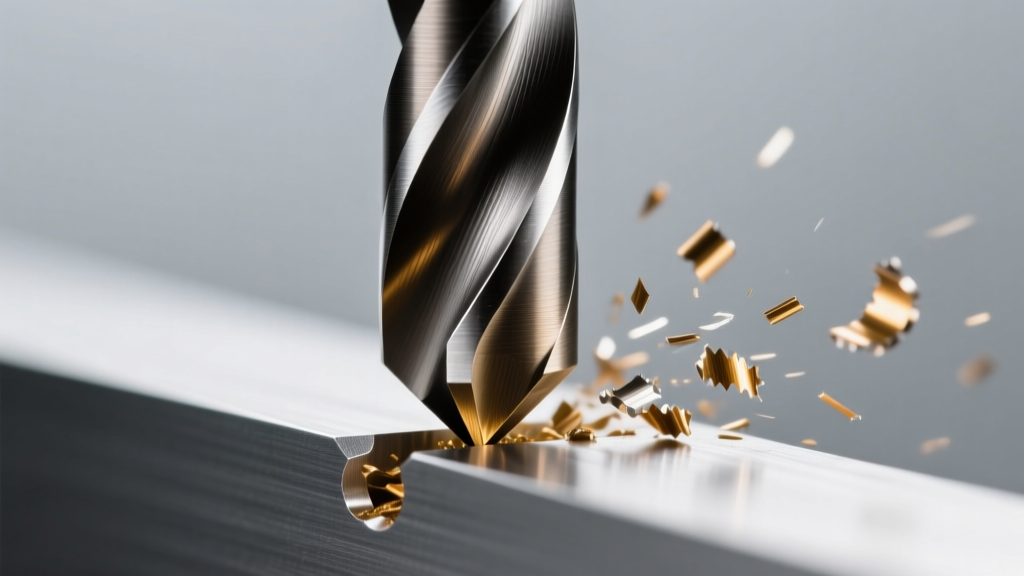
- High Helix Angle (40° - 45°): Standard drill bits feature a helix angle of 28° to 32°. Aluminum generates long, continuous chips. A 'fast spiral' or high-helix flute acts as a high-speed auger, aggressively pulling chips out of the hole before they can pack and bind.
- Point Angle (118° vs. 135°): A 118° point angle is standard and effective, but a 135° split point is technically superior for aluminum if properly sharpened. The split point reduces the required thrust force by up to 30%, allowing the bit to penetrate the material without heavy downward pressure, drastically reducing the risk of the bit pulling itself through the material and grabbing the backside.
- Flute Polish (Bright Finish): The flutes must be mirror-polished. A surface roughness (Ra) of less than 0.4 µm ensures that chips slide up the flute with minimal friction.
- Thinned Web: A thinner web at the chisel edge reduces the amount of material being pushed rather than cut at the center of the hole, lowering thrust requirements.
The Coating Conundrum: Why Uncoated or Polished Wins
The most common mistake in selecting aluminum drill bits is choosing a coated bit. Titanium Nitride (TiN) and Titanium Aluminum Nitride (TiAlN) coatings are designed to increase surface hardness and thermal insulation for cutting ferrous metals. However, these coatings have a high chemical affinity for aluminum.
'Applying a TiN-coated drill bit to aluminum is counterproductive. At the localized temperatures of the shear zone, the titanium in the coating reacts with the aluminum workpiece, accelerating Built-Up Edge formation. For aluminum, a highly polished, uncoated 'bright finish' HSS bit, or one coated with Zirconium Nitride (ZrN), provides the lowest coefficient of friction and highest resistance to chip welding.' — Society of Manufacturing Engineers (SME) Machining Guidelines.
If a coating is strictly required for production longevity, Zirconium Nitride (ZrN) or Diamond-Like Carbon (DLC) are the only acceptable options, as they maintain a low chemical reactivity with non-ferrous metals.
Feeds, Speeds, and SFM Calculations
Even the best drill bit material for aluminum will fail if operated at incorrect parameters. Aluminum requires high Surface Feet per Minute (SFM) and moderate feed rates to ensure the cutting edge stays ahead of the heat generation curve.
To find the optimal spindle speed, use the formula: RPM = (SFM × 3.82) / Tool Diameter (inches). For M2 HSS in 6061-T6 Aluminum, target an SFM of 300 to 400. For 7075-T6 (which machines crisper), you can push the SFM to 450.
| Bit Diameter | Target SFM (6061-T6) | Calculated RPM | Feed Rate (Inches/Rev) |
|---|---|---|---|
| 1/8' (0.125') | 350 | 10,696 | 0.002 - 0.004 |
| 1/4' (0.250') | 350 | 5,348 | 0.004 - 0.007 |
| 1/2' (0.500') | 300 | 2,292 | 0.008 - 0.012 |
| 3/4' (0.750') | 250 | 1,273 | 0.012 - 0.018 |
Note: Most handheld drills max out at 1,500 - 2,000 RPM. When using a hand drill with a 1/4' bit, run the drill at its maximum speed setting, but rely on a steady, moderate feed rate to maintain the cutting action. Never 'peck' drill aluminum with a hand drill; maintain continuous downward pressure to keep the cutting edge engaged.
Troubleshooting Common Failure Modes
When drilling aluminum on the job site or in the shop, use this diagnostic framework to correct issues in real-time:
- Symptom: Long, stringy chips wrapping around the bit.
Cause: Feed rate is too low, or helix angle is too shallow.
Fix: Increase downward feed pressure to thicken the chip, causing it to break naturally. Switch to a high-helix (fast spiral) bit. - Symptom: Bit squealing and aluminum smearing on the flutes.
Cause: Built-Up Edge (BUE) due to high friction and lack of lubrication.
Fix: Stop immediately. Clean the flutes with a brass wire brush (never steel, which can damage the polished edge). Apply a generous amount of cutting fluid—specifically a petroleum-based tapping fluid or WD-40 (which acts as an excellent light cutting oil for aluminum) to reduce the coefficient of friction. - Symptom: Bit 'grabs' and pulls through the material violently on breakthrough.
Cause: The chisel edge engages the backside of the material before the outer cutting lips, creating a sudden massive reduction in thrust resistance.
Fix: Reduce feed pressure by 50% as the tip begins to break through the back surface. For critical aesthetic finishes, drill halfway through from one side, then flip the material and complete the hole from the opposite side using a pilot hole. - Symptom: Oversized or bell-mouthed holes.
Cause: Bit walking at the start of the cut, or lateral vibration in a drill press.
Fix: Always use a center punch to create a divot, or use a spot drill (90° or 120°) to create a precise pilot chamfer before introducing the high-helix drill bit.
Summary of Procurement Specifications
When ordering drill bits specifically for aluminum fabrication, bypass the standard hardware store assortments. Specify the following parameters to your industrial supplier: M2 High-Speed Steel, High Helix (40°+), 135° Split Point, Bright/Polished Finish (Uncoated). Adhering to these technical specifications will yield clean, burr-free holes, maximize tool life, and eliminate the safety hazards associated with bit grab in non-ferrous materials.
Written by
Priya KapoorPriya Kapoor is a real estate market analyst and construction economics researcher with expertise in housing affordability, development feasibility, and infrastructure investment. She holds a Master of Regional Planning from Cornell University and previously worked as a senior analyst at CBRE's Investment Properties group, where she modeled returns for $4B in mixed-use development pipelines. Priya now runs an independent research practice advising developers, municipalities, and REITs on construction cost forecasting and market timing. She publishes the quarterly "BuildMat Market Pulse" report tracking material price indices across 12 commodity categories. Based in Austin, TX, Priya serves on the board of Habitat for Humanity Austin and is a marathon runner.
More from Priya Kapoor
View all
Construction Cost
Cost to Build a 1600 Sq Ft Home in 2026: Full Breakdown
Accurate 2026 cost to build a 1600 sq ft home—material, labor, and regional pricing breakdowns included. Plan your budget with real-time estimates.
Aug 11, 2026

Wood & Lumber
Name the Types of Wood for Pressure Treatment and Preservation
Learn how to name the types of wood best suited for pressure treatment. Compare species treatability, chemical retention levels, and 2026 preservation costs.
Aug 4, 2026

Stone & Masonry
Stone Veneer Suppliers Lindenhurst: 2026 Cost Analysis
Analyze 2026 stone veneer costs in Lindenhurst, NY. Compare local supplier pricing, delivery fees, and Suffolk County installation labor rates.
Aug 4, 2026