What Is the Best Material for a Window Frame? A Pro's Guide
Compare fiberglass, vinyl, wood, and aluminum window frames. Expert analysis on costs, thermal expansion, and climate-specific recommendations.

The Short Answer: A Climate-Based Decision Matrix
There is no single universal 'best' window frame material; the optimal choice is dictated by your local climate, structural load requirements, and budget. A frame that performs flawlessly in a mild coastal environment may suffer catastrophic seal failure in extreme temperature swings. Before evaluating specific brands, use this procurement matrix to narrow your material choice based on environmental stressors.
- Extreme Cold (IECC Zones 6-8): Fiberglass or Wood-Clad. Prioritize low U-Factor (≤ 0.20) and triple-pane compatibility. Avoid aluminum without advanced thermal breaks.
- High Heat & Direct Sun (IECC Zones 1-3): Fiberglass or Light-Colored Vinyl. Dark-colored vinyl absorbs heat exceeding 160°F, causing extrusion warping and IGU seal stress.
- Coastal & Salt Air: Fiberglass or Thermally-Broken Aluminum. Wood rots in high humidity, and standard vinyl degrades under UV/salt exposure over 15 years.
- High Wind / Hurricane Zones: Fiberglass or Heavy-Gauge Aluminum. Fiberglass offers the highest structural rigidity (deflection limits) for large architectural spans.
Deep Dive: Evaluating the Top 4 Frame Materials
1. Fiberglass: The Premium Performance Standard
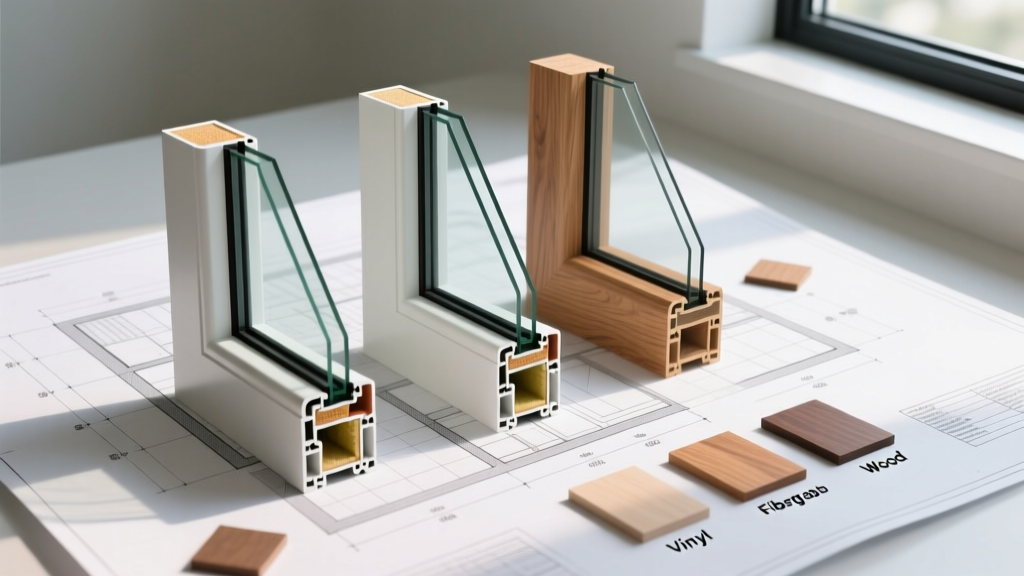
Fiberglass frames are constructed from glass fibers embedded in a polyurethane or polyester resin matrix. The defining advantage of fiberglass is its Coefficient of Thermal Expansion (CTE). Glass has a CTE of roughly 0.5 x 10^-5 in/in/°F, while fiberglass sits at 0.8 x 10^-5. Because the frame and the glass it holds expand and contract at nearly identical rates, the insulated glass unit (IGU) seal experiences minimal mechanical stress. This virtually eliminates the primary cause of window fogging and argon gas leakage.
Market Leaders & Models: Pella Impervia, Marvin Essential, and Andersen 100 Series (Fibrex composite, which behaves similarly).
Cost Reality (2026): Expect to pay $700 to $1,300 per standard 3x5 ft. double-hung unit, fully installed. Custom architectural shapes push this to $1,800+.
The Catch: Fiberglass is difficult to manufacture into complex, ornate profiles. If your project requires historic replication with deep ogee curves, fiberglass options are limited.
2. Vinyl: The Budget Workhorse
Extruded polyvinyl chloride (PVC) dominates the replacement market due to its low cost and inherent thermal resistance. High-quality vinyl frames utilize multi-chambered extrusions (look for 5 or more internal air chambers) and fusion-welded corners to prevent air infiltration. However, vinyl's CTE is roughly 3.0 x 10^-5—up to six times higher than glass. In regions with 80°F+ daily temperature swings, this differential expansion stretches the IGU sealant, leading to a 15-20% higher rate of premature seal failure compared to fiberglass.
Market Leaders & Models: Simonton 9800 Series, Alside Mezzo, Soft-Lite Classic.
Cost Reality (2026): $450 to $850 per installed unit. It remains the most cost-effective option for standard-sized openings.
The Catch: Structural rigidity. Vinyl requires internal aluminum or steel reinforcement for spans wider than 48 inches. Furthermore, painting vinyl is generally prohibited by manufacturers, as dark paints void the warranty due to heat-absorption warping.
3. Wood & Wood-Clad: The Aesthetic Choice
Wood offers unmatched natural insulation and traditional aesthetics. Modern wood windows are almost exclusively 'clad'—meaning the interior is natural wood (pine, mahogany, or oak) while the exterior is wrapped in aluminum or fiberglass to protect against weathering. When evaluating wood-clad windows, scrutinize the cladding thickness. Premium brands use 0.050-inch or thicker extruded aluminum, while budget options use 0.032-inch roll-formed aluminum that dents easily and traps water.
Market Leaders & Models: Marvin Signature Ultimate, Andersen E-Series, Jeld-Wen Custom Wood.
Cost Reality (2026): $950 to $1,800+ per installed unit. Interior finishing (staining/painting) adds $50-$100 per unit in labor.
The Catch: Moisture management. If exterior weep holes clog with debris, water pools against the wood sill, leading to concealed rot that compromises structural integrity long before it becomes visible.
4. Aluminum: The Commercial & Coastal Pick
Aluminum is exceptionally strong, lightweight, and immune to rot and UV degradation. However, raw aluminum is a highly efficient thermal conductor. For residential use, you must specify thermally broken aluminum, which features a polyurethane barrier separating the interior and exterior metal halves to stop thermal bridging. Without this break, aluminum frames will sweat profusely in winter, leading to interior mold and sill damage.
Market Leaders & Models: Fleetwood (premium architectural), Milgard Aluminum Series.
Cost Reality (2026): $500 to $1,000 for standard residential; $1,500+ for custom architectural thermally-broken systems.
Head-to-Head Performance & Cost Matrix
| Material | Avg Installed Cost (3x5 ft) | U-Factor Range (Lower is Better) | Thermal Expansion (CTE) | Expected Lifespan |
|---|---|---|---|---|
| Fiberglass | $700 - $1,300 | 0.15 - 0.25 | Very Low (Matches Glass) | 40 - 50+ Years |
| Vinyl (PVC) | $450 - $850 | 0.20 - 0.30 | High (Up to 6x Glass) | 20 - 30 Years |
| Wood-Clad | $950 - $1,800 | 0.18 - 0.28 | Moderate | 30 - 40 Years |
| Aluminum (Thermal Break) | $500 - $1,000+ | 0.25 - 0.35 | High (Metal Expansion) | 30 - 45 Years |
Hidden Failure Modes Installers Rarely Mention
Material selection is only half the battle; understanding how these materials fail in the field separates a 10-year window from a 40-year window.
- The Dark Vinyl Warping Epidemic: Homeowners increasingly want black or bronze exterior frames. On vinyl frames, dark pigments absorb solar radiation, pushing frame temperatures past 160°F in summer. This causes the extrusion to bow inward, breaking the weatherstripping seal and causing the sash to stick. Fix: If you demand dark frames, upgrade to fiberglass or aluminum-clad wood.
- Hardware Screw Stripping in Vinyl: Vinyl lacks the screw-holding strength of wood or fiberglass. Heavy triple-pane sashes can cause hinge screws to strip out of the vinyl extrusion over time, leading to sagging sashes. Fix: Ensure the vinyl profile features internal aluminum reinforcement blocks specifically at hardware attachment points.
- Galvanic Corrosion in Coastal Wood-Clad: If aluminum cladding is installed near salt air without proper anodized or Kynar 500 paint finishes, the salt accelerates oxidation. Furthermore, if the aluminum cladding touches copper flashing or untreated steel fasteners, galvanic corrosion will eat through the cladding in under a decade.
Sourcing & Certification Standards
Never procure windows without verifying independent testing labels. The National Fenestration Rating Council (NFRC) label is mandatory for verifying the U-Factor, Solar Heat Gain Coefficient (SHGC), and Visible Transmittance (VT). Do not rely on manufacturer-published 'center-of-glass' U-Factors, which artificially inflate performance by ignoring the thermal weak point of the frame edge.
Additionally, verify structural and water-resistance ratings via the ENERGY STAR climate zone maps to ensure the unit meets local code requirements for air infiltration (typically ≤ 0.3 cfm/ft at 25 mph wind). For structural load testing, look for AAMA/WDMA/CSA 101/I.S.2/A440 certification, which dictates the Design Pressure (DP) rating. A standard residential window should carry a minimum DP 30 rating, while coastal or high-wind zones require DP 40 to DP 65.
- Match the frame CTE to your local temperature swing (Fiberglass for extreme swings).
- Demand NFRC whole-unit U-Factor ratings, not just center-of-glass metrics.
- Specify Kynar 500 finishes for any dark-colored aluminum or wood-cladding.
- Verify internal metal reinforcement for any vinyl sash exceeding 8 sq. ft.
Written by
Marcus ChenMarcus Chen is a licensed structural engineer (PE) and building materials analyst with over 12 years of experience across residential, commercial, and industrial construction. He holds a Master of Science in Civil Engineering from UC Berkeley and spent six years at Thornton Tomasetti before transitioning to independent consulting and technical writing. Marcus specializes in material selection for seismic-prone regions, concrete reinforcement strategies, and lifecycle cost analysis. His work has been cited by the American Concrete Institute (ACI) and the Structural Engineers Association of California (SEAOC). When he is not on a job site or at his desk, you will find him hiking the Sierra Nevada or restoring a 1920s craftsman bungalow in Oakland, CA.
More from Marcus Chen
View all
Construction Cost
How Much Did the Eiffel Tower Cost to Build?
How much did the Eiffel Tower cost to build in 1889? We adjust for inflation and compare its budget to modern skyscraper construction.
Aug 4, 2026

Fire Resistance
What Is a Fire Resistant Material? Testing & Certification Guide
Discover what is a fire resistant material through ASTM and UL testing. Learn how fire ratings, certifications, and assemblies work in construction.
Aug 4, 2026

Construction Cost
How Much Did the Burj Khalifa Cost to Build?
How much did the Burj Khalifa cost to build? We break down the $1.5B project and extract 5 money-saving strategies for your next build.
Jul 30, 2026