What Materials Were Used to Build the Great Wall? Modern Equivalents
Discover what materials were used to build the Great Wall and how ancient techniques like sticky rice mortar and rammed earth inspire modern construction.

The Engineering Marvel: What Materials Were Used to Build the Great Wall?
When structural engineers and historians analyze what materials were used to build the Great Wall, they uncover a masterclass in adaptive, localized construction. The Great Wall is not a single continuous structure built from a uniform material palette; rather, it is a vast network of fortifications constructed over two millennia. The materials shifted dramatically based on the dynasty, the regional geology, and the available supply chains.
Understanding these ancient methodologies provides modern builders with profound insights into sustainable material science, particularly in the realms of soil stabilization, composite mortars, and load-bearing masonry. Below, we deconstruct the historical materials and map them to their high-performance modern equivalents.
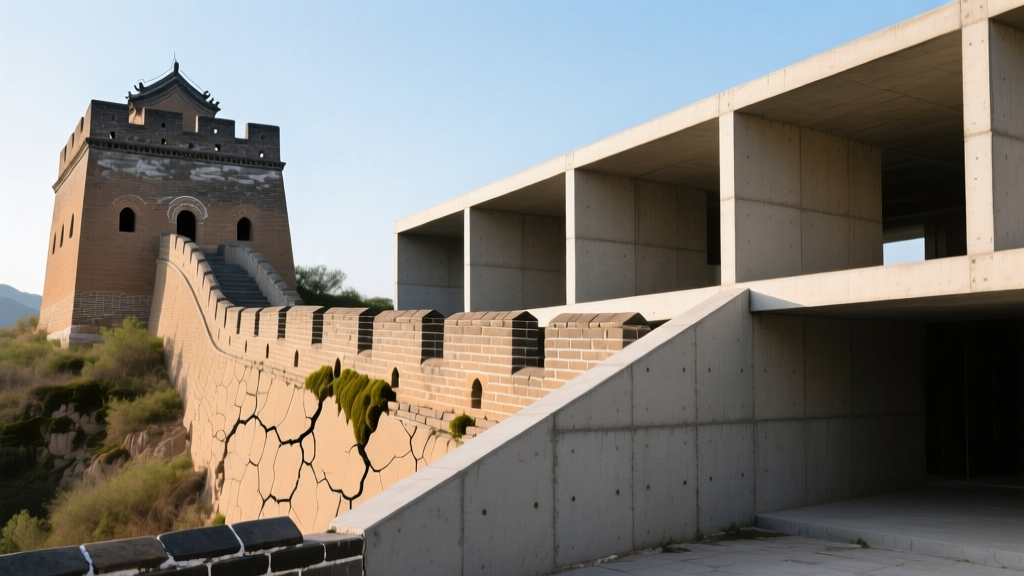
Ancient Mortar vs. Modern Binders: The Sticky Rice Revolution
The most revolutionary material discovered when investigating what materials were used to build the Great Wall is the Ming Dynasty's use of sticky rice mortar. Builders mixed slaked lime (calcium hydroxide) with a porridge made from glutinous rice. The amylopectin in the rice acted as an organic polymer, inhibiting the excessive growth of calcium carbonate crystals and creating a dense, micro-structured matrix that boasts exceptional water resistance and seismic flexibility.
Modern Equivalent: Polymer-Modified Mortars (PMM)
Today, the structural benefits of amylopectin-lime composites are replicated using Styrene Butadiene Rubber (SBR) latex or Redispersible Polymer Powders (RDP) added to Portland cement or hydraulic lime mortars. These polymers bridge micro-cracks, reduce water permeability, and increase flexural bond strength—vital for retaining walls and exterior masonry subjected to freeze-thaw cycles.
| Property | Ming Dynasty Sticky Rice Mortar | Modern SBR Latex-Modified Mortar |
|---|---|---|
| Primary Binder | Slaked Lime + Amylopectin | Type S Hydrated Lime / Portland Cement + SBR |
| Compressive Strength | Moderate (Cures slowly over centuries) | High (Achieves 2,500+ PSI at 28 days) |
| Flexural Bond Strength | Excellent (Organic polymer bridging) | Excellent (Synthetic polymer bridging) |
| Water Permeability | Extremely Low (Hydrophobic starch matrix) | Low (Polymer film blocks capillary pores) |
| Best Modern Application | Historical restoration, heritage masonry | Exterior stucco, tile setting, retaining walls |
Rammed Earth Techniques: From Qin Dynasty to Modern SRE
Before the widespread use of kiln-fired bricks, the fundamental answer to what materials were used to build the Great Wall was earth. Early dynasties utilized wooden formwork to tamp local soil, gravel, and organic binders (like willow branches) into massive load-bearing walls. This technique, known as rammed earth, relies on the mechanical interlocking of angular aggregates under immense compressive force.
Modern construction has evolved this into Stabilized Rammed Earth (SRE) and Insulated Rammed Earth (IRE). By introducing a small percentage of Portland cement and utilizing engineered formwork, modern builders achieve walls with high thermal mass, exceptional fire ratings, and structural integrity that meets contemporary building codes.
Best Practices for Modern SRE Wall Construction
According to guidelines referenced by the U.S. Department of Energy, rammed earth walls offer significant thermal mass benefits, but require precise execution to prevent moisture degradation and structural failure.
- Formwork Erection: Use engineered aluminum or heavy-duty timber forms. Unlike ancient wood lashing, modern forms must withstand lateral pressures of up to 1,200 lbs per square foot during pneumatic tamping.
- Soil-Cement Batching: The optimal mix for SRE is 85-93% well-graded aggregate (sand and gravel with a maximum particle size of 20mm) and 7-15% Portland cement (Type I/II). Avoid soils with high clay content (keep clay below 15%) to prevent shrinkage cracking.
- Moisture Optimization: The mixture must be brought to its Optimum Moisture Content (OMC), typically between 8% and 12%. A field test: the soil should hold its shape when squeezed into a ball in your hand, but crumble cleanly when poked with a finger.
- Pneumatic Tamping: Place the mixture in 150mm (6-inch) lifts. Use a pneumatic backfill tamper to compress each lift to roughly 50% of its original volume before adding the next layer.
- Curing and Sealing: After form removal, apply a breathable, silane-based penetrating sealer to prevent water ingress while allowing internal moisture vapor to escape.
Masonry and Stone: Load-Bearing Lessons from the Ming Dynasty
The Ming Dynasty sections of the wall represent a shift toward high-durability masonry. The answer to what materials were used to build the Great Wall during this era includes massive granite blocks for foundations and standardized kiln-fired clay bricks for the superstructure.
"The standardization of Ming Dynasty bricks—typically measuring around 240mm x 115mm x 53mm—allowed for rapid, modular construction. This exact dimensional logic is mirrored in today's modular face bricks and Concrete Masonry Units (CMUs), proving that standardized unit masonry remains one of the most efficient construction methodologies in human history."
Modern Equivalents: CMUs and Structural Stone
For modern builders seeking the compressive strength and longevity of Ming-era granite and brick, the standard is the ASTM C90 Load-Bearing Concrete Masonry Unit. When filled with grout and reinforced with Grade 60 rebar, CMU walls provide the sheer mass and ballistic/impact resistance that ancient engineers sought with cut stone.
For aesthetic cladding that mimics the wall's stone foundations, modern anchored natural stone veneers (using stainless steel dowels and angle iron supports per ASTM C1242) offer the visual weight of granite without the massive dead-load implications on the building's structural frame.
Actionable Takeaways for Modern Builders
Core Principles Extracted from Ancient Engineering
- Prioritize Breathability: Just as sticky rice mortar allowed ancient bricks to "breathe" (preventing trapped moisture from spalling the masonry during freeze-thaw cycles), modern masonry should utilize vapor-permeable mortars and sealers.
- Leverage Thermal Mass: The thick rammed earth and brick walls of the Great Wall absorbed heat during the day and released it at night. Incorporate high-mass materials like SRE or insulated CMUs in passive solar building designs to reduce HVAC loads.
- Adapt to Local Geology: Ancient builders used whatever was locally abundant—reeds in the desert, stone in the mountains, earth in the plains. Modern sustainable building (such as LEED or Living Building Challenge projects) heavily rewards the use of locally sourced aggregates and earth to minimize embodied carbon from transportation.
Frequently Asked Questions
Did they use human bones in the Great Wall mortar?
No. This is a persistent myth. Forensic analysis and historical records confirm that the mortar was a composite of slaked lime and glutinous rice porridge. The organic component was strictly plant-based (amylopectin), which provided the necessary polymer matrix for structural cohesion.
How deep were the foundations of the Great Wall?
Foundation depths varied wildly based on the terrain. In mountainous regions, builders carved directly into bedrock, requiring zero traditional foundation depth. In loess plateaus and valleys, foundations of tamped earth and rough stone were often dug 2 to 3 meters deep to reach stable, load-bearing substrates below the frost line.
Can I use sticky rice mortar in modern DIY projects?
While you can replicate the recipe (mixing hydrated lime with boiled glutinous rice water), it is not recommended for structural or code-governed modern builds due to its incredibly slow cure time and lack of standardized ASTM testing. For DIY masonry, use a modern Type N or Type S mortar mixed with an SBR latex admixture to achieve identical water-resistant and flexible properties with a reliable 28-day cure.
By studying what materials were used to build the Great Wall, contemporary construction professionals can bridge the gap between ancient resilience and modern material science, ensuring that the structures built today possess the same enduring legacy as those erected centuries ago.
Written by
David NakamuraDavid Nakamura is a licensed architect (AIA) and construction technology writer focused on sustainable building methods, mass timber engineering, and high-performance building envelopes. He holds a Master of Architecture from the University of Washington and is a certified Passive House Consultant (CPHC). David spent eight years at the Seattle firm Mithun, where he led the design of three LEED Platinum projects, before founding his own practice specializing in net-zero residential design. He serves on the editorial advisory board of GreenBuilder Magazine and has authored peer-reviewed papers on cross-laminated timber (CLT) connections for the Journal of Structural Engineering. In his spare time, David teaches woodworking at Pratt Fine Arts Center and kayaks the Puget Sound.
More from David Nakamura
View all
Construction Cost
Labor Cost to Build a Deck Per Sq Ft: 2026 Installation Guide
Discover the exact labor cost to build a deck per sq ft in 2026. This installation guide breaks down contractor rates, complexity factors, and hidden fees.
Aug 4, 2026

Construction Cost
How Much Does It Cost to Build a 3 Bedroom House? Financing Guide
Learn exactly how much it costs to build a 3 bedroom house and explore 2026 financing options, construction loan types, and budget frameworks for your build.
Aug 4, 2026

Construction Cost
Cost to Build a Tennis Court: 2026 Guide
How much does it cost to build a tennis court in 2026? Breakdowns for asphalt, concrete, and synthetic surfaces plus fencing and lighting.
Jul 30, 2026