Best Material for Baseboards: A Technical Specification Guide
Compare MDF, PVC, and pine baseboards using density, moisture swelling, and fastener withdrawal specs to select the best material for baseboards.
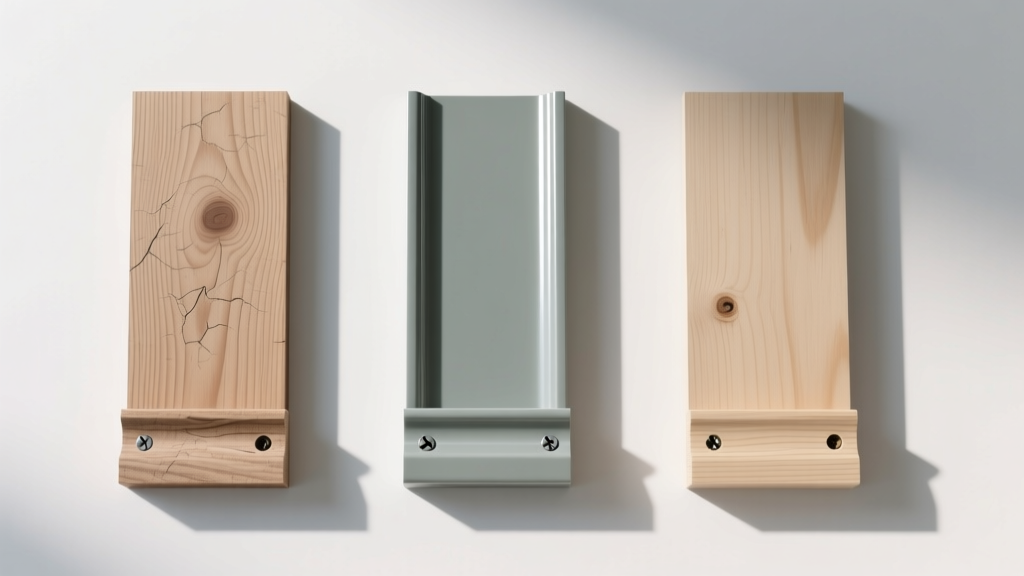
Core Performance Metrics for Baseboard Materials
Selecting the best material for baseboards requires moving beyond aesthetic preferences to evaluate the underlying material science. Baseboards serve as the critical transitional trim between flooring and wall planes, subjecting them to continuous mechanical impact from vacuums, footwear, and furniture, alongside severe hygroscopic and thermal fluctuations. To specify the correct trim, professionals must evaluate Specific Gravity (SG), Thickness Swelling (TS) coefficients, Linear Thermal Expansion rates, and fastener withdrawal strength.
The Architectural Woodwork Institute (AWI) sets stringent tolerances for interior millwork, dictating that trim must maintain dimensional stability despite ambient relative humidity (RH) swings between 20% and 50%. When evaluating the best material for baseboards, contractors must match the material's physical properties to the specific environmental stressors of the installation zone.
Material Breakdown: Density, Swelling, and Machinability
Medium Density Fiberboard (MDF)
Standard MDF is manufactured by breaking down hardwood or softwood residuals into wood fibers, combining them with wax and a urea-formaldehyde (UF) or methylene diphenyl diisocyanate (MDI) resin binder, and applying high temperature and pressure. The resulting panels possess a high Specific Gravity (typically 0.70 to 0.85 g/cm³), making MDF exceptionally heavy and dense. This uniform density eliminates wood grain, allowing for perfectly crisp, tear-free routed profiles such as intricate ogee or shoe molding contours. However, standard MDF exhibits high hygroscopic sensitivity; if exposed to liquid water, thickness swelling can exceed 15%, leading to irreversible edge blowout and structural degradation.
Moisture-Resistant MDF (MR-MDF)
For wet zones, MR-MDF utilizes specialized moisture-resistant resin systems (often melamine-urea-formaldehyde) and higher wax content. According to testing standards outlined by the Composite Panel Association, high-grade MR-MDF limits thickness swelling to less than 8% after 24 hours of submersion (EN 317 standard). While it resists ambient humidity and occasional mopping splashes, it is not waterproof and will still fail under continuous hydrostatic pressure.
Finger-Jointed Pine (FJP)
Finger-jointed ponderosa or radiata pine offers a natural wood alternative with a lower Specific Gravity (0.35 to 0.45 g/cm³). FJP is manufactured by bonding short wood blocks using PVA (Polyvinyl Acetate) D3 or D4 adhesives. While FJP is lighter and holds nails exceptionally well due to the interlocking wood fibers, it presents a specific finishing challenge: the finger joints and varying wood grain densities can "telegraph" through standard water-based paints over time as the wood expands and contracts. Furthermore, the USDA Forest Products Laboratory notes that softwoods are prone to localized shrinkage, which can cause visible seams at the miter joints if the material was not properly acclimated to the building's interior RH prior to installation.
Cellular PVC Extrusions
Cellular PVC is an extruded polymer with a micro-cellular core, yielding a Specific Gravity of 0.50 to 0.65 g/cm³. It is entirely impervious to moisture, insect damage, and fungal decay, making it the undisputed best material for baseboards in bathrooms, mudrooms, and exterior transitions. However, PVC possesses a high Coefficient of Thermal Expansion (CTE)—approximately 3.5 x 10⁻⁵ in/in/°F. This translates to roughly 1/32 inch of linear movement per 18 linear feet for every 10°F temperature change, requiring specific installation protocols to prevent buckling or joint separation.
Technical Comparison Matrix
| Material | Specific Gravity (g/cm³) | Thickness Swelling (24hr) | Thermal Expansion | Nail Withdrawal Strength | Approx. Cost / Linear Ft |
|---|---|---|---|---|---|
| Standard MDF | 0.70 - 0.85 | 12% - 18% | Negligible | Moderate (Requires adhesive) | $0.75 - $1.50 |
| MR-MDF (V100 Grade) | 0.75 - 0.88 | < 8% | Negligible | Moderate (Requires adhesive) | $1.20 - $2.20 |
| Finger-Jointed Pine | 0.35 - 0.45 | N/A (Linear Shrinkage) | Negligible | High (Excellent fiber grip) | $1.10 - $2.50 |
| Cellular PVC | 0.50 - 0.65 | 0% (Impervious) | High (Requires gaps) | Low (Prone to pull-through) | $2.50 - $4.50 |
| Poplar (Solid Hardwood) | 0.40 - 0.50 | N/A (Moderate movement) | Negligible | High | $3.00 - $6.00+ |
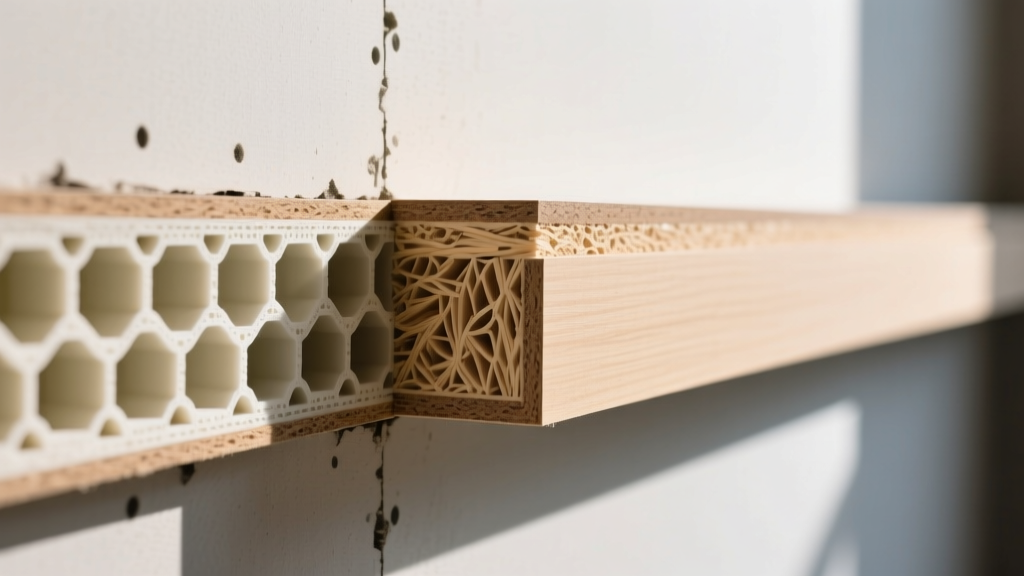
Moisture Exposure and Dimensional Stability
Dimensional stability is paramount for maintaining tight miter joints. Solid wood and FJP react to ambient humidity by expanding and contracting tangentially and radially. If FJP baseboards are installed during the humid summer months at 12% moisture content (MC), they will shrink significantly when the building's HVAC system dries the interior air to 4% MC in the winter. This shrinkage pulls miters apart, revealing unsightly gaps. MDF and PVC eliminate hygroscopic movement, though PVC requires compensation for thermal movement.
Machining Profiles and Edge Crispness
The ability of a material to hold a complex routed profile dictates its suitability for custom millwork. MDF is the industry standard for painted, high-detail profiles. Because it lacks a grain structure, carbide-tipped router bits shear the material cleanly, producing a glass-smooth edge that requires minimal sanding or grain-filling before priming.
Conversely, routing FJP or solid poplar often results in tear-out, particularly when cutting against the grain or machining intricate coves. To mitigate this in solid woods, machinists must use high-speed steel (HSS) or specialized shear-angle carbide bits, and feed the material at precise rates to prevent burning or chattering. For production environments where time and finishing labor are calculated into the project cost, MDF's superior machinability makes it the most economically viable choice for intricate baseboard profiles.
Paint Adhesion and Surface Energy
The surface chemistry of baseboard materials drastically alters the required primer and paint specifications. MDF is highly porous; its edges act like a sponge, absorbing the liquid binders from standard latex primers and leaving the surface resin starved and brittle. To achieve a durable, Level 5-equivalent finish on MDF edges, professionals must apply a high-solids alkyd primer or a solvent-based shellac primer (such as B-I-N) to seal the fibers and build a hard, sandable shell.
Cellular PVC presents the opposite challenge: extremely low surface energy. Paint will not mechanically bond to raw PVC without an adhesion-promoting primer specifically formulated for plastics. Furthermore, because PVC expands and contracts with temperature fluctuations, the topcoat must possess high elastomeric properties (flexibility). Using a rigid, high-gloss alkyd enamel on PVC baseboards will inevitably result in micro-cracking along the nail holes and miter joints as the substrate moves beneath the brittle paint film. 100% acrylic latex topcoats are mandatory for PVC trim.
Installation Fastening and Substrate Compatibility
Fastener withdrawal strength varies wildly across baseboard materials, dictating the pneumatic nailer setup and adhesive requirements:
- MDF: Lacks interlocking fibers, meaning nails can easily pull through or blow out the back of the material. MDF baseboards must be installed using a combination of construction adhesive (e.g., polyurethane-based PL Premium) applied to the back, and 15-gauge finish nails driven into the wall studs. 18-gauge brad nails are only suitable for temporary tacking while the adhesive cures and lack the head size to hold dense MDF against an uneven drywall plane.
- FJP & Poplar: Excellent nail-holding capabilities. 16-gauge or 15-gauge finish nails driven at 90-110 PSI will securely anchor the trim without requiring adhesive, provided the nails penetrate the wall studs or bottom plate by at least 1 inch.
- Cellular PVC: Prone to "mushrooming" around the nail head and pulling through under stress. Installers must use specialized trim screws with washer heads or hot-dipped galvanized/stainless steel finish nails with enlarged heads. Crucially, PVC miters must be glued with PVC-specific solvent cements (which chemically weld the joint) rather than standard wood glue, allowing the joint to flex slightly without breaking.
Decision Framework: Selecting by Room Environment
To specify the best material for baseboards across a whole-home or commercial project, apply this environment-based decision matrix:
- Living Rooms, Bedrooms, and Hallways (Dry Zones): Standard MDF is the optimal choice. It offers the lowest material cost, the highest profile crispness for painted finishes, and zero seasonal joint gapping. Use 15-gauge nails and wood glue on miters.
- Kitchens and Powder Rooms (Moderate Moisture): MR-MDF (V100 grade) provides the paintability of standard MDF with added resistance to occasional spills and high ambient humidity from cooking or hand-washing.
- Full Bathrooms, Mudrooms, and Commercial Wet Zones: Cellular PVC is mandatory. Its total imperviousness to water prevents rot and mold growth behind the trim. Ensure installers use solvent-welded miters and flexible acrylic topcoats.
- Stain-Grade Applications and Historic Restorations: Solid hardwoods (Poplar for paint, Oak or Maple for stain) are required. FJP and MDF cannot be stained due to their manufactured surfaces and visible glue lines.
For comprehensive millwork standards and tolerances, contractors should consult the Architectural Woodwork Institute guidelines to ensure all baseboard installations meet premium-grade structural and aesthetic requirements.
Written by
James ThorntonJames Thornton is a construction industry veteran with 25 years of hands-on experience in wood framing, lumber grading, and residential building codes. He started as a framing carpenter in rural Oregon, earned his ICC Residential Building Inspector certification, and eventually became a senior plan reviewer for the City of Portland Bureau of Development Services. James holds a B.S. in Wood Science & Technology from Oregon State University and is a certified lumber grader through the West Coast Lumber Inspection Bureau (WCLIB). He has inspected over 3,000 residential construction sites and authored the city's internal guide on advanced framing techniques (2x6 at 24" O.C.). James lives in Bend, OR, where he builds custom timber-frame cabins and competes in lumberjack sports.
More from James Thornton
View all
Insulation
Best Home Insulation Materials: Complete 2026 Guide
Compare top home insulation materials for 2026. Find R-values, installed costs per square foot, and best uses for fiberglass, spray foam, and mineral wool.
Aug 4, 2026

Sustainable Building
Certify Your Green Building Material for LEED and WELL
Step-by-step guide to certifying a green building material for LEED v5 and WELL v2. Master EPDs, HPDs, and VOC limits for 2026 project specifications.
Aug 4, 2026

Stone & Masonry
Veneer Stacked Stone Panels: Interior Design & Style Showcase
Discover how veneer stacked stone panels transform interiors. Explore modern design profiles, material pairings, and technical installation specs.
Aug 4, 2026