What Is the Best Material for Screen Protector Facade Films?
Discover what is the best material for screen protector films on architectural facades, security mesh, and glazing. Compare PET, TPU, and PVDF specs.

The Architectural Pivot: Beyond Consumer Electronics
While consumers frequently search for what is the best material for screen protector applications on smartphones and tablets, architectural specifiers and facility managers face a vastly different, high-stakes challenge. In the construction industry, 'screens' refer to exterior security mesh, privacy louvers, acoustic polycarbonate barriers, and expansive glass facades. Protecting these architectural screens from UV degradation, forced entry, micro-scratching, and environmental corrosion requires advanced industrial polymers and fluoropolymer coatings.
As of 2026, the global architectural protective film market has shifted toward multi-layered nanotechnology and self-healing elastomers. Selecting the right protective material is no longer a one-size-fits-all decision; it requires a precise matching of the protective substrate to the environmental threat profile and the base material of the architectural screen.
Material Matrix: Industrial Screen Protection Compared
The table below benchmarks the four dominant materials used to protect architectural screens and facades in commercial and high-end residential construction. Pricing reflects 2026 average installed costs for commercial-scale projects (1,000+ sq. ft.).
| Material Type | Best Substrate | Thickness / Spec | Lifespan | Est. Cost (per sq. ft.) |
|---|---|---|---|---|
| Multi-Layer PET | Glass, Rigid Glazing | 8 to 14 mil | 10–15 Years | $8.00 – $14.00 |
| TPU (Thermoplastic Polyurethane) | Polycarbonate, Acrylic | 8 to 10 mil | 7–10 Years | $16.00 – $24.00 |
| ETFE (Fluoropolymer Film) | Tensile Screens, Skylights | 100 to 250 microns | 25+ Years | $35.00 – $60.00 |
| PVDF Powder Coating | Aluminum / Steel Mesh | AAMA 2605 (1.6 mil min) | 20–30 Years | $4.50 – $9.00 |
Deep Dive: Selecting by Substrate and Threat Profile
1. Glass Facades and Glazing: Multi-Layer PET
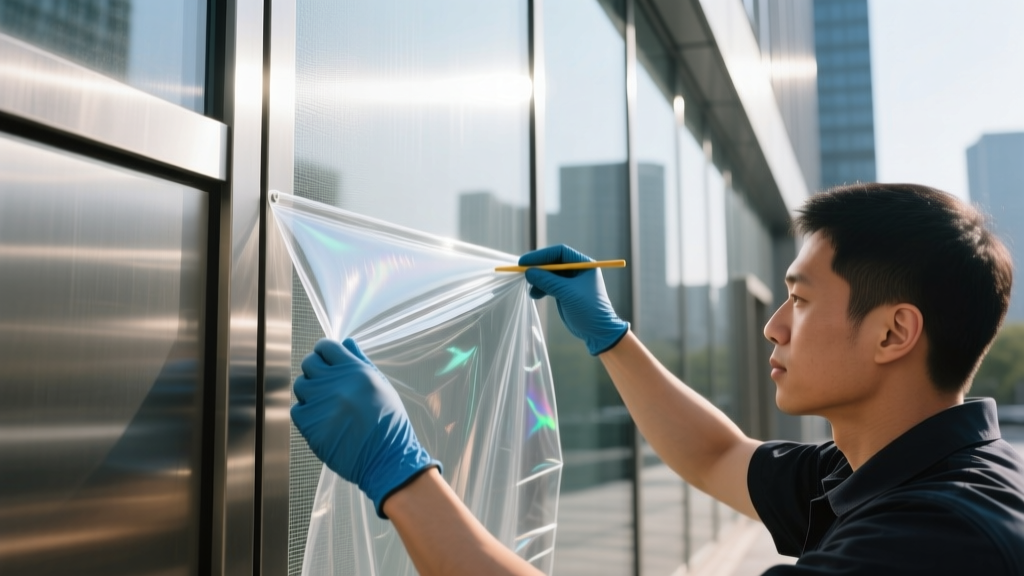
For traditional glass curtain walls and architectural glass screens, Polyethylene Terephthalate (PET) remains the industry standard. However, standard single-layer PET is obsolete for high-security applications. Modern specifiers utilize micro-layered PET, such as the 3M Safety & Security Ultra Series (e.g., Ultra S800 or Ultra P18). These films consist of dozens of ultra-thin PET layers bonded with specialized pressure-sensitive adhesives, achieving an 8-mil to 14-mil total thickness without sacrificing optical clarity.
According to the U.S. Department of Energy, advanced spectrally selective PET films not only protect the glass from physical impact and scratching but also reject up to 97% of infrared light, significantly reducing HVAC loads in commercial buildings. For blast-mitigation and forced-entry protection on ground-floor glass screens, a minimum 8-mil PET film anchored with a structural silicone wet-glaze system is required to prevent the glass pane from dislodging from the frame upon impact.
2. Polycarbonate Acoustic Screens: TPU (Thermoplastic Polyurethane)
Polycarbonate is increasingly used for highway acoustic privacy screens and interior architectural dividers due to its high impact resistance. However, polycarbonate is notoriously soft and prone to micro-scratching and chemical etching from acid rain. Applying standard PET film to polycarbonate is a critical failure mode. The adhesives in standard PET react with the plasticizers in polycarbonate, causing severe outgassing, bubbling, and permanent hazing within months.
The solution is TPU. Thermoplastic Polyurethane features a non-reactive adhesive and possesses 'self-healing' elastomeric properties. Minor surface scratches on the TPU film will absorb ambient heat and level out over time, maintaining optical clarity for the architectural screen. While TPU costs roughly 40% more than PET, it is the only viable protective film for exterior polycarbonate substrates.
3. Metal Security Screens: PVDF Fluoropolymer Coatings
When dealing with woven metal security screens (such as stainless steel or extruded aluminum privacy louvers), adhesive films are entirely impractical. Instead, the 'screen protector' is a factory-applied electrostatic powder coating. The undisputed benchmark for exterior metal protection is PVDF (Polyvinylidene Fluoride), commonly known by the trade name Kynar 500.
Specifiers must explicitly mandate AAMA 2605 compliance in their architectural drawings. The American Architectural Manufacturers Association (AAMA) 2605 standard dictates that the coating must contain a minimum of 70% PVDF resin. This ensures the metal screen can withstand 4,000 hours of salt-spray testing and extreme UV exposure without chalking, fading, or succumbing to galvanic corrosion—a vital requirement for coastal construction projects.
Real-World Failure Modes and Edge Cases
Even when the correct material is selected, architectural screen protectors frequently fail due to improper specification or installation. Avoid these common pitfalls:
- Adhesive Outgassing on Laminated Glass: Applying thick security PET films to the interior surface of insulated glass units (IGUs) can trap solar heat between the film and the glass. This thermal stress can cause the IGU seal to fail or the glass to experience thermal shock fracture. Always specify exterior-grade films or conduct a thermal stress analysis for IGUs.
- Galvanic Corrosion on Metal Mesh: If a protective powder coating on an aluminum security screen is chipped during installation, and the bare aluminum comes into contact with stainless steel fasteners in a humid environment, rapid galvanic corrosion will destroy the screen node. Specify factory-applied touch-up protocols using PVDF-rich liquid coatings.
- ETFE Creep in Tensile Structures: While ETFE is virtually immune to UV degradation, it is susceptible to 'creep' (stretching under continuous load). When using ETFE as a protective layer for tensile architectural screens, the structural framing must account for a 2% to 4% material stretch over the first year of installation.
Expert Verdict: Which Material Should You Specify?
'The best material is entirely dictated by the substrate. Do not attempt to value-engineer a TPU requirement down to PET on polycarbonate screens; the resulting plasticizer migration will ruin a multi-million-dollar facade within a single summer.'
The 2026 Decision Framework
IF the architectural screen is glass or rigid glazing requiring security and solar control → Specify Multi-Layer PET (8-mil+) with a structural silicone attachment system.
IF the screen is polycarbonate or acrylic (acoustic barriers, transparent dividers) → Specify TPU with a non-reactive adhesive to prevent outgassing and enable self-healing.
IF the screen is extruded aluminum or woven steel mesh (privacy louvers, security doors) → Specify PVDF Powder Coating meeting AAMA 2605 standards.
IF the project involves tensile facades or extreme coastal UV exposure → Specify ETFE foil cushions, factoring in long-term material creep.
For further technical specifications on fenestration and facade protection, facility managers and architects should consult the Whole Building Design Guide (WBDG) Fenestration Resources to ensure all protective films meet local building codes and energy compliance standards.
Written by
Sarah WhitfieldSarah Whitfield is a chartered quantity surveyor (MRICS) and construction cost analyst with 15 years of experience in material pricing, procurement strategy, and project budgeting. She earned her degree in Construction Management from the University of Reading (UK) and has worked on projects ranging from $2M custom homes to $180M mixed-use developments across North America and Europe. Sarah currently leads cost estimating for BuildMat Insight, maintaining a proprietary database of 4,000+ material price points updated quarterly. She is a frequent contributor to RSMeans cost data panels and has presented at the International Cost Engineering Council (ICEC) congress. Based in Denver, CO, Sarah is an avid trail runner and volunteer mentor for Women in Construction.
More from Sarah Whitfield
View all
Wood & Lumber
What Are the Different Types of Wood? A Builder's Guide
Compare structural softwoods, finish hardwoods, and engineered lumber. Analyze Janka ratings, MOE values, and 2026 pricing for construction.
Aug 4, 2026

Walls & Panels
Steel Framing vs Wood Framing: Corrosion and Moisture Defense
Compare steel framing vs wood framing for moisture resistance. Learn about galvanized coatings, condensation risks, and corrosion protection strategies.
Jul 21, 2026

Stone & Masonry
How to Cut Stone Veneer: Wet Saw vs Grinder Comparison
Compare the best tools for cutting stone veneer. We review wet saws, angle grinders, and chop saws to help you achieve clean, chip-free cuts.
Jul 21, 2026