Best Material for Pickleball Paddle Construction in 2026
Discover the best material for pickleball paddle construction in 2026. Compare carbon fiber, fiberglass, and honeycomb cores for optimal performance.

The Composite Architecture of Modern Pickleball Paddles
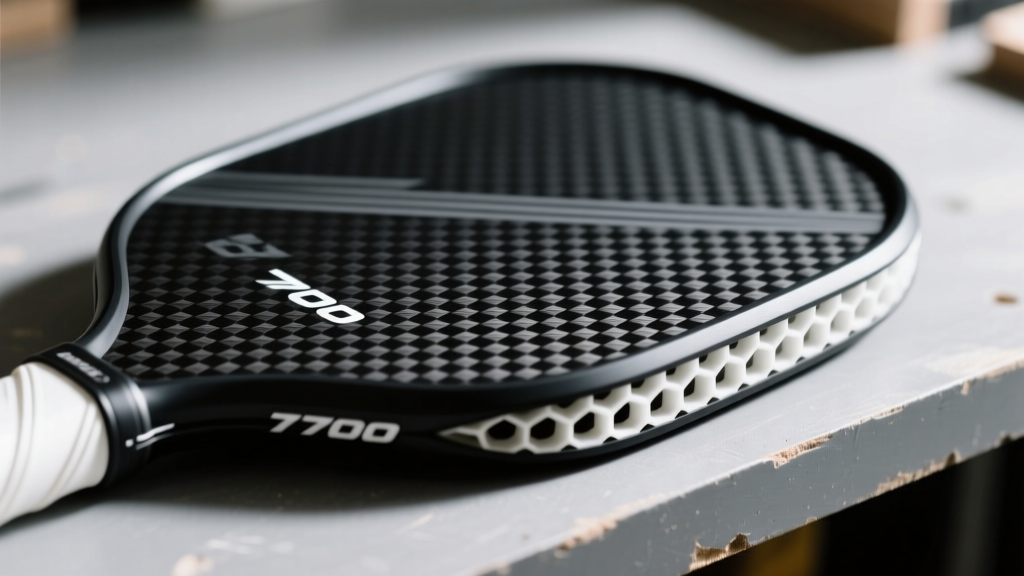
From a materials science perspective, a pickleball paddle is not a solid object but a highly engineered composite sandwich panel. The structural integrity, energy transfer, and surface friction of the paddle are dictated by the interaction between its face sheets, core substrate, and adhesive matrix. Selecting the best material for pickleball paddle construction requires analyzing the tensile strength, coefficient of restitution (COR), and damping properties of these layered composites. In 2026, advancements in thermoforming and raw carbon fiber weaving have fundamentally shifted the performance baseline, making legacy materials like aluminum and basic fiberglass obsolete for competitive play.
Core Substrates: Polypropylene vs. Aramid vs. Aluminum
The core dictates the paddle's dwell time (how long the ball stays on the face) and its overall stiffness. The core acts as a shock absorber and a spacer between the face sheets, increasing the moment of inertia without adding proportional weight.
Polypropylene (PP) Honeycomb: The Industry Standard
Polypropylene honeycomb is the undisputed baseline for modern paddle construction due to its exceptional fatigue resistance and tunable density. Manufacturers manipulate the core thickness and cell size to alter performance:
- 16mm Cores with 8mm Cells: The larger cell structure compresses more easily, absorbing kinetic energy. This results in a softer feel, higher dwell time, and superior control for drop shots and dinks. The trade-off is a slight reduction in baseline drive power.
- 13mm Cores with 6mm Cells: The denser, thinner core resists compression, transferring more energy directly back into the ball. This configuration favors aggressive players who rely on fast volleys and drive speed, though it demands precise footwork to avoid unforced errors.
Nomex (Aramid) and Aluminum: Legacy Alternatives
Nomex, an aramid paper honeycomb, is exceptionally stiff and lightweight. It produces a distinct, loud "pop" upon impact and offers maximum power with minimal dwell time. However, its acoustic signature frequently violates noise ordinances at residential courts. Aluminum honeycomb cores, while offering a rigid feel, are highly susceptible to localized plastic deformation (denting) when subjected to high-velocity impacts or edge strikes, rendering them structurally inferior to polymer composites.
The USA Pickleball Equipment Standards strictly regulate paddle stiffness to prevent excessive trampoline effects. Any core material that allows the paddle face to deflect beyond the specified limit under a standardized 5 kg load will fail certification. When selecting ultra-thin 11mm or 13mm cores, manufacturers must use higher-modulus carbon faces to maintain structural compliance.
Face Sheet Materials: Determining Spin and Power
The face sheet is the primary interface with the 40-hole polymer ball. The material's modulus of elasticity and surface topography directly influence spin generation (measured in RPMs) and power output.
| Face Material | Tensile Modulus | Surface Topography | Primary Performance Trait |
|---|---|---|---|
| T700 Raw Carbon Fiber | 230 GPa | Micro-textured (Peel-ply) | High Spin, Consistent Control |
| T800 Carbon Fiber | 294 GPa | Micro-textured (Peel-ply) | Stiffer Feel, High Power |
| E-Glass Fiberglass | 72 GPa | Smooth (Grit coated) | Maximum Trampoline Effect |
| Kevlar / Aramid Blend | 131 GPa | Woven Texture | Vibration Dampening |
The Dominance of Raw T700 Carbon Fiber
In 2026, raw T700 carbon fiber remains the best material for pickleball paddle face sheets for advanced players. The term "raw" refers to the manufacturing process: after the carbon weave is impregnated with epoxy resin and cured, a textured peel-ply fabric is removed from the surface. This leaves a microscopic, ridged topography that grips the plastic ball without the need for aftermarket grit sprays. According to CompositesWorld, the alignment of the carbon tows in a 45-degree biaxial weave optimizes torsional rigidity, ensuring the paddle face does not twist during off-center hits.
Fiberglass and the Coefficient of Restitution (COR)
Fiberglass (E-Glass) has a significantly lower tensile modulus than carbon fiber, meaning it stretches and snaps back more violently upon impact. This creates a higher COR, resulting in effortless power. However, fiberglass faces are prone to "fiber blooming" and structural fatigue, often losing their pop and developing dead spots after 6 to 8 months of heavy play. Furthermore, to achieve USAP-approved spin limits, fiberglass paddles require a sprayed-on grit coating (like silicon carbide), which eventually wears smooth, drastically reducing spin potential over time.
Manufacturing Methodology: Thermoformed vs. Cold-Pressed
The best materials will fail if the assembly process is flawed. The construction method dictates the paddle's edge integrity and overall sweet spot volume.
Thermoformed Construction (Heat-Sealed)
Thermoforming involves placing the carbon face sheets and PP honeycomb core into a mold and applying intense heat and pressure. This process compresses the perimeter of the core and fuses the face sheets together at the edges, creating a unibody structure. Advantages: Eliminates the need for a bulky edge guard, reduces overall weight, and pushes the structural boundary outward, increasing the sweet spot by up to 18%. The heat also cures the epoxy more uniformly, enhancing the paddle's torsional stability (twist weight).
Cold-Pressed Assembly
Cold-pressed paddles are cut to shape after curing, leaving exposed honeycomb edges that must be sealed with a U-shaped edge guard (typically PVC or ABS plastic). While cheaper to manufacture, the edge guard adds perimeter weight, altering the swing weight and reducing the effective hitting surface near the rim.
Material Selection Framework: Matching Biomechanics to Composites
Selecting the optimal material combination requires aligning the paddle's physical properties with the player's biomechanical output and tactical style.
- If you prioritize heavy topspin and soft dinks: Select a 16mm PP Honeycomb Core paired with a Raw T700 Carbon Fiber Face. The 8mm cells absorb pace, while the peel-ply carbon generates maximum RPMs.
- If you rely on baseline drives and counter-attacks: Select a 13mm PP Honeycomb Core paired with a T800 Carbon or Fiberglass Face. The stiffer core and high-COR face sheet will maximize exit velocity.
- If you suffer from tennis elbow or joint fatigue: Select a 16mm Core with a Kevlar/Aramid Face Blend. Kevlar's high energy absorption rate drastically reduces high-frequency shock transfer to the wrist and elbow.
Handle Assembly and Vibration Dampening
The handle is the final structural component, serving as the conduit for kinetic feedback. High-end 2026 models utilize injected polyurethane (PU) foam within the handle cavity. This foam serves a dual purpose: it prevents moisture ingress into the honeycomb core and acts as a low-pass filter, dampening high-frequency vibrations while allowing low-frequency feedback (the "feel" of the ball) to reach the player's hand. Avoid paddles with hollow, unsealed handles, as they are susceptible to internal delamination and core crushing near the neck joint.
Frequently Asked Questions
What is the USAP surface roughness limit?
USA Pickleball mandates that the surface roughness (Rz) must not exceed 30 micrometers. Raw carbon fiber naturally falls within this limit due to its woven topography, whereas fiberglass requires carefully calibrated grit sprays to avoid disqualification.
Does a thicker core always mean more power?
No. A thicker core (16mm) actually absorbs more energy, resulting in less power but more control. A thinner core (13mm) resists compression, returning more energy to the ball for increased power.
Written by
James ThorntonJames Thornton is a construction industry veteran with 25 years of hands-on experience in wood framing, lumber grading, and residential building codes. He started as a framing carpenter in rural Oregon, earned his ICC Residential Building Inspector certification, and eventually became a senior plan reviewer for the City of Portland Bureau of Development Services. James holds a B.S. in Wood Science & Technology from Oregon State University and is a certified lumber grader through the West Coast Lumber Inspection Bureau (WCLIB). He has inspected over 3,000 residential construction sites and authored the city's internal guide on advanced framing techniques (2x6 at 24" O.C.). James lives in Bend, OR, where he builds custom timber-frame cabins and competes in lumberjack sports.
More from James Thornton
View all
Insulation
Best Home Insulation Materials: Complete 2026 Guide
Compare top home insulation materials for 2026. Find R-values, installed costs per square foot, and best uses for fiberglass, spray foam, and mineral wool.
Aug 4, 2026

Sustainable Building
Certify Your Green Building Material for LEED and WELL
Step-by-step guide to certifying a green building material for LEED v5 and WELL v2. Master EPDs, HPDs, and VOC limits for 2026 project specifications.
Aug 4, 2026

Stone & Masonry
Veneer Stacked Stone Panels: Interior Design & Style Showcase
Discover how veneer stacked stone panels transform interiors. Explore modern design profiles, material pairings, and technical installation specs.
Aug 4, 2026