Best Material for Planter Boxes: A Builder's Durability & Cost Guide
Discover the best material for planter boxes with our builder's guide. Compare wood, metal, and concrete costs, lifespans, and drainage requirements.

The Engineering Reality of Planter Box Materials
Selecting the best material for planter boxes requires moving beyond basic aesthetics to evaluate structural longevity, thermal mass, and soil chemistry interactions. A planter box is essentially a retaining wall subjected to constant hydrostatic pressure, freeze-thaw cycles, and acidic biological decay. Standard lumber rots within three seasons when in direct contact with damp soil, while unprotected metals corrode and leach. This guide provides a technical breakdown of the top construction-grade materials for raised planters, detailing exact specifications, failure modes, and 2026 market pricing to help contractors and serious DIYers make informed structural decisions.
The 4-Factor Selection Framework
Before specifying a material, run your project through this decision matrix:
- Climate Zone: Zones 5 and below require materials with high freeze-thaw resistance or flexible joinery to prevent heaving.
- Crop Chemistry: Edible root vegetables require inert materials (no CCA-treated wood or unlined Corten steel) to prevent heavy metal uptake.
- Thermal Mass Needs: Concrete and steel absorb heat, protecting roots in spring but potentially cooking them in summer. Wood and composites offer better insulation.
- Subgrade Load: Large masonry planters require engineered footings below the frost line to prevent differential settling.
Weathering Steel (Corten / ASTM A588)
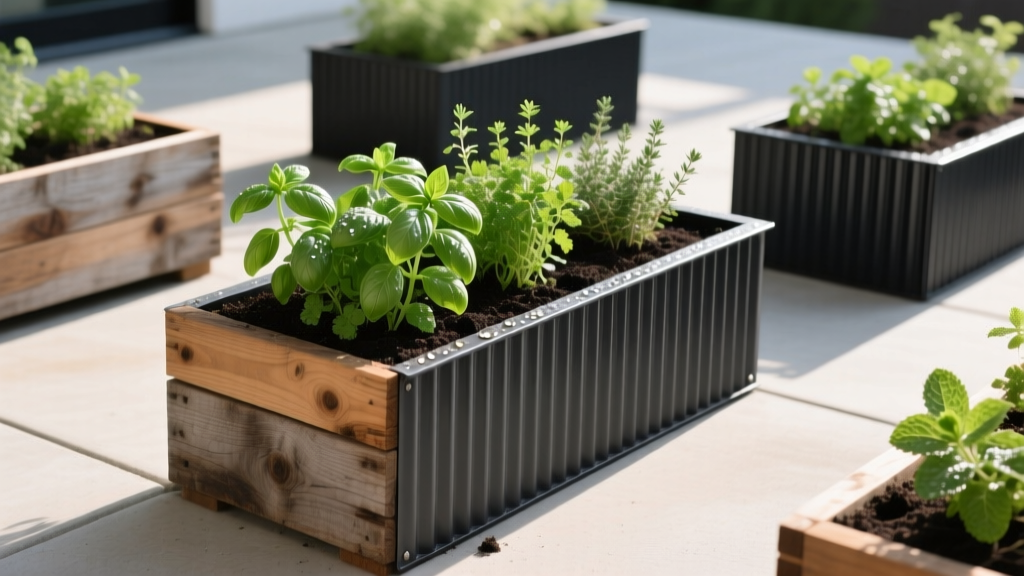
Weathering steel develops a dense, protective oxide patina that halts further corrosion, making it a premier choice for modern architectural landscapes. However, specifying it correctly is critical to avoid catastrophic failure.
Specifications and Sizing
For structural planter boxes up to 36 inches in height, specify 14-gauge (0.0747 inches) or 11-gauge (0.1196 inches) ASTM A588 Corten steel. Boxes exceeding 36 inches require 3/16-inch plate steel with welded 2x2-inch square tube stiffeners spaced every 24 inches on center to resist soil bowing.
Failure Modes and Mitigation
The primary failure mode of Corten steel in landscaping is pitting corrosion caused by standing water and high-chloride environments (coastal zones or areas where de-icing salts are used). Furthermore, the patina runoff will permanently stain adjacent concrete pavers. To mitigate this, contractors must install a 4-inch gravel French drain behind the box and apply a silane-based masonry sealer to any adjacent hardscaping. According to data from the UW-Madison Extension, lining metal beds is also crucial for temperature regulation, as steel transfers ambient heat rapidly, which can damage shallow root systems during summer heatwaves.
- Average Cost: $180 - $320 per linear foot (fabricated, 24" height).
- Expected Lifespan: 25 to 40+ years.
- Fastener Spec: Must use 316-grade stainless steel pop rivets or welds; standard galvanized hardware will induce galvanic corrosion.
Rot-Resistant Hardwoods and Softwoods
Wood remains a traditional favorite, but standard pressure-treated pine (even modern ACQ or MCQ formulations) is increasingly avoided for edible gardens due to copper leaching concerns. Instead, builders should specify naturally decay-resistant species.
Black Locust vs. Western Red Cedar
The USDA Forest Products Laboratory classifies Black Locust (Robinia pseudoacacia) as a Class 1 highly durable heartwood, capable of lasting 50+ years in direct ground contact. It is incredibly dense (specific gravity of 0.69), meaning it requires pre-drilling for all fasteners. Western Red Cedar, a Class 2 durable wood, offers a lighter, more workable alternative with a 10 to 15-year lifespan in ground contact, provided the heartwood is specified (sapwood will rot in 3 years).
- Black Locust Cost: $18 - $26 per board foot (rough sawn, 2x8).
- Western Red Cedar Cost: $6 - $11 per board foot (clear, kiln-dried).
- Joinery Technique: Use mortise and tenon or half-lap corners secured with 3/8-inch stainless steel carriage bolts. Butt joints with screws will fail as the wood expands and contracts with seasonal moisture changes.
Poured Concrete and CMU (Concrete Masonry Units)
Masonry planters offer unmatched permanence and thermal mass, but they introduce significant structural and chemical complexities. Poured concrete walls must be engineered to withstand the lateral earth pressure of saturated soil, which weighs approximately 120 lbs per cubic foot.
Structural and Chemical Requirements
For CMU block planters, use 8-inch nominal blocks filled with a 3,000 PSI grout mix and reinforced with #4 (1/2-inch) vertical rebar at 16 inches on center, tied to a continuous footing. The University of Minnesota Extension highlights a critical chemical issue with masonry: concrete naturally leaches calcium hydroxide, which raises soil pH over time. While beneficial for brassicas, high alkalinity will lock out iron and manganese for acid-loving plants like blueberries.
To solve the pH issue and protect the masonry from freeze-thaw spalling caused by internal moisture migration, the interior walls must be coated with a breathable, silane/siloxane penetrating sealer (such as Prosoco Siloxa-Tek 8500) and lined with a dimpled polypropylene drainage mat before backfilling.
- Average Cost: $35 - $65 per square foot of wall face (including footing and block).
- Expected Lifespan: 50 to 100+ years.
- Drainage Spec: Core-drill 1/2-inch weep holes every 12 inches along the base course, fitted with stainless steel mesh screens to prevent soil washout and insect intrusion.
Fiber Cement and Wood-Plastic Composites
For projects requiring the look of wood or masonry without the associated maintenance or weight, fiber cement panels (like James Hardie) and wood-plastic composites (WPC like Trex) are viable alternatives. Fiber cement panels (5/8-inch thick) are impervious to rot and insects but are highly susceptible to wicking moisture from the soil if the bottom edge is not properly capped. If water wicks into the panel and freezes, it will delaminate. WPC materials solve the wicking issue but suffer from thermal expansion; a 12-foot WPC board can expand up to 1/4-inch in summer heat, requiring slotted screw holes and hidden clip fastening systems to prevent buckling.
Material Comparison Matrix
| Material | Est. Cost (4x8x2 Box) | Lifespan | Thermal Mass | Interior Liner Required? |
|---|---|---|---|---|
| 14-Gauge Corten Steel | $1,400 - $2,100 | 30+ Years | High | Yes (60-mil HDPE) |
| Black Locust (2x8) | $900 - $1,300 | 50+ Years | Low | No |
| Western Red Cedar | $450 - $700 | 10-15 Years | Low | Optional |
| CMU Block (8-inch) | $1,100 - $1,800 | 75+ Years | Very High | Yes (Dimpled Mat) |
| WPC Composite | $800 - $1,200 | 25+ Years | Medium | Yes (EPDM Rubber) |
Critical Construction Details: Liners and Drainage
The material you choose is only half the equation; the interior waterproofing and drainage strategy dictate the actual lifespan of the structure and the health of the soil biome.
Specifying the Right Liner
Do not use cheap 6-mil polyethylene sheeting from the paint aisle. It will degrade under UV exposure and tear during soil backfilling. For metal and composite boxes, specify a 60-mil HDPE (High-Density Polyethylene) or 45-mil EPDM rubber pond liner. The liner must be mechanically fastened to the top rim using a wooden cap rail or metal trim coil, and it must extend all the way to the bottom of the box, but must not block the drainage weep holes. Cut precise X-slits in the liner directly over the weep holes to allow water egress while retaining soil.
Subgrade Drainage Engineering
Planters placed on impermeable surfaces (concrete patios, flat roofs) require a different drainage approach than those placed on native soil. For hard-surface installations, elevate the planter box 1/2-inch off the ground using high-density polypropylene shims or specialized adjustable pedestal feet. This air gap prevents the bottom rail of wooden boxes from sitting in standing water and allows effluent to clear the weep holes freely, preventing anaerobic soil conditions and root rot.
Pro Tip: When backfilling deep planters (over 24 inches), do not fill the entire depth with premium potting soil. The bottom 8 inches should consist of a coarse drainage layer of 3/4-inch clean crushed gravel, separated from the soil above by a layer of non-woven geotextile filter fabric. This prevents the soil matrix from migrating into the gravel and clogging the weep holes over time.
Written by
Sarah WhitfieldSarah Whitfield is a chartered quantity surveyor (MRICS) and construction cost analyst with 15 years of experience in material pricing, procurement strategy, and project budgeting. She earned her degree in Construction Management from the University of Reading (UK) and has worked on projects ranging from $2M custom homes to $180M mixed-use developments across North America and Europe. Sarah currently leads cost estimating for BuildMat Insight, maintaining a proprietary database of 4,000+ material price points updated quarterly. She is a frequent contributor to RSMeans cost data panels and has presented at the International Cost Engineering Council (ICEC) congress. Based in Denver, CO, Sarah is an avid trail runner and volunteer mentor for Women in Construction.
More from Sarah Whitfield
View all
Wood & Lumber
What Are the Different Types of Wood? A Builder's Guide
Compare structural softwoods, finish hardwoods, and engineered lumber. Analyze Janka ratings, MOE values, and 2026 pricing for construction.
Aug 4, 2026

Walls & Panels
Steel Framing vs Wood Framing: Corrosion and Moisture Defense
Compare steel framing vs wood framing for moisture resistance. Learn about galvanized coatings, condensation risks, and corrosion protection strategies.
Jul 21, 2026

Stone & Masonry
How to Cut Stone Veneer: Wet Saw vs Grinder Comparison
Compare the best tools for cutting stone veneer. We review wet saws, angle grinders, and chop saws to help you achieve clean, chip-free cuts.
Jul 21, 2026