Best Material for Speaker Box Enclosures: Technical Specs & Damping
Analyze the best material for speaker box construction using technical specs. Compare MDF, Baltic birch, and HDPE density, stiffness, and damping.

The Physics of Enclosure Resonance and Material Selection
The primary function of a loudspeaker enclosure is to provide an acoustically inert, rigid volume of air that prevents the cancellation of low-frequency sound waves between the front and rear of the driver cone. When evaluating the best material for speaker box construction, the decision hinges on three critical mechanical properties: density (mass per unit volume), stiffness (Young’s modulus), and internal damping (the ability to dissipate vibrational energy as heat). A material that is stiff but lacks damping will store and release acoustic energy, causing ‘ringing’ or coloration. Conversely, a material with high damping but low stiffness will suffer from panel deflection, resulting in muddy bass response and wasted amplifier power.
Material Comparison Matrix: Acoustic Properties & Density
The following matrix compares the baseline mechanical specifications of the most common enclosure materials. Data is derived from standard acoustic engineering references and the USDA Forest Products Laboratory Wood Handbook.
| Material | Density (kg/m³) | Stiffness (GPa) | Internal Damping | Primary Failure Mode |
|---|---|---|---|---|
| Standard MDF | 700 - 800 | 3.0 - 3.5 | High | Screw pull-out, moisture swelling |
| Baltic Birch Plywood | 650 - 680 | 10.0 - 12.0 | Medium | Core voids (if low grade) |
| HDPE (Marine Board) | 940 - 960 | 0.8 - 1.2 | Extremely Low | Acoustic ringing, panel flex |
| Fiberglass (Hand-laid) | 1800 - 2100 | 15.0 - 25.0 | Low | Thin-wall resonance |
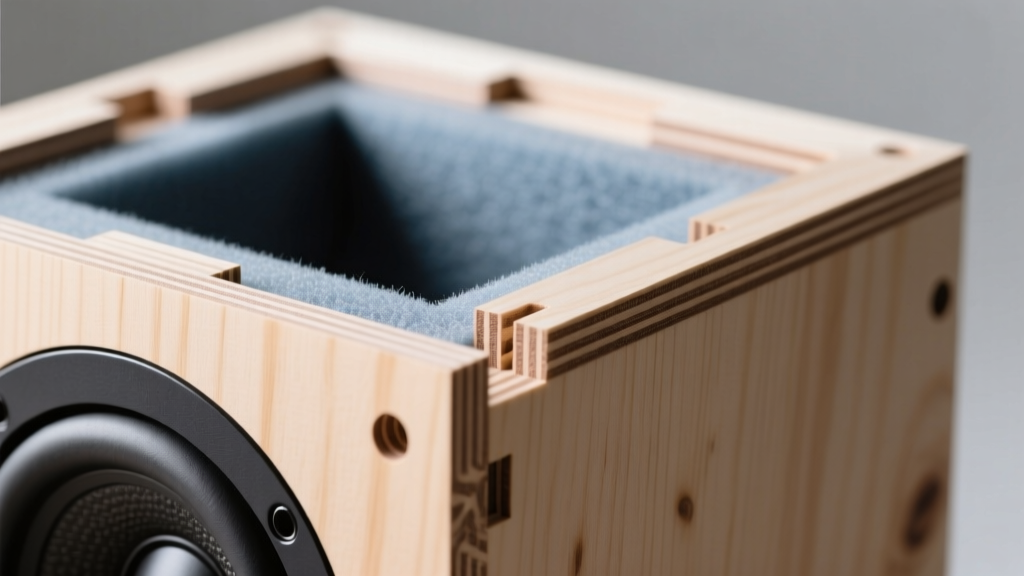
Medium Density Fiberboard (MDF): The Baseline Standard
MDF remains the most ubiquitous material in commercial and DIY loudspeaker manufacturing due to its high internal damping and isotropic nature (equal strength in all directions). The lignin and wood fibers are broken down and reconstituted with urea-formaldehyde resin under high heat and pressure, eliminating the grain structure found in solid wood. This lack of grain means MDF does not exhibit directional stiffness variations, and its porous cellular structure effectively absorbs high-frequency vibrations.
Technical Specifications & Fastening Protocols
Standard 3/4-inch (19mm) MDF weighs approximately 2.2 lbs per square foot. While its damping is excellent, its stiffness is relatively poor. According to acoustic design principles outlined by Elliott Sound Products, an unbraced MDF panel wider than 12 inches will exhibit significant deflection at high sound pressure levels (SPL).
- Adhesives: Use aliphatic resin wood glues (e.g., Titebond II or III). Apply a continuous bead and clamp at 100-150 PSI until cured. MDF end-grain absorbs glue rapidly; apply a sizing coat (glue diluted 20% with water) to edges before final assembly.
- Fasteners: MDF has notoriously low screw-holding strength (approximately 400 lbs of pull-out force for a #8 screw). Never rely on wood screws alone for driver mounting. Use 10-24 or 1/4-20 T-nuts, threaded inserts, or hurricane nuts for all driver and terminal cup hardware.
Baltic Birch Plywood: High-Fidelity and Structural Rigidity
For high-end audiophile enclosures, professional touring monitors, and high-SPL subwoofers, Baltic Birch plywood is the definitive choice. Unlike standard construction plywood, genuine Baltic Birch (sourced from the Betula pendula species) features uniform, void-free inner plies and a high ply count. A standard 18mm (3/4-inch) sheet contains 13 individual plies, cross-banded at 90-degree angles.
Ply Count and Void Analysis
The cross-grain lamination process yields a material with a Young’s modulus roughly three times higher than MDF, while weighing slightly less. This superior stiffness-to-mass ratio allows for larger unbraced panel spans. However, the acoustic damping of Baltic Birch is lower than MDF, meaning the panels will resonate at a higher amplitude if not treated. To mitigate this, builders must apply constrained layer damping (CLD) treatments, such as self-adhesive butyl rubber sheets (e.g., Kilmat or Dynamat), to the interior surfaces of the largest panels.
Advanced Polymers (HDPE) and Composites
When environmental resistance is required—such as in marine, outdoor, or high-humidity installations—wood-based products fail due to moisture ingress. High-Density Polyethylene (HDPE), often sold under brand names like StarBoard, is the standard for marine speaker enclosures.
However, HDPE presents severe acoustic challenges. Its internal damping is virtually non-existent, and its stiffness is remarkably low for its density. An HDPE box will ‘ring’ like a bell when struck, and that resonance will transfer directly into the audio passband. To use HDPE effectively as the best material for speaker box applications in harsh environments, engineers must employ heavy internal bracing (often using aluminum extrusions) and line the interior with mass-loaded vinyl (MLV) or bitumen pads to artificially induce damping. Furthermore, HDPE cannot be glued with standard wood adhesives; joints must be mechanically fastened using stainless steel hardware and sealed with marine-grade polyurethane sealants (e.g., 3M 5200), or welded using specialized plastic welding tools.
Calculating Panel Deflection and Bracing Geometry
Regardless of whether you select MDF or Baltic Birch, bracing is mandatory for any enclosure dimension exceeding 14 inches. The goal of bracing is not merely to hold the walls together, but to alter the resonant frequency of the panels by reducing their effective surface area.
- Identify the Longest Span: Panel resonance is inversely proportional to the square of the panel's length. Halving the unsupported span of a panel increases its fundamental resonant frequency by a factor of four.
- Implement Window Bracing: Instead of simple dowel braces, use CNC-cut ‘window’ braces that span from the front baffle to the rear wall, and from side to side. The cutouts in the brace allow acoustic energy to pass through to the rear damping material while maintaining structural rigidity.
- Optimize Brace Placement: Never place a brace exactly in the geometric center of a panel. The center is the point of maximum excursion for the fundamental resonance mode. Offset braces by roughly 20% to 30% from the center to disrupt multiple harmonic modes simultaneously.
Failure Modes in Enclosure Assembly
Even with the optimal material selected, improper construction techniques will compromise the acoustic integrity of the enclosure. The Linkwitz Lab acoustic design archives emphasize that an enclosure must be treated as a pressurized vessel. The following failure modes must be engineered out of the design:
- Baffle Step Diffraction & Flex: The front baffle experiences the highest mechanical stress due to the direct coupling of the driver's motor structure. If using MDF, double or triple the baffle thickness (e.g., 1.5 to 2.25 inches) to prevent flex and to allow for flush-mounting of drivers and round-over routing to mitigate diffraction.
- Acoustic Leaks: Any gap in the joinery will result in a loss of internal pressure, causing a drop in bass extension and introducing ‘chuffing’ noises at high excursions. All internal seams must be sealed with a bead of silicone or acoustic caulk after the primary wood glue has cured.
- Driver Decoupling: Mounting heavy subwoofer drivers directly to a single layer of 3/4-inch MDF can lead to baffle fatigue and screw tear-out over time. Utilize a captive T-nut system with machine screws (typically 10-24 or M5/M6 metric) and a neoprene gasket between the driver frame and the baffle to ensure an airtight seal and prevent mechanical rattling.
Written by
Priya KapoorPriya Kapoor is a real estate market analyst and construction economics researcher with expertise in housing affordability, development feasibility, and infrastructure investment. She holds a Master of Regional Planning from Cornell University and previously worked as a senior analyst at CBRE's Investment Properties group, where she modeled returns for $4B in mixed-use development pipelines. Priya now runs an independent research practice advising developers, municipalities, and REITs on construction cost forecasting and market timing. She publishes the quarterly "BuildMat Market Pulse" report tracking material price indices across 12 commodity categories. Based in Austin, TX, Priya serves on the board of Habitat for Humanity Austin and is a marathon runner.
More from Priya Kapoor
View all
Construction Cost
Cost to Build a 1600 Sq Ft Home in 2026: Full Breakdown
Accurate 2026 cost to build a 1600 sq ft home—material, labor, and regional pricing breakdowns included. Plan your budget with real-time estimates.
Aug 11, 2026

Wood & Lumber
Name the Types of Wood for Pressure Treatment and Preservation
Learn how to name the types of wood best suited for pressure treatment. Compare species treatability, chemical retention levels, and 2026 preservation costs.
Aug 4, 2026

Stone & Masonry
Stone Veneer Suppliers Lindenhurst: 2026 Cost Analysis
Analyze 2026 stone veneer costs in Lindenhurst, NY. Compare local supplier pricing, delivery fees, and Suffolk County installation labor rates.
Aug 4, 2026