What Materials Were Used to Build Pyramids? A Structural Guide
Discover what materials were used to build pyramids, from Tura limestone casing to Aswan granite cores, and the ancient engineering behind them.

The Core Question: What Materials Were Used to Build Pyramids?
When engineers and architects ask what materials were used to build pyramids, the answer extends far beyond a simple pile of rocks. The Great Pyramid of Giza (Khufu) consists of an estimated 2.3 million blocks, but the structural integrity of these monuments relies on a highly deliberate, multi-zone material strategy. Ancient Egyptian builders selected specific lithologies based on compressive strength, weathering resistance, and workability, creating a composite structure that has survived for over 4,500 years.
- Outer Casing: Highly polished Tura limestone (reflective, weather-resistant).
- Structural Core: Local nummulitic limestone (high volume, moderate strength).
- Load-Bearing Chambers: Aswan syenite granite (extreme compressive strength).
- Binding & Leveling: Calcined gypsum mortar (lubrication and micro-seismic flexibility).
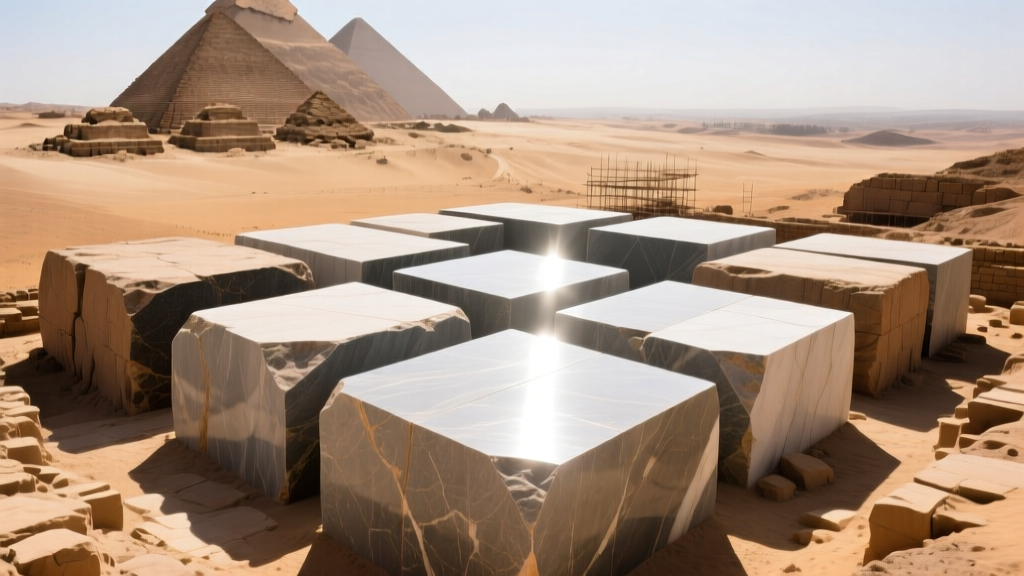
The Outer Casing: Tura Limestone and the Reflective Shield
The original exterior of the major Giza pyramids was not the stepped, rough-hewn surface we see today. It was encased in Tura limestone, quarried from the Tura-Masara hills on the eastern bank of the Nile. This material was chosen for its brilliant white color, fine grain, and high resistance to weathering.
From a materials science perspective, Tura limestone has a compressive strength ranging from 40 to 60 MPa, making it significantly harder and more durable than the core blocks. The casing stones were cut with extreme precision—tolerances were often within 0.5 millimeters—and set at an angle of 51 degrees and 50 minutes. This smooth, angled surface not only reflected the intense solar radiation, reducing thermal expansion stress on the inner core, but also prevented wind-driven sand erosion from degrading the structural joints.
The Structural Core: Local Nummulitic Limestone
The vast majority of the pyramid's volume—roughly 90% of its total mass—consists of local nummulitic limestone quarried directly from the Giza plateau itself. This stone dates back to the Eocene epoch and is heavily embedded with nummulites, a type of large fossilized foraminifera.
Quarrying and Material Limitations
Local Giza limestone has a relatively low compressive strength of 20 to 30 MPa and a high porosity rate. Because it is brittle and prone to fracturing along fossil fault lines, it was unsuitable for the outer casing or the massive load-bearing spans of the internal chambers. However, its proximity to the build site made it the only logistically viable choice for the core. Builders extracted these blocks using copper chisels and wooden mallets, exploiting the natural horizontal bedding planes of the plateau to cleave massive 2.5-ton blocks with minimal energy expenditure.
The Weight-Bearers: Aswan Granite and Basalt
To answer what materials were used to build pyramids without mentioning Aswan granite is to ignore the structural backbone of the King's Chamber. The builders required a material capable of spanning wide voids while supporting the immense vertical load of the masonry above. Local limestone would have crushed under this pressure.
The solution was syenite granite (often referred to historically as Aswan granite) sourced from quarries over 800 kilometers south in Aswan. This igneous rock boasts a compressive strength of 150 to 250 MPa and a density of 2.65 to 2.75 g/cm³. The granite beams roofing the King's Chamber weigh up to 80 tons each. To relieve the stress on these beams, the architects designed a series of 'relieving chambers' above them, culminating in a corbelled, pitched limestone roof that deflects the vertical weight outward into the surrounding core masonry.
| Material | Compressive Strength (MPa) | Density (g/cm³) | Primary Application |
|---|---|---|---|
| Tura Limestone | 40 - 60 | 2.30 - 2.40 | Outer Casing |
| Giza Core Limestone | 20 - 30 | 2.10 - 2.20 | Main Volume / Core |
| Aswan Syenite Granite | 150 - 250 | 2.65 - 2.75 | Chamber Roofs / Portcullises |
| Basalt | 100 - 300 | 2.80 - 3.00 | Valley Temple Flooring |
The Unsung Hero: Gypsum Mortar and Lubricants
A common misconception is that the pyramids were built dry, relying solely on gravity and precision cutting. In reality, gypsum mortar played a critical role. The chemical composition of this mortar is primarily calcium sulfate dihydrate (CaSO4·2H2O). Ancient workers calcined raw gypsum by heating it to roughly 150°C to 200°C in open fires, driving off the water to create plaster of Paris, which was then rehydrated on-site.
Engineering Insight: Unlike modern Portland cement, which cures through hydration and shrinks as it hardens, gypsum mortar sets via recrystallization. It does not shrink significantly and retains a slight elasticity. This flexibility allowed the pyramid to absorb micro-seismic shifts and thermal expansion without cracking the rigid stone joints.
The mortar was not used as an adhesive to bind the blocks together; the sheer weight of the stones provided the structural cohesion. Instead, it was applied as a thick slurry to lubricate the massive blocks, allowing masons to slide them into exact positions and achieve perfectly level bedding planes.
Logistics and Transport: The Physics of Moving Stone
Understanding what materials were used to build pyramids requires understanding how those materials were moved. The transport of 80-ton granite beams from Aswan relied on the Nile's annual inundation, but moving the 2.5-ton limestone blocks across the desert required a mastery of tribology (the study of friction).
Research published in the Proceedings of the National Academy of Sciences (PNAS) demonstrated that Egyptian workers poured water on the sand immediately in front of wooden transport sledges. Adding exactly 2% to 3% water by volume to desert sand creates capillary bridges between the sand grains, effectively doubling the stiffness of the sand and reducing sliding friction by up to 50%. This precise moisture control prevented the sand from bunching up in front of the sledge, cutting the required pulling manpower in half.
Modern Discoveries: ScanPyramids and Muon Radiography
Modern non-destructive testing has revolutionized our understanding of the internal material distribution. The ScanPyramids project, utilizing cosmic-ray muon radiography, has mapped the internal density of the Great Pyramid without drilling a single hole. Muons pass easily through low-density voids but are absorbed by high-density stone.
According to findings published in the journal Nature, this technology confirmed the existence of a massive, previously unknown 'Big Void' located above the Grand Gallery. The data indicates that the builders deliberately manipulated the placement of high-density granite and low-density limestone to create structural buffers, proving that the material selection was governed by a sophisticated understanding of load distribution that modern engineers are still working to fully decode.
Material Degradation and Preservation
Today, the Great Pyramid looks like a stepped mountain of rough yellow stone, but this is an artifact of material degradation and human intervention. The smooth Tura limestone casing was largely stripped away following a massive earthquake in 1303 AD, which loosened the outer stones. They were subsequently carted away to build mosques and fortresses in Cairo. The underlying nummulitic core, while softer and more porous, survived because the pyramid's sheer geometric mass and the protective gypsum mortar joints prevented catastrophic structural failure. For further context on the preservation of these ancient structures, the UNESCO World Heritage Centre maintains extensive documentation on the Memphis and its Necropolis site, highlighting the ongoing challenges of material conservation in a modern, high-pollution environment.
Written by
Marcus ChenMarcus Chen is a licensed structural engineer (PE) and building materials analyst with over 12 years of experience across residential, commercial, and industrial construction. He holds a Master of Science in Civil Engineering from UC Berkeley and spent six years at Thornton Tomasetti before transitioning to independent consulting and technical writing. Marcus specializes in material selection for seismic-prone regions, concrete reinforcement strategies, and lifecycle cost analysis. His work has been cited by the American Concrete Institute (ACI) and the Structural Engineers Association of California (SEAOC). When he is not on a job site or at his desk, you will find him hiking the Sierra Nevada or restoring a 1920s craftsman bungalow in Oakland, CA.
More from Marcus Chen
View all
Construction Cost
How Much Did the Eiffel Tower Cost to Build?
How much did the Eiffel Tower cost to build in 1889? We adjust for inflation and compare its budget to modern skyscraper construction.
Aug 4, 2026

Fire Resistance
What Is a Fire Resistant Material? Testing & Certification Guide
Discover what is a fire resistant material through ASTM and UL testing. Learn how fire ratings, certifications, and assemblies work in construction.
Aug 4, 2026

Construction Cost
How Much Did the Burj Khalifa Cost to Build?
How much did the Burj Khalifa cost to build? We break down the $1.5B project and extract 5 money-saving strategies for your next build.
Jul 30, 2026