Best Materials for Egg Drop: An Impact Engineering Guide
Discover the best materials for egg drop challenges using structural engineering principles. Compare foams, elastomers, and lattice frames.
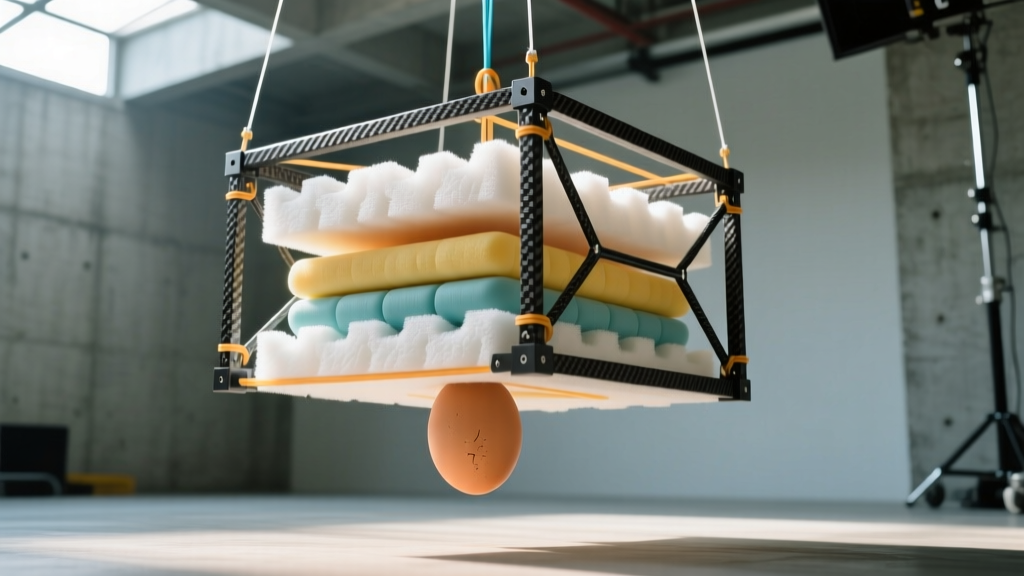
The Engineering Physics of Impact Absorption
Designing a successful protective enclosure requires a fundamental understanding of impulse and momentum. A standard large chicken egg has a mass of approximately 50 grams and will fracture when subjected to a peak impact force of roughly 50 Newtons. The objective of any egg drop apparatus is not merely to "cushion" the egg, but to manipulate the physics of the collision. According to the impulse-momentum theorem, the change in momentum is equal to the force multiplied by the time over which it acts ($F \Delta t = \Delta p$). Because the change in momentum is fixed based on the drop height and terminal velocity, the only way to reduce the peak force ($F$) below the 50N fracture threshold is to maximize the collision duration ($\Delta t$). For a deeper analysis of these physics principles, refer to the Physics Classroom's guide on momentum and impulse.
Selecting the best materials for egg drop applications means choosing substances that undergo controlled, irreversible deformation (crumple zones) or exhibit high viscoelastic hysteresis (energy dissipation). Below is a technical breakdown of the most effective materials, categorized by their structural function.
Tier 1: Energy Dissipating Core Materials
The core material directly interfaces with the payload. Its primary job is to extend the deceleration time through compression, air displacement, or molecular friction.
Open-Cell Polyurethane Foams
Unlike closed-cell foams (which trap air and act as bouncy, rigid springs), open-cell polyurethane foam allows air to escape through its interconnected pore network during compression. This pneumatic damping effect converts kinetic energy into heat and air friction. For optimal performance, specify a foam density between 1.2 lb/ft³ and 1.8 lb/ft³. Densities lower than 1.0 lb/ft³ will bottom out too quickly on a 10-meter drop, resulting in a harsh spike in G-force, while densities above 2.5 lb/ft³ are too rigid and will transfer the shockwave directly to the shell.
Viscoelastic Elastomers (Sorbothane)
Sorbothane is a proprietary viscoelastic polyurethane that simultaneously acts as a shock absorber, vibration damper, and acoustic insulator. It absorbs up to 94.7% of impact energy. For a 50-gram payload, you should utilize a 30 to 50 Shore A durometer rating. Cut the elastomer into small, isolated pads (e.g., 1-inch cubes) and place them at the six primary axes of the egg. This prevents the "rebound effect," where a single large block of rubber stores elastic potential energy and launches the egg against the opposite interior wall after the initial impact.
Non-Newtonian Fluid Suspensions
For advanced applications, a suspension of cornstarch and water (oobleck) or a commercial shear-thickening fluid (STF) encased in a sealed heavy-mil polyethylene bag offers dynamic protection. Under normal handling, the fluid remains liquid, allowing the egg to settle into the center. Upon the high-velocity shock of impact, the fluid's viscosity increases exponentially, locking into a semi-solid state that distributes the force evenly across the entire surface area of the eggshell, eliminating localized stress points.

Material Comparison Matrix: Weight vs. Energy Absorption
Weight is a critical constraint in most structural challenges. The following matrix compares the physical properties of common core materials used in impact mitigation.
| Material | Density (kg/m³) | Energy Absorption Mechanism | Reusability | Relative Cost |
|---|---|---|---|---|
| Open-Cell PU Foam | 18 - 28 | Pneumatic damping, cell wall buckling | High (if not bottomed out) | $ |
| Sorbothane (50A) | 1,100 | Molecular hysteresis, thermal dissipation | Very High | $$$ |
| Corrugated Cardboard | 60 - 90 | Plastic deformation, structural buckling | Single Use | $ |
| Expanded Polystyrene (EPS) | 15 - 30 | Cellular crushing, brittle fracture | Single Use | $ |
| Shear-Thickening Fluid | 1,200+ | Hydrodynamic locking, force distribution | High | $$ |
Tier 2: Exoskeleton and Lattice Framing
The exoskeleton protects the core from lateral impacts and prevents the apparatus from shattering upon initial ground contact. The framing must be lightweight but possess a high flexural modulus.
Balsa Wood and Basswood Struts
Balsa wood (Ochroma pyramidale) remains the standard for micro-lattice frames due to its exceptional strength-to-weight ratio. Use 1/8-inch by 1/8-inch square stock for primary load-bearing members. To maximize energy absorption, construct a geodesic or octet truss geometry. Triangles distribute compressive loads axially along the struts, preventing bending moments that cause premature snapping. Glue joints should be reinforced with cyanoacrylate (CA) accelerator for instant curing, as standard PVA wood glue introduces unwanted moisture weight and requires clamping time.
Carbon Fiber and Fiberglass Pultrusions
For high-budget or unrestricted weight categories, 2mm carbon fiber rods offer immense tensile strength. However, carbon fiber is brittle and fails catastrophically without warning. Fiberglass (GFRP) rods are often superior for impact applications because they exhibit a higher strain-to-failure ratio, allowing them to bend and whip, dissipating kinetic energy through elastic deformation before snapping.
Structural Configurations and Application Techniques
Having the best materials for egg drop challenges is useless without the correct geometric configuration. According to structural testing guidelines adapted from ASTM D4169 standard practices for shipping container performance, multi-stage deceleration is the most reliable methodology.
- Stage 1: Aerodynamic Drag (Pre-Impact). Utilize a ripstop nylon parachute (minimum 24-inch diameter) or a drag-inducing geometric frame (like a large wire-frame cube) to reduce the terminal velocity before the apparatus even touches the ground.
- Stage 2: Exterior Crumple Zone (Initial Contact). Implement a 2-inch perimeter of corrugated cardboard cones or rolled paper tubes. These act as the vehicle's "crumple zone," crushing sequentially to bleed off the first 40% of the kinetic energy.
- Stage 3: Internal Suspension (Final Deceleration). Suspend the padded egg in the exact geometric center of the frame using rubber bands or pantyhose. This ensures that regardless of which side of the exoskeleton hits the ground, the egg must decelerate by stretching the suspension membrane, preventing direct hard-point contact.
Common Failure Modes and Edge Cases
When prototypes fail during 10-meter drop tests, the failure is rarely due to a lack of padding. It is usually a result of one of the following mechanical edge cases:
- The Internal Rebound: The exterior padding stops the container, but the egg's internal momentum carries it forward, causing it to smash against the interior wall of the container. Fix: Implement a 360-degree internal harness using nylon stockings or elastic netting to decouple the egg from the container walls.
- Asymmetric Ground Strike: The apparatus lands on a corner or edge, concentrating the force into a single structural node, which punches through the frame and directly into the payload. Fix: Design a spherical or multi-faceted polyhedral exterior that guarantees a distributed impact surface regardless of orientation.
- Parachute Entanglement: The drag device fails to deploy, resulting in a free-fall terminal velocity impact. Fix: Use a rigid deployment canister with a spring-loaded pilot chute, or abandon parachutes entirely in favor of high-drag auto-rotating fins.
Sourcing and Prototyping Economics
For teams iterating on multiple designs, material sourcing dictates the speed of prototyping. While hobby shops carry basic balsa and EPS, industrial suppliers provide the precise tolerances required for serious engineering applications. Suppliers like McMaster-Carr offer open-cell polyurethane foams cut to exact densities, and specialized elastomer sheets that allow for precision laser cutting of custom suspension harnesses. For comprehensive educational frameworks and testing methodologies, engineering educators frequently reference the TeachEngineering curriculum modules, which provide standardized testing rubrics for evaluating payload survival and structural efficiency.
Ultimately, the best materials for egg drop success are those that allow you to control the rate of deceleration. By combining a high-drag exterior, a sacrificial corrugated crumple zone, and a viscoelastic internal suspension, you can reliably protect a fragile payload from drops exceeding 15 meters, translating micro-scale physics into a masterclass in structural impact engineering.
Written by
Priya KapoorPriya Kapoor is a real estate market analyst and construction economics researcher with expertise in housing affordability, development feasibility, and infrastructure investment. She holds a Master of Regional Planning from Cornell University and previously worked as a senior analyst at CBRE's Investment Properties group, where she modeled returns for $4B in mixed-use development pipelines. Priya now runs an independent research practice advising developers, municipalities, and REITs on construction cost forecasting and market timing. She publishes the quarterly "BuildMat Market Pulse" report tracking material price indices across 12 commodity categories. Based in Austin, TX, Priya serves on the board of Habitat for Humanity Austin and is a marathon runner.
More from Priya Kapoor
View all
Construction Cost
Cost to Build a 1600 Sq Ft Home in 2026: Full Breakdown
Accurate 2026 cost to build a 1600 sq ft home—material, labor, and regional pricing breakdowns included. Plan your budget with real-time estimates.
Aug 11, 2026

Wood & Lumber
Name the Types of Wood for Pressure Treatment and Preservation
Learn how to name the types of wood best suited for pressure treatment. Compare species treatability, chemical retention levels, and 2026 preservation costs.
Aug 4, 2026

Stone & Masonry
Stone Veneer Suppliers Lindenhurst: 2026 Cost Analysis
Analyze 2026 stone veneer costs in Lindenhurst, NY. Compare local supplier pricing, delivery fees, and Suffolk County installation labor rates.
Aug 4, 2026