What Materials Were Used to Build the Pyramids? Modern Cost Analysis
Discover what materials were used to build the pyramids and explore a detailed modern cost analysis of limestone, granite, and basalt in today's market.

The Economics of Antiquity: Sourcing the Great Pyramid
When architects and engineers ask what materials were used to build the pyramids, the answer usually focuses on the geological origins of the stone. However, from a modern construction and cost analysis perspective, the true marvel lies in the sheer volume of material moved and the economic scale required to replicate it today. The Great Pyramid of Giza (Khufu) consists of an estimated 2.3 million blocks, weighing a combined 5.75 million metric tons. To understand the true material cost of this ancient megastructure, we must translate the ancient quarrying of the Mokattam, Tura, and Aswan formations into 2026 market pricing, factoring in modern diamond-wire extraction, heavy freight logistics, and raw commodity valuation.
Core Masonry: Mokattam Limestone
The vast majority of the pyramid's core—roughly 5.5 million tons—was sourced locally from the Mokattam limestone formation, located just a few hundred yards from the Giza plateau. This nummulitic limestone is relatively soft when quarried but hardens upon exposure to air, making it an ideal bulk fill material with a compressive strength ranging from 3,000 to 5,000 psi.
2026 Replication Cost
In the modern construction market, rough-cut, low-grade quarry limestone used for structural fill and retaining walls costs between $45 and $65 per metric ton, depending on regional diesel prices and blasting regulations.
- Volume Required: ~5,500,000 metric tons
- 2026 Unit Cost: $55 per ton (averaged)
- Estimated Core Material Cost: $302.5 million
Material Insight: The Hidden Value of Nummulites
Mokattam limestone is heavily fossilized with nummulites (ancient marine organisms). While modern structural engineers often reject highly fossilized stone for high-load bearing due to micro-voids, the Egyptians utilized a brilliant structural workaround: they graded the stone. The densest, least porous layers were reserved for the outer structural tiers, while the more porous, nummulite-heavy blocks were used for the inner, low-stress core fill.
The Casing Stones: Tura Limestone
The original exterior of the Great Pyramid was not the stepped, rough-hewn surface we see today. It was encased in highly polished, brilliant white limestone quarried at Tura, across the Nile. According to the World History Encyclopedia, these casing stones were cut with extreme precision, fitted together with joints barely wider than a sheet of paper.
Modern Architectural Cladding Equivalents
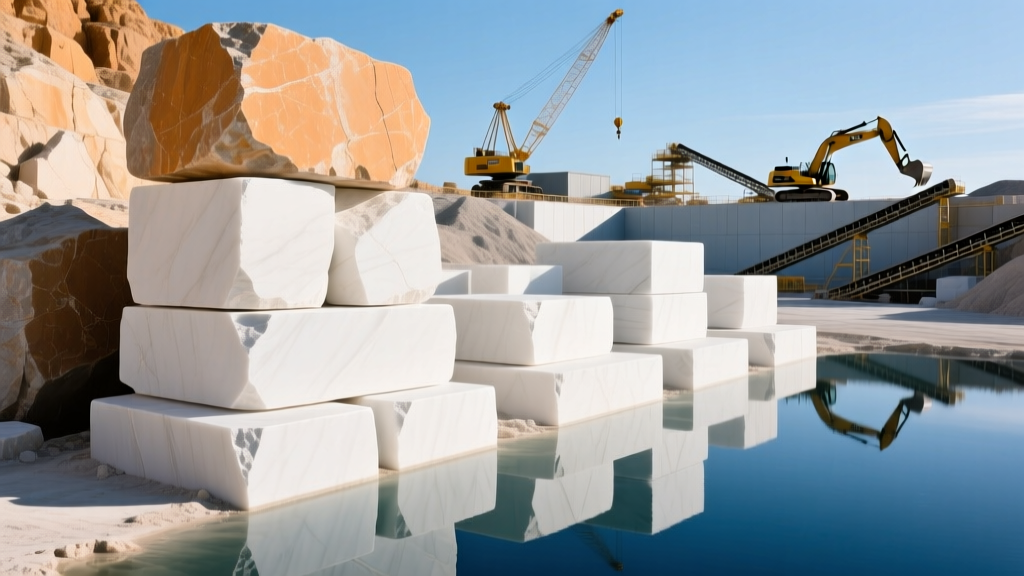
Tura limestone is geologically similar to modern high-grade Indiana Limestone or premium Mediterranean white limestone used in luxury architectural cladding. In 2026, premium architectural limestone, quarried, gang-sawn, and polished for exterior facade use, commands between $250 and $400 per metric ton (or roughly $18 to $30 per square foot installed).
The Great Pyramid originally required approximately 144,000 casing stones, averaging 1.5 tons each, totaling roughly 216,000 tons of premium finished stone.
| Material Specification | Estimated Volume (Tons) | 2026 Market Unit Cost | Total Modern Material Cost |
|---|---|---|---|
| Mokattam Core Limestone (Rough) | 5,500,000 | $55 / ton | $302,500,000 |
| Tura Casing Limestone (Polished) | 216,000 | $325 / ton | $70,200,000 |
| Aswan Red Granite (Structural) | 8,500 | $850 / ton | $7,225,000 |
| Calcined Gypsum Mortar | 500,000 | $140 / ton | $70,000,000 |
| Total Raw Material Estimate | 6,224,500 | - | $449,925,000 |
Structural Granite: The Aswan Quarries
The King’s Chamber and its complex relieving chambers were constructed using massive beams of red granite sourced from Aswan, located over 500 miles south of Giza. Some of these granite monoliths weigh up to 80 tons. The Natural Stone Institute classifies high-density structural granite of this caliber as premium monumental stone, noting its exceptional compressive strength (often exceeding 20,000 psi) and low water absorption rates.
Today, quarrying an 80-ton monolithic beam of red granite without internal fissures requires advanced ground-penetrating radar, diamond-wire sawing, and specialized heavy-lift gantry cranes. The raw material cost for monumental-grade Aswan-equivalent granite (such as premium red granite from North American or Scandinavian quarries) sits around $600 to $850 per ton. However, the fabrication cost to achieve the mirror-like interior finish seen in the King's Chamber pushes the delivered cost well over $2,500 per ton.
The Mortar Mystery: Calcined Gypsum
A common misconception is that the pyramids were built using simple mud mortar or that the stones were dry-stacked. Research by the Ancient Egypt Research Associates (AERA) confirms that the builders used vast quantities of calcined gypsum mortar. This was not merely a bonding agent; it acted as a crucial lubricant during the placement of multi-ton blocks and provided a leveling bed that distributed immense structural loads evenly across uneven stone surfaces.
Producing calcined gypsum requires heating raw gypsum rock to roughly 150°C (300°F) to drive off water, then rehydrating it on-site. To generate the estimated 500,000 tons of gypsum mortar used in the Great Pyramid, the Egyptians had to burn thousands of tons of wood and scrub in a largely treeless desert environment, representing a massive secondary material and fuel cost that is often excluded from basic stone tallies.
Logistics vs. Material: The True Cost Multiplier
If the raw materials cost roughly $450 million in 2026 dollars, why would replicating the Great Pyramid today cost an estimated $5 billion to $10 billion? The answer lies in the modern cost of precision logistics and specialized labor.
- Freight and Transport: Moving 8,500 tons of granite 500 miles via modern heavy-haul rail and barge would cost roughly $120 per ton, adding $1 million just in Aswan freight. Moving 5.5 million tons of limestone even a few miles via modern dump trucks would cost upwards of $8 per ton per mile, adding $44 million in localized transport.
- Precision Cutting: Modern CNC wire saws can cut limestone to a 1-millimeter tolerance, but operating these machines requires specialized labor, diamond-wire consumables, and massive water-cooling infrastructure.
- Crane and Rigging Limitations: Placing a 15-ton block at an elevation of 400 feet requires heavy-lift tower cranes. As the structure narrows, crane placement becomes exponentially more complex and expensive, requiring specialized climbing crane systems.
Frequently Asked Questions
Were any metals used in the construction of the pyramids?
Metals played a minimal role in the structural integrity of the pyramids. The Egyptians used copper chisels and saws, hardened with arsenic, to cut the softer limestones. However, copper is too soft to effectively cut granite. For the Aswan granite, builders relied on dolerite pounders (a harder igneous rock) and copper saws used in conjunction with quartz sand as an abrasive slurry. The material cost of the copper and dolerite consumed during the 20-year construction period was economically significant in the Bronze Age, though negligible in raw dollar value today.
How does the material cost of the Great Pyramid compare to modern skyscrapers?
The raw material cost of the Great Pyramid (~$450 million) is actually lower than the structural steel, high-performance glass, and reinforced concrete required for a modern 80-story skyscraper, which often exceeds $800 million in raw materials. However, the Great Pyramid's material volume is vastly superior. The Burj Khalifa, for example, utilized roughly 330,000 cubic meters of concrete and 39,000 tons of steel—masses that pale in comparison to the 2.6 million cubic meters of solid stone in the Great Pyramid.
What happened to the Tura limestone casing?
The brilliant white Tura casing stones were largely stripped away during the Middle Ages, particularly after a massive earthquake in 1303 AD loosened many of the blocks. They were repurposed as building materials for mosques, fortresses, and other structures in nearby Cairo. From a modern cost analysis perspective, this represents one of the largest historical instances of architectural material recycling, effectively transferring a $70 million (modern equivalent) facade to the medieval Cairo real estate market for free.
Written by
Sarah WhitfieldSarah Whitfield is a chartered quantity surveyor (MRICS) and construction cost analyst with 15 years of experience in material pricing, procurement strategy, and project budgeting. She earned her degree in Construction Management from the University of Reading (UK) and has worked on projects ranging from $2M custom homes to $180M mixed-use developments across North America and Europe. Sarah currently leads cost estimating for BuildMat Insight, maintaining a proprietary database of 4,000+ material price points updated quarterly. She is a frequent contributor to RSMeans cost data panels and has presented at the International Cost Engineering Council (ICEC) congress. Based in Denver, CO, Sarah is an avid trail runner and volunteer mentor for Women in Construction.
More from Sarah Whitfield
View all
Wood & Lumber
What Are the Different Types of Wood? A Builder's Guide
Compare structural softwoods, finish hardwoods, and engineered lumber. Analyze Janka ratings, MOE values, and 2026 pricing for construction.
Aug 4, 2026

Walls & Panels
Steel Framing vs Wood Framing: Corrosion and Moisture Defense
Compare steel framing vs wood framing for moisture resistance. Learn about galvanized coatings, condensation risks, and corrosion protection strategies.
Jul 21, 2026

Stone & Masonry
How to Cut Stone Veneer: Wet Saw vs Grinder Comparison
Compare the best tools for cutting stone veneer. We review wet saws, angle grinders, and chop saws to help you achieve clean, chip-free cuts.
Jul 21, 2026