Best Sound Deadening Material for UTV: 2026 Tech Specs
Discover the best sound deadening material for UTV builds. Compare CLD, MLV, and CCF tech specs, butyl vs asphalt chemistry, and exact 2026 coverage formulas.

The NVH Reality of Side-by-Sides: Why Standard Mats Fail
Utility Task Vehicles (UTVs) operate in extreme Noise, Vibration, and Harshness (NVH) environments. A stock Polaris RZR Pro XP or Can-Am Maverick X3 routinely generates cabin noise levels between 95 dB and 105 dB at cruising speeds. According to the National Institute on Deafness and Other Communication Disorders (NIDCD), prolonged exposure to noise above 85 dB causes permanent sensorineural hearing loss. Standard automotive sound deadening materials frequently fail in UTV applications due to three distinct environmental stressors: extreme thermal cycling (engine and exhaust proximity), high-frequency structural vibration from unsprung mass, and constant exposure to water, mud, and UV radiation.
To engineer a proper acoustic enclosure for a UTV cabin, you cannot rely on a single material. You must deploy a multi-stage acoustic stack that addresses both structural resonance and airborne noise transmission. This requires a precise understanding of material specifications, polymer chemistry, and acoustic physics.
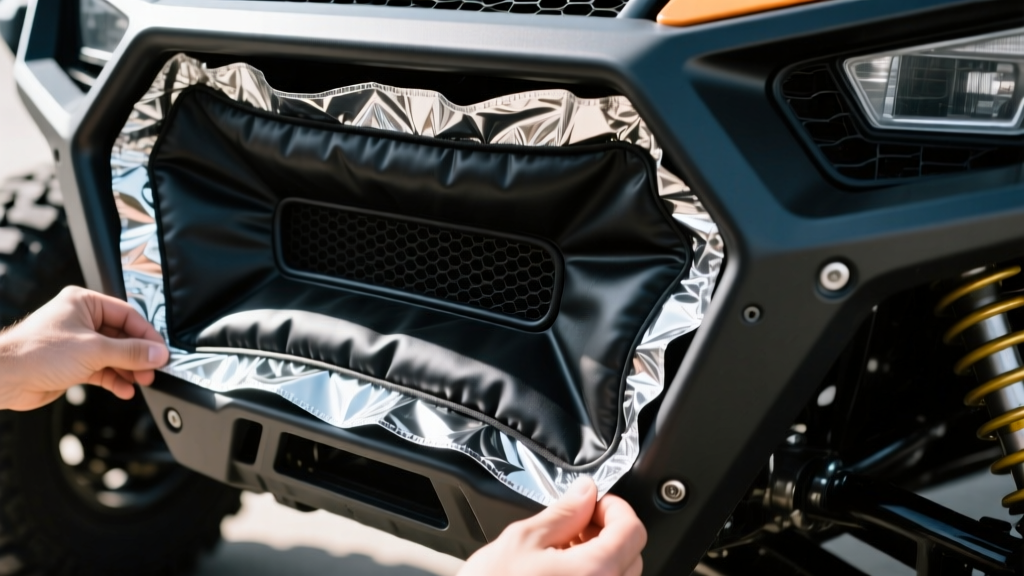
Technical Matrix: CLD, MLV, and CCF Specifications
The most effective UTV sound deadening strategy utilizes a three-layer composite approach. Each layer targets a specific acoustic frequency band and transmission mechanism. Below is the technical specification matrix for the three primary material classes required for a complete UTV acoustic build.
| Material Class | Composition | Standard Thickness | Mass (lb/sqft) | Temp Limit | Primary Acoustic Function |
|---|---|---|---|---|---|
| CLD (Constrained Layer Damper) | Viscoelastic Butyl Rubber + Aluminum Foil | 50 - 80 mil (1.2 - 2.0 mm) | 0.30 - 0.45 | 250°F (121°C) | Reduces structural panel resonance and low-frequency vibration. |
| MLV (Mass Loaded Vinyl) | Barium Sulfate / Silica infused PVC | 1/8" (3.2 mm) | 1.00 - 2.00 | 180°F (82°C) | Blocks mid-to-high frequency airborne noise (exhaust, wind, CVT whine). |
| CCF (Closed Cell Foam) | Cross-linked Polyethylene / Neoprene | 1/8" - 1/4" (3 - 6 mm) | 0.02 - 0.05 | 225°F (107°C) | Decouples MLV from chassis, absorbs high-frequency reflections, provides thermal insulation. |
The Chemical Divide: Butyl Rubber vs. Asphalt Compositions
The most critical specification when selecting the best sound deadening material for UTV firewall and floorpan applications is the base polymer of the Constrained Layer Damper (CLD). The market is saturated with cheap, asphalt-based (bitumen) mats. In a UTV environment, asphalt is a catastrophic failure point.
Asphalt-based dampers rely on bitumen, which has a relatively low glass transition temperature. When exposed to the radiant heat of a UTV exhaust header or transmission tunnel (frequently exceeding 150°F in summer conditions), asphalt loses its viscoelastic damping properties, becomes brittle upon cooling, and delaminates from the chassis. Furthermore, heated asphalt off-gasses volatile organic compounds (VOCs), filling the enclosed UTV cabin with a toxic, tar-like odor.
The Butyl Rubber Advantage
Premium CLD materials utilize a butyl rubber (polyisobutylene) base. Butyl maintains its viscoelastic damping coefficient across a much broader thermal range, typically from -40°F up to 250°F. When the aluminum foil constraint layer is applied over the butyl, the mechanical energy of the vibrating UTV chassis is converted into trace amounts of heat via shear deformation within the butyl layer. When sourcing materials, verify the technical data sheet (TDS) explicitly states a butyl or synthetic elastomer base. If the product smells strongly of tar or petroleum distillates out of the box, it is asphalt-based and must be rejected for UTV use.
Precision Coverage: Engineering the Damping Coefficient
A common engineering error in UTV builds is the assumption that CLD materials require 100% surface coverage. This is physically incorrect and adds unnecessary unsprung weight to the vehicle. The Engineering Toolbox outlines the principles of Sound Transmission Loss (STL), which dictate how mass and damping interact with acoustic waves.
- CLD Coverage (25% - 33%): Constrained Layer Dampers alter the resonant frequency of a panel. Covering just 25% to 33% of a flat UTV floorpan or firewall with 80-mil butyl CLD is mathematically sufficient to drop the panel's resonant frequency below the audible threshold (typically below 40 Hz). Applying 100% CLD coverage yields diminishing returns while adding 15-20 lbs of dead weight to the vehicle.
- MLV Coverage (100% Required): Mass Loaded Vinyl operates on the Mass Law of acoustics, which states that every doubling of mass yields a 6 dB increase in transmission loss. Because MLV blocks airborne noise, any gap, hole, or unsealed seam will act as an acoustic flanking path, rendering the entire barrier ineffective. MLV must be installed with 100% coverage, with all seams overlapped by 1 inch and sealed with acoustic tape.
- CCF Coverage (100% Required): Closed Cell Foam must cover 100% of the area to act as a continuous decoupling layer between the chassis and the MLV, preventing rigid contact points that transmit structural vibration.
The Ultimate 2026 UTV Acoustic Stack (Bill of Materials)
For a high-performance UTV build (e.g., Polaris RZR Pro R, Can-Am Maverick X3), the following material stack provides the optimal balance of acoustic attenuation, thermal resistance, and weight management. Pricing reflects average 2026 market rates for premium-grade materials.
Layer 1: Structural Damping (CLD)
Specification: 80 mil (2mm) Butyl Rubber with 4 mil Aluminum Constraint Layer.
Recommended Products: Dynamat Xtreme, Kilmat 80 mil, or Sound Deadener Showdown (SDS) Tiles.
Cost: $2.50 - $3.50 per sq. ft.
Application: Apply to bare metal firewall, floorpan, and roof panel. Target 30% coverage, focusing on the center of large, flat sheet metal areas where resonance amplitude is highest.
Layer 2: Acoustic Decoupling (CCF)
Specification: 1/4" (6mm) Cross-linked Polyethylene Closed Cell Foam.
Recommended Products: Dynaliner 1/4", SDS Hydrophobic CCF.
Cost: $1.20 - $1.80 per sq. ft.
Application: Applied directly over the CLD layer. This layer provides crucial thermal insulation against exhaust heat and prevents the heavy MLV from rattling against the chassis.
Layer 3: Airborne Noise Barrier (MLV)
Specification: 1 lb/sqft Mass Loaded Vinyl (1/8" thick).
Recommended Products: Soundsulate 1 lb MLV, Second Skin Audio Luxury Liner Pro.
Cost: $1.50 - $2.20 per sq. ft.
Application: Installed over the CCF layer. Must be kept 1 inch away from moving pedals and shift linkages. All seams must be sealed with aluminum HVAC tape.
The primary noise generators in a UTV are the Continuously Variable Transmission (CVT) and the exhaust system. While the acoustic stack handles the cabin, ensure you install high-temperature silicone heat shielding (rated to 500°F+) on the cabin side of the exhaust header. MLV will melt if subjected to direct radiant heat exceeding 180°F. Always maintain a minimum 2-inch air gap between the exhaust pipe and any acoustic treatment.
Surface Preparation and Adhesion Specifications
The failure rate of sound deadening installations is almost entirely dictated by improper surface preparation. UTV chassis components are frequently treated with anti-corrosion oils, mold release agents, and trail dust. If the CLD butyl adhesive bonds to a layer of dust or oil rather than the bare metal, it will delaminate under thermal stress.
- Mechanical Cleaning: Remove all loose dirt, mud, and debris using a stiff-bristle brush and compressed air.
- Chemical Degreasing: Wipe down all bare metal surfaces with a lint-free microfiber towel saturated with 90% or higher Isopropyl Alcohol (IPA).
Note on Solvents: Avoid using acetone, brake cleaner, or harsh petroleum degreasers on UTVs. Many UTV interior plastics, dash panels, and wire looms are made from HDPE, PP, or ABS plastics, which will craze, melt, or weaken when exposed to aggressive solvents. IPA is safe for both metal and automotive-grade plastics.
- Application Temperature: Butyl rubber requires a minimum ambient and surface temperature of 65°F (18°C) to achieve proper wetting and initial adhesion. If installing in a cold garage, use a heat gun to warm the bare metal chassis to 80°F before applying the mat.
- Compression: Immediately after applying the CLD mat, use a hard plastic or wooden roller to apply 15-20 lbs of downward pressure. This forces the butyl into the microscopic pores of the metal, maximizing the surface contact area and ensuring a permanent bond.
Compliance and Safety Standards
While OSHA's Occupational Noise Exposure standard (1910.95) primarily governs industrial workplaces, the underlying permissible exposure limits (PEL) serve as an excellent benchmark for UTV builders. OSHA dictates a 90 dB time-weighted average (TWA) for an 8-hour shift. Given that trail riding often involves 4 to 6 hours of continuous exposure to 95+ dB environments, installing a properly engineered CLD/CCF/MLV stack is not merely a comfort upgrade—it is a critical health intervention to prevent irreversible acoustic trauma. By strictly adhering to the material specifications and coverage formulas outlined above, you can achieve a 12 dB to 18 dB reduction in cabin noise, bringing the UTV environment into a safe, compliant, and highly refined acoustic space.
Written by
James ThorntonJames Thornton is a construction industry veteran with 25 years of hands-on experience in wood framing, lumber grading, and residential building codes. He started as a framing carpenter in rural Oregon, earned his ICC Residential Building Inspector certification, and eventually became a senior plan reviewer for the City of Portland Bureau of Development Services. James holds a B.S. in Wood Science & Technology from Oregon State University and is a certified lumber grader through the West Coast Lumber Inspection Bureau (WCLIB). He has inspected over 3,000 residential construction sites and authored the city's internal guide on advanced framing techniques (2x6 at 24" O.C.). James lives in Bend, OR, where he builds custom timber-frame cabins and competes in lumberjack sports.
More from James Thornton
View all
Insulation
Best Home Insulation Materials: Complete 2026 Guide
Compare top home insulation materials for 2026. Find R-values, installed costs per square foot, and best uses for fiberglass, spray foam, and mineral wool.
Aug 4, 2026

Sustainable Building
Certify Your Green Building Material for LEED and WELL
Step-by-step guide to certifying a green building material for LEED v5 and WELL v2. Master EPDs, HPDs, and VOC limits for 2026 project specifications.
Aug 4, 2026

Stone & Masonry
Veneer Stacked Stone Panels: Interior Design & Style Showcase
Discover how veneer stacked stone panels transform interiors. Explore modern design profiles, material pairings, and technical installation specs.
Aug 4, 2026