Insul Bright Material vs. Reflectix: Thermal Insulation Review
Compare Insul Bright material vs. Reflectix for sheds and outbuildings. Expert analysis of R-values, installation failure modes, and 2026 pricing.

The Thin-Insulation Dilemma in Outbuildings
Insulating unconditioned or semi-conditioned spaces like garden sheds, backyard workshops, HVAC crawlspaces, and pet enclosures presents a unique structural challenge. Standard fiberglass batts (R-13 to R-19) require deep wall cavities that simple 2x4 or 2x3 outbuilding frames cannot accommodate. This constraint forces builders and DIYers toward thin-profile reflective insulations. The most common debate in this niche centers on Insul Bright material versus traditional double-bubble foil products like Reflectix. While both feature reflective metallic surfaces designed to bounce radiant heat, their core compositions, structural behaviors, and failure modes are fundamentally different. This comparison review dissects the physics, installation realities, and true R-value performance of both materials to help you specify the correct product for your next project.
Material Anatomy: Core Composition and Physics
To understand how these materials perform in the field, you must look past the shiny exterior and examine the core matrix. Heat transfers via conduction, convection, and radiation; the core material dictates how well the product resists the first two.
Insul Bright Material
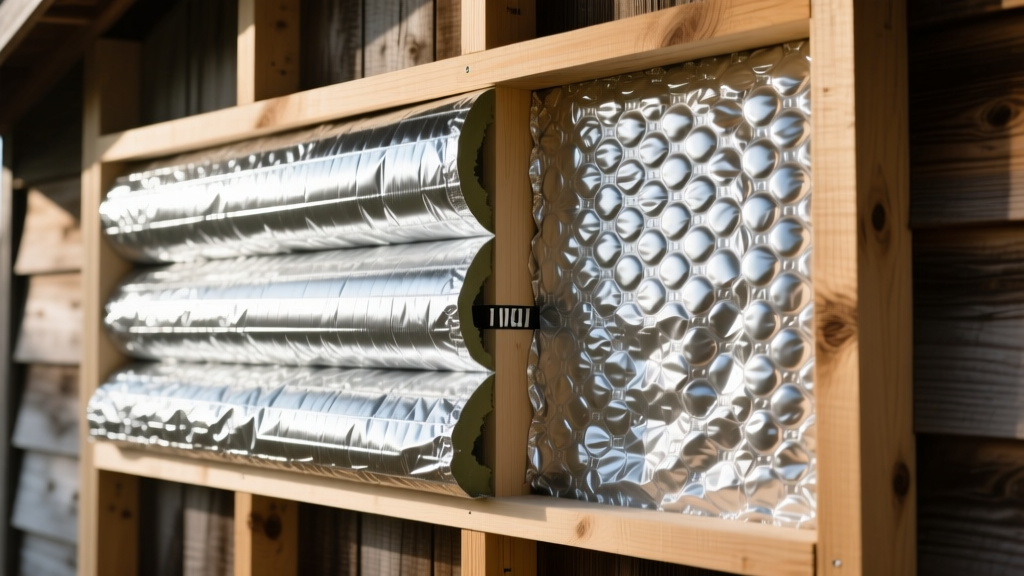
Manufactured primarily by The Warm Company, Insul Bright material utilizes a needle-punched polyester fiber batting bonded to a proprietary metallized film. The needle-punching process creates a dense, fibrous web that traps microscopic air pockets. This fibrous core provides marginal conductive resistance and excellent draft-stopping capabilities, while the metallized surface reflects up to 97% of radiant heat. Because it lacks a rigid cellular structure, it is highly flexible and conforms easily to irregular surfaces, such as wrapping around ductwork or curved enclosure walls.
Standard Bubble-Foil (Reflectix)
Reflectix and its generic equivalents consist of one or two layers of polyethylene bubble wrap (typically 5/16-inch or 21/32-inch thick) laminated between sheets of aluminum foil. The bubbles act as miniature dead-air spaces designed to resist conductive heat flow, while the foil faces handle radiant heat. The polyethylene core gives the material a semi-rigid, springy structure that resists light compression better than fibrous batts.
Head-to-Head Comparison Matrix
| Feature | Insul Bright Material | Reflectix (Standard 21/32") |
|---|---|---|
| Core Composition | Needle-punched polyester batting | Polyethylene double-bubble |
| Nominal Thickness | ~1/8" to 3/16" (compressible) | 21/32" (semi-rigid) |
| Standalone R-Value (Conductive) | R-0.5 to R-1.0 | R-1.1 to R-2.1 |
| System R-Value (with 3/4" air gap) | Up to R-4.3 (Radiant dominated) | Up to R-8.6 (Radiant dominated) |
| Vapor Permeability | Semi-permeable (breathable core) | Class 1 Vapor Retarder (impermeable) |
| Acoustic Dampening | Moderate (fibrous absorption) | Negligible (sound transmission) |
| 2026 Avg. Cost per Sq. Ft. | $0.95 - $1.25 | $0.65 - $0.85 |
The R-Value Reality Check (And Why It Matters)
The most common mistake builders make with thin reflective insulations is trusting the "System R-Value" printed on the packaging without understanding the required testing conditions. According to the U.S. Department of Energy, reflective insulation systems absolutely require an adjacent, sealed air space to function. The reflective surface only blocks radiant heat if it is facing an open air gap; if the foil is sandwiched tightly between two solid surfaces (like drywall and plywood), its radiant-blocking capability drops to zero, and you are left only with the conductive R-value of the core material.
Expert Insight: If you staple Insul Bright material directly to a shed wall and immediately screw plywood over it, compressing the batting, your effective R-value will be less than R-1. To achieve the advertised thermal performance, you must install furring strips to maintain a minimum 3/4-inch dead air space between the reflective face and the interior wall paneling.
Because Reflectix has a thicker, semi-rigid bubble core, its baseline conductive R-value is slightly higher than the compressed polyester of Insul Bright. However, Insul Bright's fibrous matrix is vastly superior at stopping convective air leaks (drafts), which often account for a larger percentage of heat loss in poorly sealed outbuildings than conduction does. For a comprehensive understanding of how air sealing impacts overall thermal performance, refer to the DOE's guidelines on insulation types and air barriers.
Installation Failure Modes & Troubleshooting
Both materials are unforgiving if installed incorrectly. Below are the most frequent field failures and how to engineer them out of your build.
- The Compression Trap
- Symptom: Interior wall panels feel cold; condensation forms behind the drywall.
- Cause: Over-driving staples or using thick battens that crush the Insul Bright material or pop the polyethylene bubbles in Reflectix.
- Fix: Use 1/4-inch crown staples with a depth-adjustable pneumatic stapler. Install 1x2 or 1x3 wood furring strips over the insulation before hanging interior panels to guarantee the air gap.
- The Seam Tape Mistake
- Symptom: Tape peels off after one summer season, breaking the continuous radiant and vapor barrier.
- Cause: Using standard cloth-backed duct tape or HVAC mastic tape, which degrades under high attic or shed temperatures.
- Fix: Use only UL-listed aluminum foil tape (e.g., Nash 322 or 3M 3340). The acrylic adhesive on true foil tape is engineered to withstand temperature swings from -20°F to 210°F without off-gassing or losing adhesion.
- Thermal Bridging at Studs
- Symptom: Visible "ghosting" or dust lines on interior walls over the framing members.
- Cause: Thin insulations do not cover the wooden studs, allowing heat to bypass the insulation via conduction through the wood.
- Fix: Apply a continuous horizontal layer of Insul Bright material over the vertical studs before attaching furring strips. This breaks the thermal bridge, a technique standard fiberglass batts cannot achieve without adding significant wall thickness.
Moisture Management and Vapor Permeability
Outbuildings are notorious for trapping moisture, leading to catastrophic wood rot and mold. This is where the core difference between the two materials dictates their application.
Reflectix is a Class 1 vapor retarder. If installed on the interior (warm-in-winter side) of a wall cavity, it prevents interior moisture from entering the wall. However, if moisture gets trapped behind it from exterior leaks, it cannot dry to the interior, trapping water against the structural sheathing.
Insul Bright material, due to its fibrous polyester core, is semi-permeable. It allows incidental moisture to diffuse through the material and dry out. This makes Insul Bright the vastly superior choice for insulating existing structures where exterior water intrusion is a risk, or for wrapping HVAC ductwork in unconditioned crawlspaces where condensation sweat is a primary concern.
Project Cost Breakdown: 10x12 Workshop Insulation
To provide actionable budgeting data, here is a material cost estimate for insulating the walls and ceiling of a standard 10x12 foot backyard workshop (approx. 450 square feet of coverage area), including necessary tapes and furring hardware.
| Line Item | Insul Bright Build | Reflectix Build |
|---|---|---|
| Insulation Material (450 sq ft) | $495.00 (at $1.10/sq ft) | $337.50 (at $0.75/sq ft) |
| Aluminum Foil Tape (4 rolls) | $68.00 | $68.00 |
| 1x2 Furring Strips (to maintain air gap) | $85.00 | $85.00 |
| Fasteners & Staples | $25.00 | $25.00 |
| Total Material Cost | $673.00 | $515.50 |
While Reflectix offers a lower upfront material cost, the Insul Bright material provides superior draft-stopping and acoustic dampening, which may justify the $157 premium for workshops housing loud power tools or located in windy, exposed environments.
The Final Decision Framework
Do not choose your insulation based solely on the printed R-value. Base your specification on the physical demands of the structure:
- Specify Insul Bright Material when: You are wrapping irregular shapes (pipes, ductwork, curved walls), insulating a structure prone to minor moisture intrusion where breathability is required, or when acoustic dampening and draft-stopping are just as critical as thermal resistance.
- Specify Reflectix (Bubble-Foil) when: You are insulating a dry, new-construction shed or metal building where maximum standalone conductive R-value is needed, when a strict Class 1 interior vapor barrier is required by local code, or when minimizing upfront material costs is the primary project driver.
By matching the material's physical core properties to your specific environmental and structural constraints, you ensure your thin-profile insulation actually performs in the field, rather than just on the packaging.
Written by
Priya KapoorPriya Kapoor is a real estate market analyst and construction economics researcher with expertise in housing affordability, development feasibility, and infrastructure investment. She holds a Master of Regional Planning from Cornell University and previously worked as a senior analyst at CBRE's Investment Properties group, where she modeled returns for $4B in mixed-use development pipelines. Priya now runs an independent research practice advising developers, municipalities, and REITs on construction cost forecasting and market timing. She publishes the quarterly "BuildMat Market Pulse" report tracking material price indices across 12 commodity categories. Based in Austin, TX, Priya serves on the board of Habitat for Humanity Austin and is a marathon runner.
More from Priya Kapoor
View all
Construction Cost
Cost to Build a 1600 Sq Ft Home in 2026: Full Breakdown
Accurate 2026 cost to build a 1600 sq ft home—material, labor, and regional pricing breakdowns included. Plan your budget with real-time estimates.
Aug 11, 2026

Wood & Lumber
Name the Types of Wood for Pressure Treatment and Preservation
Learn how to name the types of wood best suited for pressure treatment. Compare species treatability, chemical retention levels, and 2026 preservation costs.
Aug 4, 2026

Stone & Masonry
Stone Veneer Suppliers Lindenhurst: 2026 Cost Analysis
Analyze 2026 stone veneer costs in Lindenhurst, NY. Compare local supplier pricing, delivery fees, and Suffolk County installation labor rates.
Aug 4, 2026