Cost Analysis: The Best Material for Quilting Insulation
Compare costs of FSK, PVC, and MLV facings. Discover the best material for quilting HVAC, pipe, and acoustic insulation in commercial builds.

Industrial Quilting in Construction: Beyond Textiles
In commercial and industrial construction, "quilting" does not refer to textile crafts. It defines the mechanical stitching, binding, and encapsulation of protective facings to insulation cores—creating flexible, durable blankets for HVAC ducts, high-temperature pipes, and acoustic enclosures. When engineers and estimators search for the best material for quilting these assemblies, they are evaluating the outer jackets, facings, and binding threads that protect the thermal or acoustic core from moisture, UV degradation, and mechanical damage.
Selecting the correct quilting material directly impacts project budgets, lifecycle maintenance, and building code compliance. A failure in the outer quilted jacket leads to compressed insulation, thermal bridging, and acoustic breakout. This cost analysis breaks down the primary materials used for construction insulation quilting, comparing 2026 market pricing, labor requirements, and specific use cases.
Cost Matrix: Quilting Facings and Jackets
The following matrix outlines the current material and labor economics for the most common industrial quilting materials used in mechanical, electrical, and plumbing (MEP) applications.
| Facing / Jacket Material | Core Application | 2026 Material Cost (per sq. ft.) | Installation Labor | Expected Lifespan |
|---|---|---|---|---|
| FSK (Foil-Scrim-Kraft) | Thermal Duct Wrap | $0.45 – $0.75 | Low (Staple/Tape) | 15–20 Years |
| PVC (Polyvinyl Chloride) | Outdoor Pipe Lagging | $1.20 – $1.80 | Medium (Weld/Glue) | 10–15 Years |
| Mass Loaded Vinyl (MLV) | Acoustic Duct Quilting | $2.10 – $3.50 | High (Mechanical) | 25+ Years |
| Silicone-Coated Fiberglass | Removable High-Temp Quilts | $8.50 – $14.00 | Very High (Custom Sewn) | 20+ Years |
Deep Dive: Thermal vs. Acoustic Quilting Materials
FSK (Foil-Scrim-Kraft) for Thermal Quilts
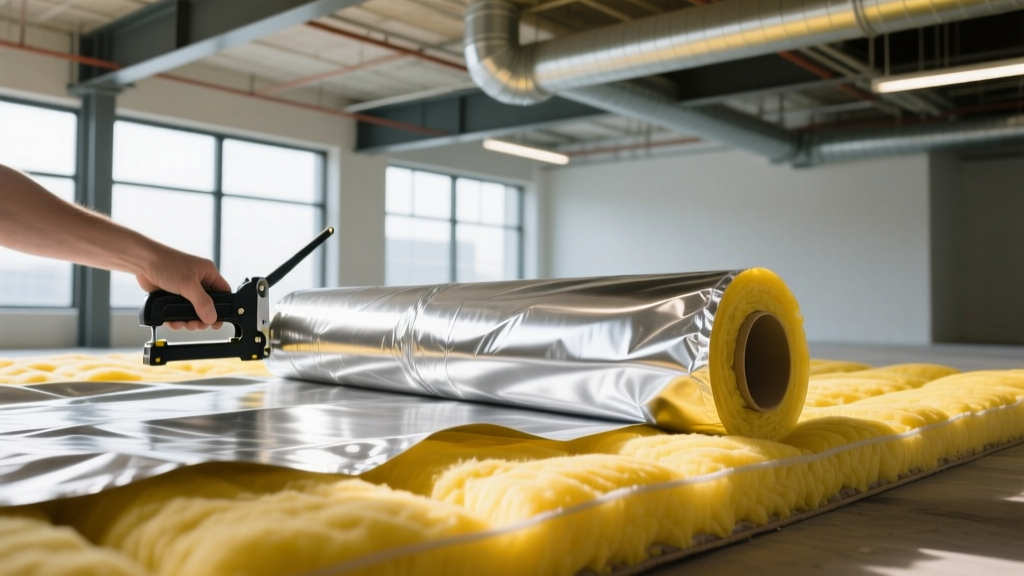
FSK is the industry standard for faced fiberglass and mineral wool insulation quilts used in commercial ductwork. The "scrim" is a fiberglass mesh laminated between aluminum foil and kraft paper, providing the tensile strength required for the quilting process (stapling to insulation pins or mechanical fastening). According to the U.S. Department of Energy, properly faced insulation quilts act as a Class I vapor retarder, critical for preventing condensation on cold-air supply ducts.
- Specification: Look for FSK-75 or FSK-110 (indicating the weight and thickness of the foil/scrim layers).
- Fire Rating: Must meet ASTM E84 for Flame Spread and Smoke Developed indices (typically 25/50).
- Cost Factor: Highly economical. The primary cost driver is not the material itself, but the labor required to seal all seams with matching FSK tape to maintain the vapor barrier.
Mass Loaded Vinyl (MLV) for Acoustic Quilting
When mitigating low-frequency noise breakout from HVAC equipment, standard thermal facings are insufficient. Acoustic quilting involves wrapping ductwork, VAV boxes, and chiller pipes in MLV. The Whole Building Design Guide (WBDG) recommends flexible, high-mass barriers for mechanical noise control in sensitive environments like hospitals and recording studios.
- Specification: 1 lb/sq. ft. MLV (STC 26) for standard duct wrap; 2 lb/sq. ft. MLV (STC 32) for heavy machinery enclosures.
- Quilting Method: MLV is too heavy for standard adhesive. It must be mechanically quilted using heavy-duty insulation hangers, speed clips, and overlapping seams sealed with acoustic caulk.
- Cost Factor: Material costs are high, and the weight of MLV increases structural support requirements and installation time by up to 40% compared to standard FSK wraps.
Silicone-Coated Fiberglass for High-Temp Removable Quilts
For high-temperature pipes, turbines, and valves that require regular inspection, permanent insulation is impractical. Instead, fabricators create removable "quilts" using silicone-coated fiberglass fabric, stitched with PTFE (Teflon) or Kevlar thread over a high-density mineral wool core.
- Specification: 17 oz/sq. yd silicone-coated fiberglass fabric, rated for continuous use up to 500°F (260°C).
- Quilting Method: Industrial sewing. The fabric is literally quilted to the inner core using lock-stitch patterns to prevent the insulation from sagging or shifting during removal and reinstallation.
- Cost Factor: These are custom-fabricated off-site. While the upfront cost ($8.50–$14.00 per sq. ft. fabricated) is steep, the ROI is realized through zero-damage maintenance access and a 20+ year reusable lifespan.
In high-vibration environments (e.g., within 10 feet of Air Handling Units or exhaust fans), adhesive-laminated facings will eventually delaminate from the insulation core. Specifications for these zones must mandate mechanically quilted or stitch-bound jackets to ensure the vapor and acoustic barriers remain intact over the equipment's lifecycle.
Labor and Fabrication Economics
The true cost of insulation quilting is rarely found in the raw materials; it is embedded in the fabrication and installation labor. Field-fabricated quilting (measuring, cutting, and pinning facings on-site) is highly susceptible to weather delays and human error, often resulting in 10-15% material waste.
To mitigate this, large-scale commercial projects in 2026 are increasingly shifting to prefabricated insulated duct systems. In these systems, the quilting process is automated in a controlled factory environment. While the unit cost of prefabricated quilted ductwork is 20-30% higher than raw materials, field installation time is reduced by up to 60%, drastically lowering overall MEP labor costs and ensuring perfect seam integrity.
Decision Framework: Selecting the Right Quilting Material
Use the following framework to specify the correct material based on your project's environmental and acoustic requirements:
- If the application is indoor, low-vibration thermal ductwork: Specify FSK-75. It provides the necessary vapor retarder properties at the lowest material and labor cost.
- If the application is exterior piping exposed to UV and physical abuse: Specify PVC or Aluminum jacketing over the insulation quilt. FSK will degrade under UV exposure, and PVC offers superior impact resistance.
- If the application requires acoustic attenuation of mechanical noise: Specify a dual-layer quilt: an inner layer of acoustic-grade mineral wool, wrapped in a 1 lb/sq. ft. MLV barrier, finished with an outer FSK or PVC protective shell.
- If the application involves high-heat components requiring maintenance access: Specify custom-fabricated, stitch-quilted silicone-coated fiberglass jackets with Kevlar threading.
FAQ: Construction Quilting Material Economics
Does mechanical quilting compress the insulation core and reduce the R-value?
Yes. Any mechanical fastening or tight quilting that compresses fiberglass or mineral wool reduces its trapped air volume, thereby lowering its R-value at the compression point. To compensate, estimators should specify insulation that is 20-25% thicker than the target R-value requires, or use rigid insulation boards at high-compression seams.
What type of thread is required for industrial insulation quilting?
Standard cotton or polyester threads will melt or rot in industrial environments. Fabricators must use PTFE-coated fiberglass thread or spun Kevlar thread. These materials withstand temperatures exceeding 400°F and resist chemical degradation from industrial atmospheres.
How do 2026 supply chain conditions affect MLV pricing?
Following the stabilization of global vinyl supply chains post-2024, Mass Loaded Vinyl prices have plateaued. However, the shift toward environmentally compliant, non-phthalate MLV plasticizers has added a slight premium (roughly $0.20 per sq. ft.) to high-end acoustic quilting materials specified for LEED-certified healthcare and educational facilities.
Written by
Elena RodriguezElena Rodriguez is a civil engineer and technical writer specializing in concrete technology, masonry systems, and ASTM/ACI compliance. She earned her B.S. in Civil Engineering from Texas A&M University and spent a decade at a materials testing laboratory, performing over 2,000 concrete compressive strength tests and masonry prism evaluations. Elena is an ACI-certified Field Testing Technician (Grade I) and a member of ASTM Committee C12 on Natural Building Stone. She currently consults on forensic engineering cases involving concrete failures and moisture intrusion. Based in San Antonio, TX, Elena is a proud member of the Society of Women Engineers (SWE) and coaches her daughter's FIRST Robotics team.
More from Elena Rodriguez
View all
Walls & Panels
Cost Analysis: Light Gauge Steel Framing Advantages and Disadvantages
Evaluate light gauge steel framing advantages and disadvantages through a strict cost analysis lens, comparing material, labor, and lifecycle expenses.
Aug 4, 2026

Walls & Panels
Gypsum Board Types: Exact Specifications, Thickness & Dimensions
Compare standard, Type X, and moisture-resistant gypsum board types. Get exact specifications, thicknesses, dimensions, and ASTM standards for your project.
Aug 4, 2026

Fire Resistance
Best Fire-Resistant Outdoor Decking Materials: 2026 Buyer Guide
Discover the best fire-resistant outdoor decking materials for 2026. Compare Class A PVC, aluminum, and hardwood options for WUI compliance and safety.
Aug 4, 2026