What Is the Best Material for Brake Pads on Heavy Equipment?
Discover what is the best material for brake pads in heavy construction equipment, comparing sintered metallic, ceramic, and wet-disc composites for fleets.
The Braking Reality of Heavy Construction Fleets
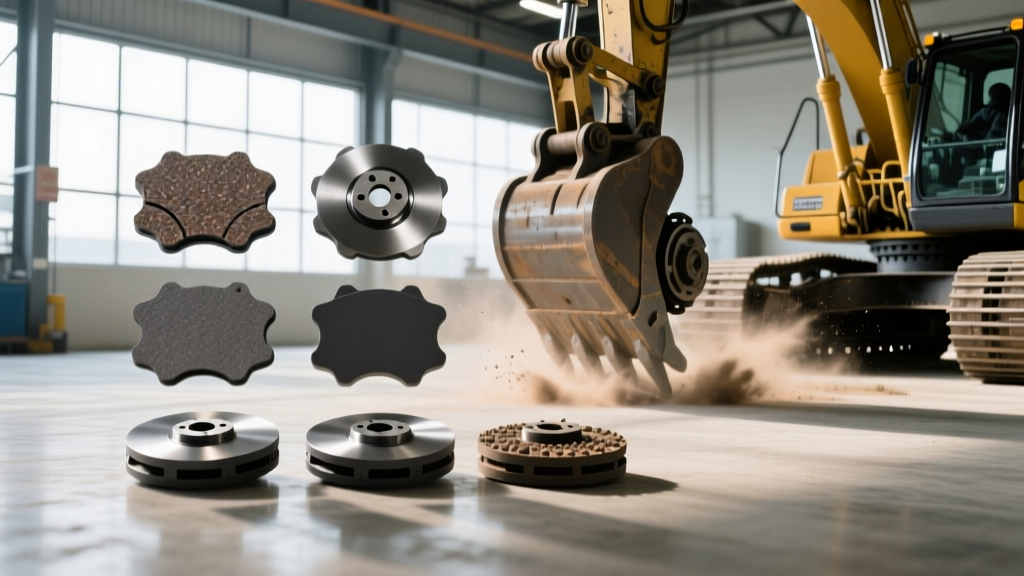
When fleet managers and heavy machinery mechanics ask what is the best material for brake pads, the answer is rarely found in standard automotive guides. Construction equipment operates under extreme kinetic and environmental stressors that rapidly destroy conventional friction materials. An 80,000-pound loaded articulated dump truck (ADT) stopping on a 12% quarry grade generates thermal loads exceeding 1,200°F at the rotor interface, while simultaneously battling abrasive silica dust and deep mud ingress.
To specify the correct friction material, you must first identify the braking architecture of the machine. Heavy construction equipment generally relies on two distinct systems:
- Dry Caliper Systems: Found on on-highway construction vehicles (concrete mixers, highway dump trucks, crane carriers). These use traditional brake pads clamping against an exposed rotor.
- Wet Disc Brakes (Multiple Disc Brakes): Found on off-road heavy equipment (wheel loaders, excavators, dozers). These use internal friction discs bathed in cooling oil, requiring entirely different material science.
Dry Caliper Materials: Sintered vs. Ceramic
For construction vehicles utilizing dry caliper systems, the debate centers on two primary friction matrices. Non-Asbestos Organic (NAO) materials are universally rejected for heavy construction due to severe fade above 400°F.
1. Sintered Semi-Metallic (The Off-Road Standard)
Sintered metallic pads are manufactured by fusing iron, steel wool, graphite, and metallic powders under extreme heat and pressure. For off-road construction equipment that encounters steep grades and heavy payloads, sintered metallic is the undisputed baseline.
- Thermal Threshold: Maintains a stable friction coefficient up to 1,100°F.
- Bite Characteristics: High initial bite, crucial for emergency stops on loose gravel or mud where traction is already compromised.
- Drawback: High rotor wear and acoustic noise. They act as a mild abrasive on the rotor, which is acceptable in heavy fleets where rotors are routinely machined or replaced during axle overhauls.
2. Advanced Ceramic Composites (The On-Highway Specialist)
Modern ceramic pads utilize potassium titanate, aramid fibers (like Kevlar), and non-ferrous fillers. While dominant in the passenger vehicle market, their role in construction is strictly limited to on-highway transit, such as concrete mixers traveling between the batch plant and the job site.
- Thermal Threshold: Optimal between 300°F and 800°F; prone to micro-cracking under the severe thermal shock of off-road emergency stops.
- Environmental Benefit: Produces minimal dust, preventing the buildup of abrasive particulate around the caliper pistons.
- Drawback: Poor cold-bite performance and susceptible to impact-fracture when struck by flying rocks or debris on active excavation sites.
Historically, semi-metallic pads contained up to 20% copper to aid in heat dissipation. Under the EPA Copper-Free Brake Initiative, all friction materials manufactured for the US market must contain less than 0.5% copper. When procuring sintered pads for your fleet, verify NSF certification to ensure compliance and avoid heavy fines during DOT or environmental site audits.
Wet Disc Materials: Sintered Bronze & Carbon-Fiber Paper
If your equipment utilizes wet disc brakes (common in Caterpillar wheel loaders and John Deere excavators), standard brake pads do not apply. These systems use internal friction discs that operate submerged in transmission or axle oil to prevent contamination from the job site.
Sintered Bronze on Steel
The traditional standard for wet brakes. A bronze alloy is sintered onto a steel backing plate. It provides exceptional durability and handles the continuous slip-lockup cycles required for heavy digging and loading operations without degrading the oil's chemical stability.
Carbon-Fiber Paper (Advanced Composite)
A high-end upgrade for wet disc systems. Carbon-fiber friction paper offers a higher dynamic friction coefficient and significantly reduces the heat transferred into the axle oil. This allows for tighter machine packaging and reduces the need for massive external oil coolers on modern 2026 equipment models.
Material Performance Matrix
| Material Type | System Application | Peak Temp Tolerance | Friction Coeff (SAE J866) | Cost per Axle/Set | Best Machine Match |
|---|---|---|---|---|---|
| Sintered Semi-Metallic | Dry Caliper | 1,100°F+ | 0.35 - 0.45 (FF/EE) | $250 - $450 | Off-road ADTs, Highway Dump Trucks |
| Advanced Ceramic | Dry Caliper | 800°F | 0.30 - 0.40 (EE) | $400 - $650 | Concrete Mixers, Crane Carriers |
| Sintered Bronze | Wet Disc | 600°F (Oil cooled) | 0.08 - 0.12 (Wet) | $800 - $1,200 | Wheel Loaders, Excavators |
| Carbon-Fiber Paper | Wet Disc | 750°F (Oil cooled) | 0.10 - 0.15 (Wet) | $1,500 - $2,200 | High-cycle Material Handlers |
Environmental Failure Modes in Construction
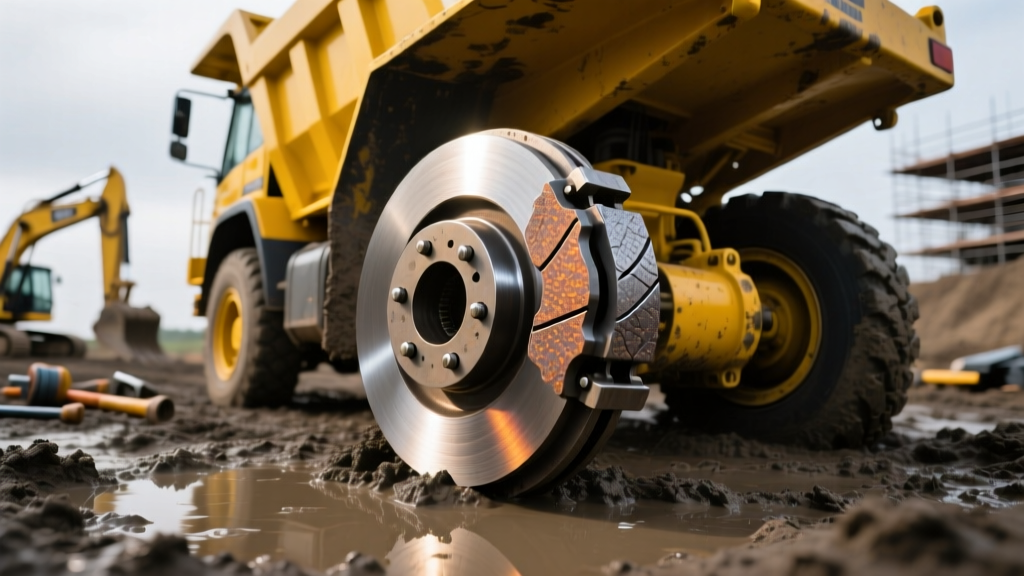
Understanding why brake pads fail on the job site is critical for selecting the right material. Construction environments introduce variables that standard laboratory testing rarely captures.
1. Silica Ingress and Lapping
According to the OSHA respirable crystalline silica standard, construction sites are heavily saturated with quartz dust. When silica dust infiltrates dry calipers, it embeds into softer ceramic or NAO pads, turning the brake pad into a lapping tool that rapidly scores the rotor. Sintered metallic pads, due to their higher surface hardness, resist silica embedding far better, preserving rotor life in earthmoving applications.
2. Thermal Glazing
When a heavily loaded haul truck descends a grade, pad temperatures can spike past 1,000°F. If the pad material contains high levels of organic binders (common in cheaper, imported NAO pads), the binders vaporize and leave a glassy, frictionless crust on the pad surface. This 'glazing' results in catastrophic brake fade. True sintered metallic pads contain zero organic binders, eliminating the risk of thermal glazing.
3. Moisture Delamination in Wet Discs
In wet disc systems, if water breaches the axle seals (common when machines ford deep mud or wash racks), the water contaminates the oil. Carbon-fiber paper friction materials are highly susceptible to delamination when exposed to water-logged oil, whereas sintered bronze will simply experience a temporary drop in friction coefficient without structural failure.
2026 Procurement Specifications
When ordering replacement friction materials for your fleet, vague requests lead to incorrect parts. Use these exact specifications when communicating with suppliers like Bendix Commercial Vehicle Systems, Meritor, or OEM dealers:
- For Highway Dump Trucks (Dry): Specify 'Severe-Duty Sintered Semi-Metallic, Copper-Free (NSF Certified), EE or FF Friction Rating per SAE J866.' Expect to pay a 20% premium over standard fleet pads, but realize a 40% increase in rotor life.
- For Concrete Mixers (Dry): Specify 'Aramid-Reinforced Ceramic Composite, Low-Dust Formulation.' This prevents concrete dust and brake dust from combining into a cement-like paste around the caliper slide pins.
- For Wheel Loaders (Wet): Specify 'OEM-Equivalent Sintered Bronze on Steel Core, compatible with [Specific Axle Oil Grade, e.g., SAE 10W or 30] friction modifiers.' Never install carbon-fiber paper discs in older axles not designed for their higher bite characteristics, as this can cause driveline shock and axle shaft shearing.
Decision Framework: Matching Material to Machine
To definitively answer what is the best material for brake pads in your specific operation, apply this decision matrix:
- Is the machine operating primarily off-road in dirt, mud, or rock?
Yes: Use Sintered Semi-Metallic (Dry) or Sintered Bronze (Wet). Do not use ceramic. - Is the machine strictly on-highway, carrying high-value loads where smooth braking prevents cargo spillage?
Yes: Use Advanced Ceramic Composites. - Does the machine operate in high-cycle, continuous slip applications (e.g., a wheel loader constantly braking and reversing in a stockpile)?
Yes: Ensure the machine uses a Wet Disc system with Carbon-Fiber Paper to manage extreme heat transfer into the axle oil.
Selecting the correct friction material is not merely a maintenance decision; it is a critical safety and operational efficiency parameter. By aligning the metallurgical properties of the brake pad with the specific kinetic and environmental demands of the machine, fleet managers can drastically reduce unscheduled downtime and prevent catastrophic braking failures on the job site.
Written by
David NakamuraDavid Nakamura is a licensed architect (AIA) and construction technology writer focused on sustainable building methods, mass timber engineering, and high-performance building envelopes. He holds a Master of Architecture from the University of Washington and is a certified Passive House Consultant (CPHC). David spent eight years at the Seattle firm Mithun, where he led the design of three LEED Platinum projects, before founding his own practice specializing in net-zero residential design. He serves on the editorial advisory board of GreenBuilder Magazine and has authored peer-reviewed papers on cross-laminated timber (CLT) connections for the Journal of Structural Engineering. In his spare time, David teaches woodworking at Pratt Fine Arts Center and kayaks the Puget Sound.
More from David Nakamura
View all
Construction Cost
Labor Cost to Build a Deck Per Sq Ft: 2026 Installation Guide
Discover the exact labor cost to build a deck per sq ft in 2026. This installation guide breaks down contractor rates, complexity factors, and hidden fees.
Aug 4, 2026

Construction Cost
How Much Does It Cost to Build a 3 Bedroom House? Financing Guide
Learn exactly how much it costs to build a 3 bedroom house and explore 2026 financing options, construction loan types, and budget frameworks for your build.
Aug 4, 2026

Construction Cost
Cost to Build a Tennis Court: 2026 Guide
How much does it cost to build a tennis court in 2026? Breakdowns for asphalt, concrete, and synthetic surfaces plus fencing and lighting.
Jul 30, 2026